Date visited: Wednesday, September 23, 2026 (National Holiday) — Sunny
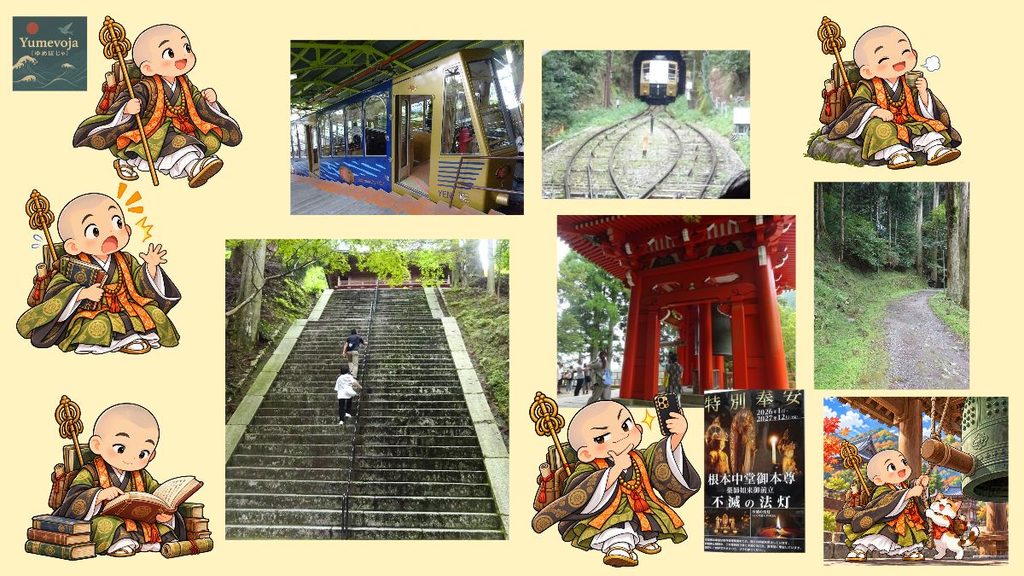
Taking the cable car up Mount Hiei.
I thought there wouldn’t be much walking involved.
But somehow?
By the end, I was running through the mountains.
I’ve marked my route on My Maps.
From Sakamoto, I took the cable car up Mount Hiei.
I walked from the Todo area to the Saito area, then took the shuttle bus to the Yokawa area.
For the return journey, I headed back down to Sakamoto.
It wasn’t until I made this map that I realized something.
But more about that later.
How One Journey Led Me to Mount Hiei
On my way back from exploring Ohara, I noticed a junction at Yase and wondered where the other route led.
On another day, I visited Kibune and Kurama.
And then Mount Hiei caught my attention.
One journey keeps leading to the next.
So why not go there this time?
My first visit to Mount Hiei.
【🚉 Stopover Journey | Ohara, Kyoto – Part 2 | Quiet Prayers at Jakko-in and a Different Way Home】
【🚉 Stopover Journey|A Summer Trip to Kibune|Walking from Kibuneguchi Station】
【🚉 Stopover Journey|From Kurama to Kibune on an Unplanned Mountain Hike】
First, Something to Eat at Kyoto Station
I took the Special Rapid train to Kyoto Station.
It was around 10 a.m. when I arrived.
Before heading up Mount Hiei, I decided to have a meal that would serve as both breakfast and lunch.
On the station platform, I found a small udon shop.
There were 27 minutes until my next train.
I thought that would be plenty of time.
But I finished eating surprisingly quickly.
I boarded the train that had just arrived, only to realize it wasn’t the 10:27 train I’d planned to take.
It was the 10:12 train.
I’d gained 15 minutes.
Those extra 15 minutes would turn out to be very useful later.
👉【🍵Beauty & Taste| Kyoto Station | 27 Minutes Until My Train. Time for Udon? 】
From Sakamoto to Mount Hiei by Cable Car
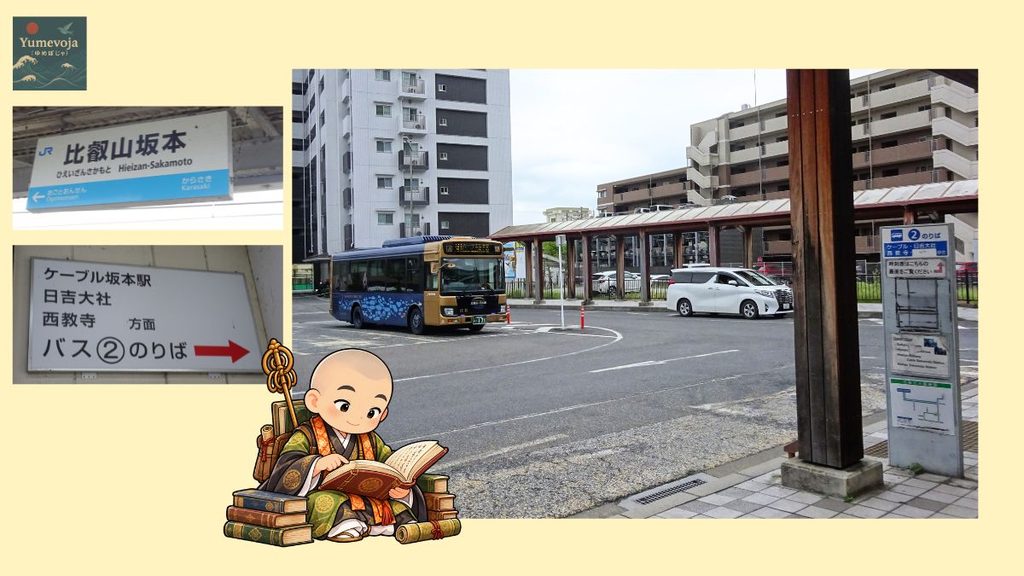
I arrived at JR Hieizan-Sakamoto Station.
Originally, I had planned to walk to Cable Sakamoto Station.
But then I noticed a bus that was leaving in just a few minutes.
Catching that earlier train at Kyoto Station had made this possible.
I’d managed to save a little more time.
I decided to explore the town of Sakamoto on my way back.
For now, it was time to move on.
I boarded the bus to Cable Sakamoto Station.
After getting off the bus, it was time for the Sakamoto Cable Car.
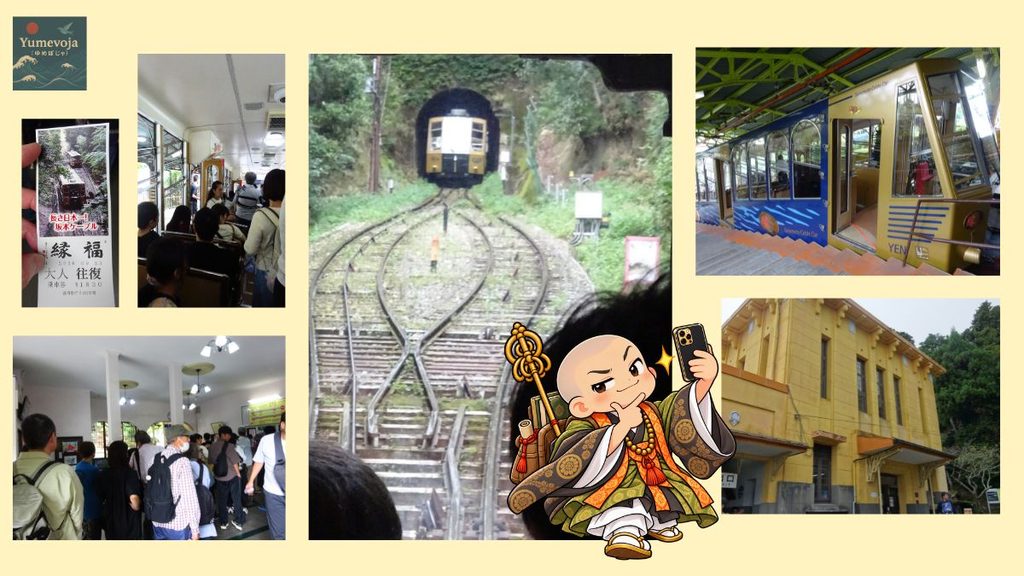
From here, the cable car would take me up Mount Hiei.
I was going to explore a mountain, but first I was riding a cable car.
Maybe today would be an easy day?
That was what I was thinking.
The cable car was crowded on the way up, so I had to stand.
I enjoyed the mountain scenery as we climbed toward Cable Enryakuji Station.
All right.
Time to start walking.
Enryakuji Wasn’t Just One Temple Building
Something I discovered on my first visit:
I’d imagined Enryakuji as one large temple.
But that wasn’t quite right.
Enryakuji on Mount Hiei is actually a collective name for numerous temple halls and buildings scattered across the mountain.
It is broadly divided into three areas:
Todo (Eastern Pagoda) Area
Saito (Western Pagoda) Area
Yokawa Area
My first destination was the Todo area.
Exploring the Todo Area
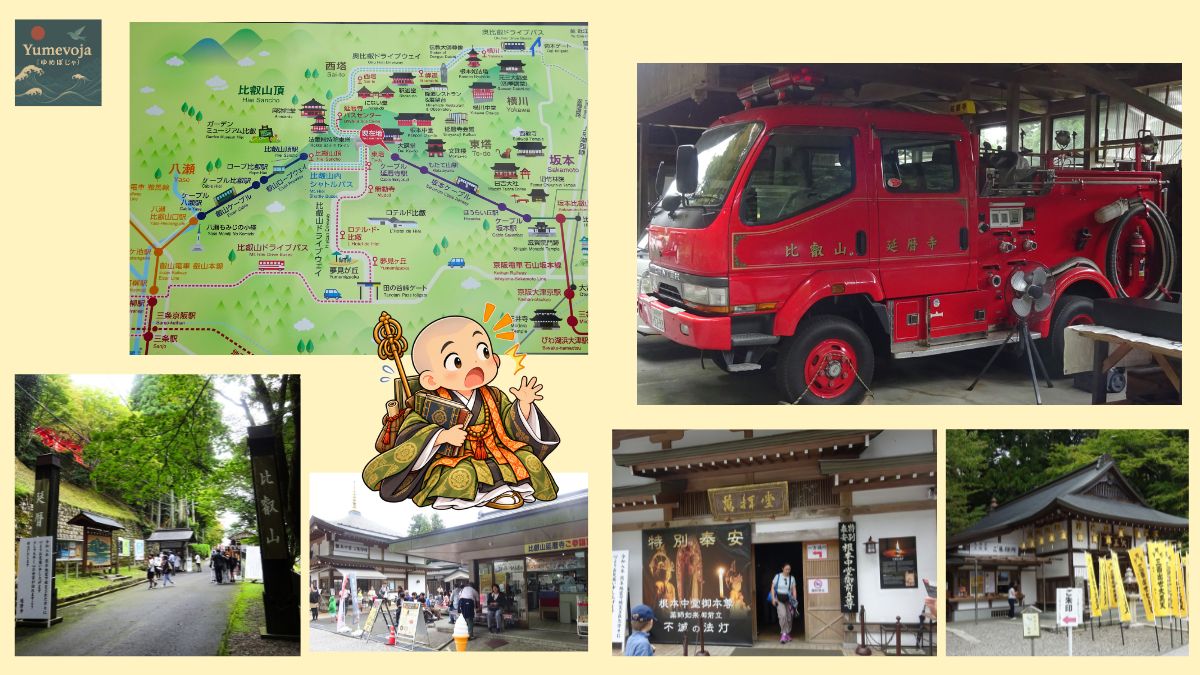
I walked through the Todo area.
What caught my eye were numerous yellow flags.
Beyond them stood the Sanmen Shusse Daikokuten, a three-faced deity associated with success and prosperity.
Here, I made a wish for my blog.
Not that it would become enormously famous.
But simply:
May I be able to keep going.
I’d be happy if it continued to grow, little by little.
There was something else special about this visit.
Konpon Chudo, the main hall, was undergoing restoration.
The principal Buddhist image had been temporarily enshrined in the Manbai-do Hall.
And there, I was able to see something remarkable.
The Inextinguishable Dharma Light.
A flame said to have been kept burning for 1,200 years.
As I looked at that small flame, I thought:
1,200 years…
Continuing something for that long.
That’s extraordinary.
A View You Can Only See During Restoration
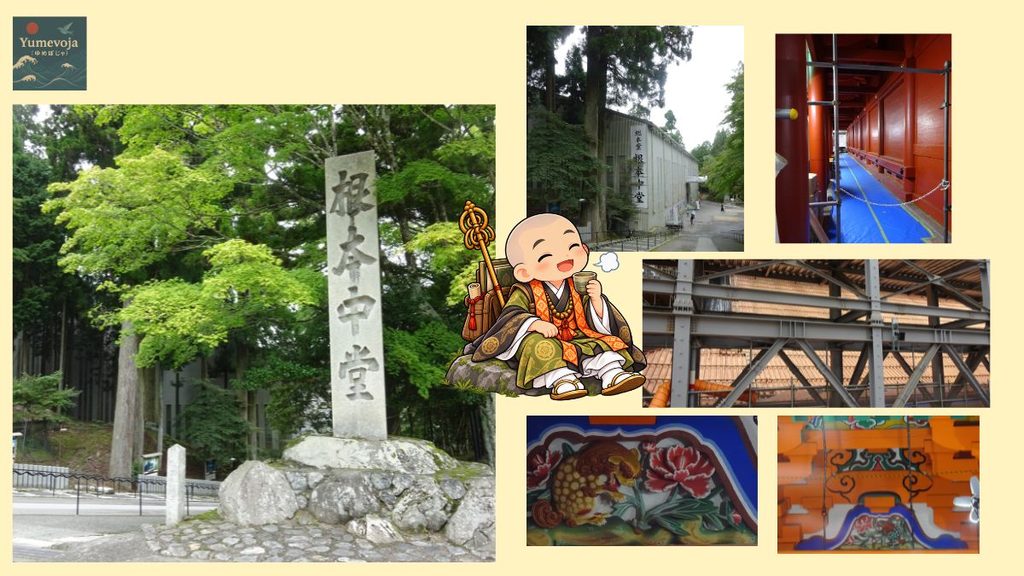
Konpon Chudo, the main hall of Enryakuji, was undergoing major restoration work.
“Oh, it’s under construction…”
At first, I was a little disappointed.
But when I went inside?
There was a special observation platform where visitors could see the restoration work up close.
I climbed the stairs.
Suddenly, the roof and decorative details were right in front of me.
Oh?
This was interesting in its own way.
Konpon Chudo was getting a makeover.
I was being allowed to peek at details normally hidden when the building is fully restored.
Somehow, it felt as though
I’d been given a little glimpse of its natural face.
Some views are only possible because restoration work is underway.
I Heard Voices. What Was Over There?
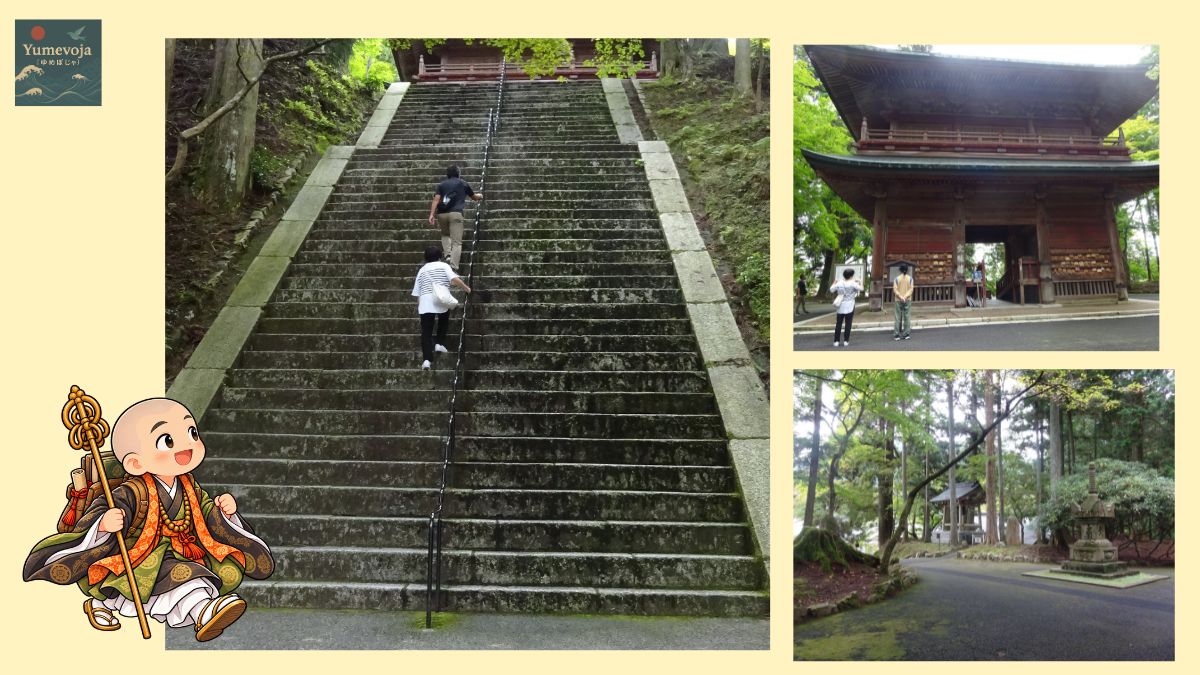
I looked toward the sound of people’s voices.
And there it was.
A towering staircase.
Quite an impressive sight.
But don’t worry.
There’s an alternative route.
And me?
I took the stairs.
Of course,
I held firmly onto the handrail.
One step at a time.
Up I went.
Ringing the Temple Bell. Wait, What?
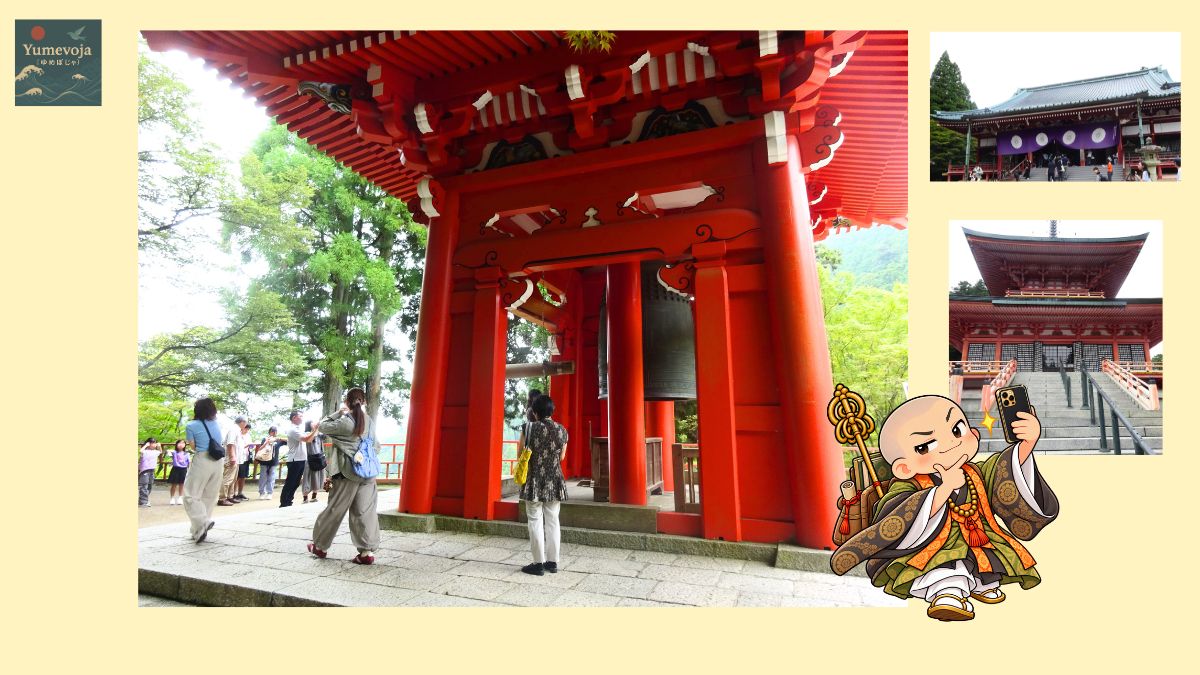
I decided to ring the temple bell.
100 yen per strike.
I’ve rung temple bells many times during my Shikoku pilgrimage.
But getting it right is surprisingly difficult.
The distance between the bell and the suspended wooden striker varies from place to place.
Here, the striker was quite close to the bell.
If I pulled it back too strongly, it might rebound after the first strike and hit the bell again.
So this time, I gave it a gentle swing.
Gooong…
…A little too gentle.
The sound was rather modest.
Nearby, someone let go of the rope after striking the bell.
Gong, gong.
Two strikes in a row.
Every bell requires a different touch.
No matter how many times I try,
getting that perfect sound is never easy.
From the Todo Area to the Saito Area: The Mountain Trail Begins Here
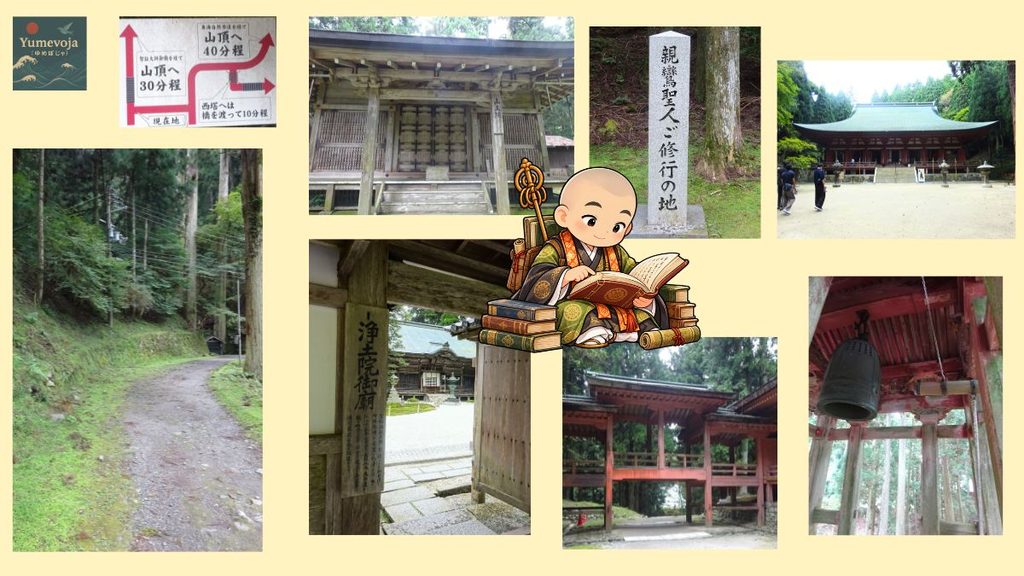
Next, I walked toward the Saito area.
From here, the mountain suddenly began to feel much more like a mountain.
This was no longer like walking through a paved tourist area.
Unpaved paths.
Slopes.
Rocks.
Stairs.
According to the official information, the walk from the Todo area to the Saito area takes approximately 20 minutes.
It also warns of unpaved paths, slopes, and stairs.
I see.
Once you actually walk the route, you understand exactly what that means.
I was glad I’d worn comfortable walking shoes.
Ringing a Bell for the Second Time
I found another bell in the Saito area.
I hadn’t managed to ring the first one very well.
So, another try.
Gooong.
…Or rather,
Thud.
Huh?
One more try.
This time, a nice sound.
Who knew a single bell could keep me so busy?
Four Kilometers to Yokawa Chudo?
As I continued walking, I came across a sign.
“4 km to Yokawa Chudo”
Four kilometers.
Looking around, I noticed some people wearing proper hiking gear.
It is possible to walk all the way to Yokawa from here.
But today, I wasn’t on a Shikoku pilgrimage.
On a pilgrimage, walking itself can sometimes be part of the purpose of the journey.
But on my usual travels, I also want to leave time to discover whatever catches my interest.
Walking every possible stretch isn’t necessarily the goal.
If you’d like to walk it, come prepared with proper hiking gear.
As for me—
I’ll take the shuttle bus.
The Wrong Turn That Turned Out to Be Useful
Actually, a little earlier, I’d taken a wrong turn and walked up a slope.
“Wait, this isn’t the right way.”
So I turned back.
And as it happened, that was where the shuttle bus stop was.
Sometimes, a wrong turn becomes the right place to be later.
It happens when you travel.
I boarded the shuttle bus that runs around Mount Hiei from the Saito area.
Next stop: Yokawa.
Yokawa | Deeper into the Quiet Mountains
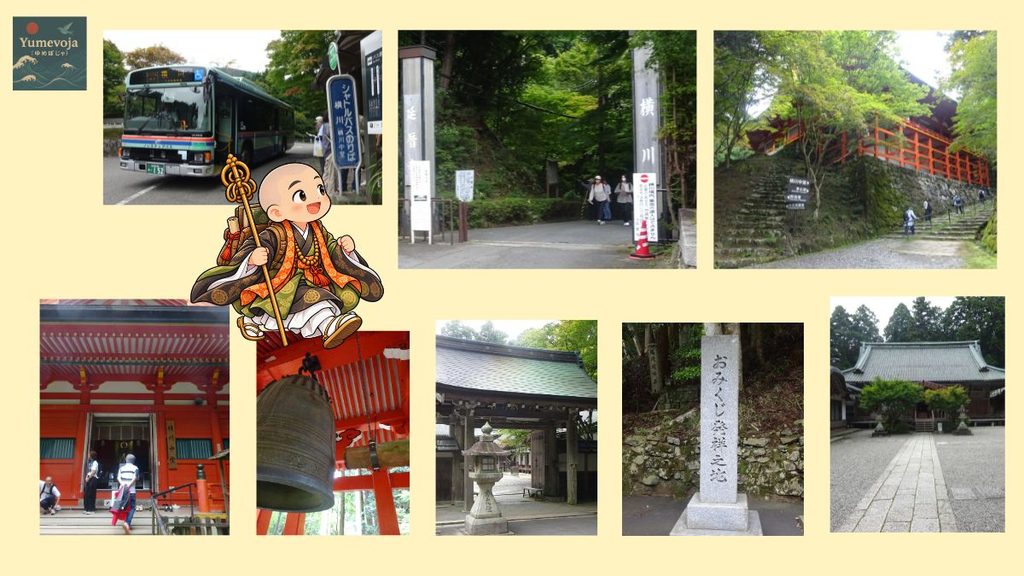
When I arrived in the Yokawa area, the atmosphere felt a little different from Todo and Saito.
It felt as though I’d gone even deeper into the mountains.
I walked toward Yokawa Chudo.
Then I overheard a conversation between some nearby visitors.
“Oh, this place closes at 4 p.m.”
Apparently, they hadn’t known.
On the day I visited, September 23, 2026, the Yokawa area was also open until 4 p.m.
Since Yokawa is some distance from the Todo and Saito areas, it’s worth checking not only the visiting hours but also the return shuttle bus timetable.
3 p.m. Time to Leave Yokawa
I boarded the shuttle bus departing Yokawa at 3 p.m.
My target was:
The 3:30 p.m. departure from Cable Enryakuji Station.
Thirty minutes.
That should be enough.
At least, that’s what I thought at the time.
“We’re Going Toward Yase”
On the return bus, I heard a parent talking to a child nearby.
“We’re going toward Yase.”
Yase.
A place I knew.
On an earlier trip, I’d walked from Ohara to Yase.
Then I’d taken the Eizan Railway home.
Back then, I’d been looking up at Mount Hiei.
And today, here I was, standing on the mountain itself.
You can descend Mount Hiei toward either Sakamoto or Yase.
I wanted to explore Sakamoto afterward, so I was heading back down toward the Shiga side.
Was Getting Off at the Bus Center a Mistake?
Around 3:13 p.m.
We arrived at the Enryakuji Bus Center.
A large bus terminal.
There were souvenir shops and places to eat.
Lots of people got off.
And it was called the “Bus Center.”
So naturally, I thought,
“This must be the place.”
And got off too.
But then…
Later, when I checked the timetable, I discovered something.
The shuttle bus returning from Yokawa follows this route:
Yokawa → Minemichi → Saito → Enryakuji Bus Center → Todo → Mount Hiei Summit
I’d got off one stop before Todo.
But Getting Off at the Bus Center Isn’t Necessarily a Mistake
Here’s where things get a little complicated.
The Enryakuji Bus Center has souvenir shops and places to eat.
From what I saw during my visit, the hall in the Todo area and the Bus Center were the two most convenient places for browsing souvenirs.
So:
If you want to shop for souvenirs, get off at the Bus Center.
On the other hand, if you’re in a hurry to reach the Sakamoto Cable Car,
staying on until the next stop, Todo, is another option.
And if you’re heading toward Yase, you can continue farther to Mount Hiei Summit.
The best place to get off depends on where you’re going next.
In my case—
I wanted to catch the 3:30 p.m. cable car.
And it was already 3:13 p.m.
There was no time for souvenir shopping.
Running
From the Bus Center, I headed back through the temple grounds.
My destination was Cable Enryakuji Station.
The path wasn’t straight.
A turn.
An uphill stretch.
Another turn.
I checked the time.
Would I make it?
I started running.
Through the mountains.
The very same person who’d thought that morning,
“I’m taking the cable car up, so I probably won’t have to walk that much.”
Was now running.
Fortunately, my legs were still willing to keep up with my determination.
Just about.
Seven Minutes to Spare
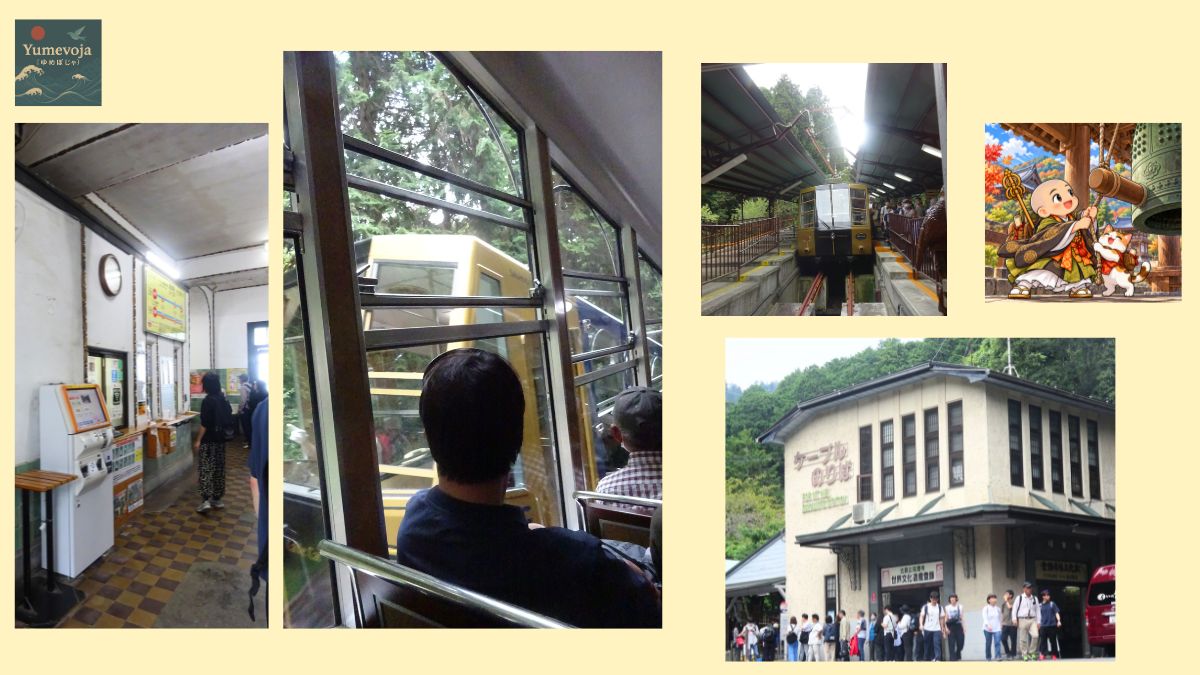
I arrived at Cable Enryakuji Station.
Until the 3:30 p.m. departure:
About seven minutes.
I made it.
When I checked later, I found that the Sakamoto Cable Car was running every 30 minutes at that time of year.
I could have simply waited for the next one.
But I still planned to explore Sakamoto afterward.
Those 30 minutes mattered.
The 15 minutes I’d gained at Kyoto Station that morning.
And the 30 minutes I’d protected by running through the mountains.
Gaining time here, almost losing it there.
What a busy journey.
Standing on the Way Up, Sitting on the Way Down
On the return cable car, I managed to get a seat.
I’d stood the whole way up.
But on the way down, I could sit back and relax.
The descent was certainly more comfortable.
But somehow, I think the journey up had been more exciting.
Back then, I hadn’t known what was waiting for me.
The cable car descended toward Sakamoto.
But my journey wasn’t over yet.
Next came Hiyoshi Taisha Shrine.
And then Saikyoji Temple.
I was going to explore Sakamoto on foot.
👉【Coming Next | Exploring Sakamoto, Hiyoshi Taisha Shrine, and Saikyoji Temple】(Coming soon)
And Then, While Writing This Article, I Realized Something
Throughout this journey, I’d thought of it as a continuation of my travels in Kyoto.
Ohara.
Yase.
Kurama.
And then Mount Hiei, which had caught my interest along the way.
So in my mind, I was still traveling around Kyoto.
But after returning home…
As I created my map and checked the official websites,
Wait a minute.
Mount Hiei lies on the border between Kyoto and Shiga Prefectures.
Yase is in Kyoto.
Sakamoto, where I took the cable car up and down, is in Otsu City, Shiga Prefecture.
And Enryakuji Temple on Mount Hiei is also officially located in Otsu City, Shiga Prefecture.
I’d been traveling in Shiga Prefecture!
I knew Lake Biwa was nearby.
And yet, I’d always thought of Mount Hiei as part of Kyoto.
The Journey Continues Even After Coming Home
Things I hadn’t understood while I was there.
Mistakes I’d made.
Why I’d ended up running through the mountains.
I look back at my photographs.
Place pins on a map.
Check the official websites.
And little by little, the scattered pieces begin to connect.
What had simply been experiences during the journey
gradually turn into knowledge that comes alive afterward.
Perhaps this is another pleasure of writing travel articles.
My first visit to Mount Hiei.
I took the cable car up.
I rode the shuttle bus.
And still, I walked a lot.
And in the end—
I ran.
Next, I’ll explore Sakamoto on foot.
For Anyone Planning a Visit to Mount Hiei
Enryakuji Temple on Mount Hiei is divided into three main areas: Todo, Saito, and Yokawa.
You can walk from the Todo area to the Saito area, but the route includes unpaved slopes and stairs.
The Saito and Yokawa areas are approximately 4 km apart, so taking the shuttle bus may be a good option depending on your available time and energy.
Please also be aware that temple visiting hours, shuttle bus schedules, and cable car timetables may change depending on the season and other circumstances.
Check the latest information before your visit.
Enryakuji Temple on Mount Hiei — Official Website
【Official Website】
Kojak Bus — Route Timetables and Fares
【Official Website】
Sakamoto Cable Car — Official Website
【Official Website】
👉 Related illustrations here
(Free to use)
▶︎ 🎨View illustration page