Date visited: Wednesday, July 29, 2026
After leaving Sanzen-in, I stopped for lunch and a yuzu juice.
My next destination was Jakko-in Temple.
It is also located in Ohara, but as I began walking, the lively atmosphere around Sanzen-in gradually faded into the distance.
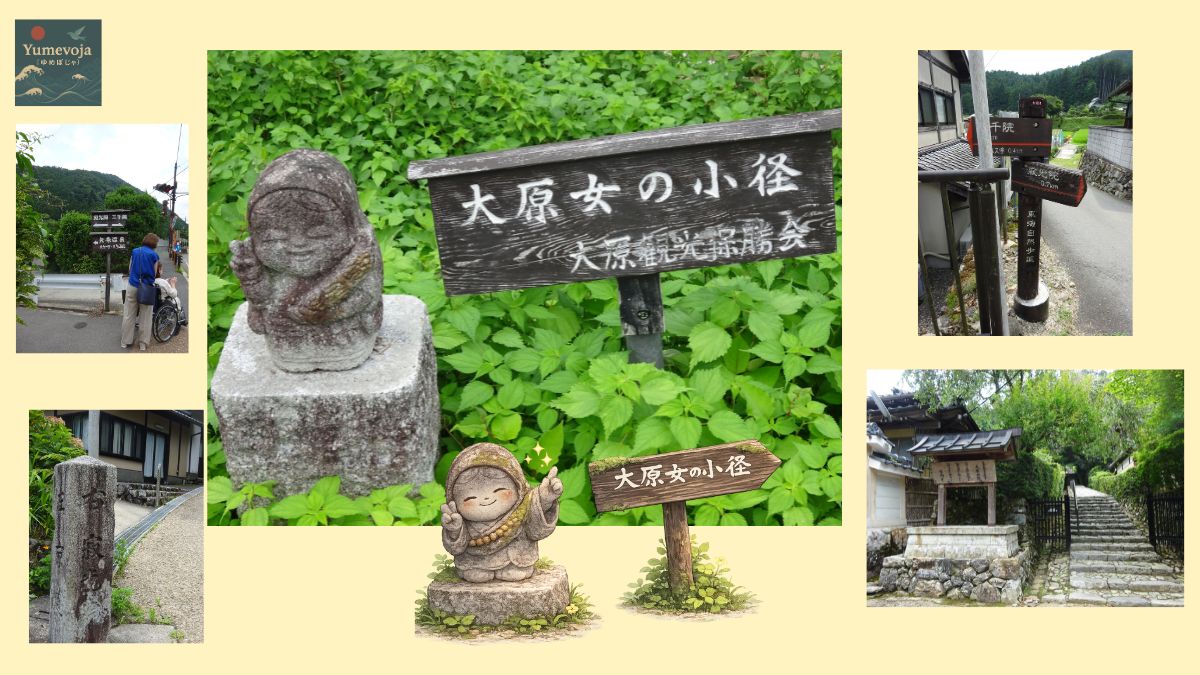
Leaving Sanzen-in behind,
I followed the Ohara-me no Komichi path toward Jakko-in.
Guided by signs and stone markers,
I walked along the quiet roads of Ohara.
Narrow roads.
Houses.
Fields.
I walked steadily through them.
“Huh?”
There was something familiar about this.
I had felt it somewhere before.
It feels like the Shikoku Pilgrimage.
Rather than moving from one tourist attraction to another, it felt as though I was being allowed to walk through a place where people actually live.
This is far from Shikoku, yet when I travel on foot, sometimes a journey from the past connects unexpectedly with the journey I am taking now.
Thinking about that, I continued toward Jakko-in.
Completely Different from Sanzen-in
Earlier that day, I had visited Sanzen-in.
Beautifully maintained moss gardens.
The buildings.
A long history.
To me, it seemed to have a certain strength, almost as if it were saying,
“Look. This is Sanzen-in.”
To put it a little more casually:
“Impressive, right?”
Of course, this is simply my personal impression from walking through the temple.
Then I arrived at Jakko-in.
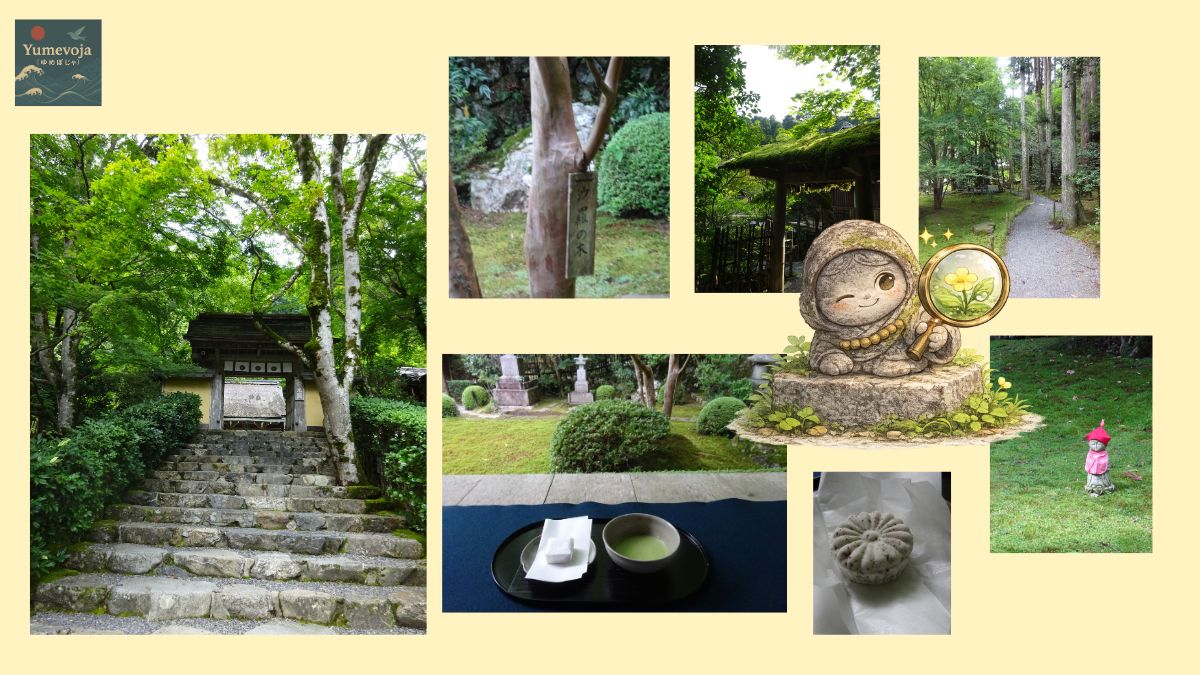
Jakko-in, surrounded by greenery.
On the temple grounds stands a shara tree,
also mentioned at the beginning of The Tale of the Heike.
After walking through the quiet grounds,
I sat overlooking the garden with matcha and a Japanese sweet.
For a moment, the old tale felt a little closer.
“Huh?”
It was such a small temple that I was almost surprised.
Completely different from Sanzen-in.
Jakko-in is a Buddhist convent with a long history.
It is associated with Kenreimon-in Tokuko, who became a Buddhist nun after the fall of the Taira clan and spent her later years here praying for those who had died.
Born as the daughter of Taira no Kiyomori, she became consort to Emperor Takakura and the mother of Emperor Antoku.
But the Taira clan was defeated at the Battle of Dan-no-ura.
The young Emperor Antoku also lost his life.
Kenreimon-in survived and is said to have spent the rest of her life quietly here in Ohara.
From a world of splendor to a quiet convent.
Once I learned about the life of this one woman, the little temple began to look different to me.
What I Heard in the Main Hall
Inside the main hall, I listened to an explanation from someone at the temple.
One thing that particularly stayed with me was the five-colored cord.
Five colored strands extend as if connecting the Buddha with those who come to pray.
After hearing about their meaning, I put my hands together in prayer.
At Sanzen-in, my eyes had been drawn to the beautiful moss gardens and buildings.
But here, rather than constantly looking for the next thing to see,
I simply put my hands together quietly.
That was how this place felt to me.
There is nothing grand here.
Nothing extravagant.
And yet, here there was
prayer.
Matcha Beneath the Shara Tree
After visiting the temple, I had matcha on the veranda in front of the shara tree.
I stopped walking and sat down.
I talked a little more with someone from the temple.
The history of the Taira clan.
The life of Kenreimon-in.
What I had just heard in the main hall.
As I drank my matcha, it felt like a quiet moment to slowly absorb everything I had learned.
When visiting temples with long histories, it is not unusual to find that the buildings standing today are reconstructions.
Over the centuries, some places have been lost to fires, wars, and other disasters, only to be rebuilt by human hands.
I understand that.
And yet, for some reason, the history I felt at Jakko-in that day seemed a little heavier.
Then, when I visited the small museum before leaving, that feeling became even stronger.
Small Jizo Statues, Blackened by Fire
At the museum, I saw small Jizo statues connected with the wooden standing statue of Jizo Bosatsu, the former principal image known as the Roku-mantai Jizo.
Rows and rows of tiny Jizo statues.
Some had survived intact.
And beside them were others that were
blackened by fire.
They were the same kind of small Jizo statues, yet they looked completely different.
I stopped there for a while.
Nearby was a large display of a Kyoto Shimbun newspaper article reporting on the fire that occurred in 2000.
If it had been a fire from some distant period in the temple’s long history, perhaps I could have accepted it simply as something that happened long ago.
But 2000.
For me, that does not feel so distant.
The sorrow of the fall of the Taira clan.
The life of one woman, Kenreimon-in, who survived.
Her prayers for those who had died.
And then, a temple protected for centuries being engulfed in flames.
The Jizo statues that survived.
The Jizo statues blackened by fire.
Events from many different periods seemed to overlap within this small temple of Jakko-in.
At Sanzen-in, there had been so much to see.
At Jakko-in, there were not nearly as many “things to see.”
And yet,
I found it difficult to leave.
Strange.
Not because there was something else I needed to see.
Just to be there.
Perhaps spending time like that is also part of a journey to a temple.
“Please Come Again”
Eventually, I decided it was time to leave and began walking through the grounds.
Someone was watering the garden, and we talked for a little while.
I was told that a tea room, normally closed to the public, is occasionally opened.
And when it is, visitors may sometimes be able to enjoy tea there.
“Please come again.”
Those were the words I was given.
It was a place where I had learned about so much sorrow.
But the last thing I received there was a warm invitation from someone caring for the temple today.
Now I have one more place I know I can return to.
For more detailed information about Jakko-in’s history and visiting the temple, please see the official website.
🌐 Official page: Ohara Tourism Association — Jakko-in
So, How Should I Get Back?
By the time I left Jakko-in, the shops around the area were beginning to close.
Even if I wanted to stop somewhere else, there was nowhere left to go.
So, time to head back.
But—
going back exactly the same way I came would be boring.
I boarded a Kyoto Bus from Ohara.
In the morning, I had come from Kokusaikaikan Station to Ohara.
This time, I decided not to use the same route.
Instead, I headed toward Yase.
I would return by Eizan Railway.
I was only going home.
But simply changing the route made it feel like another small journey had begun.
One More Little Detour Before the Train
I arrived in Yase.
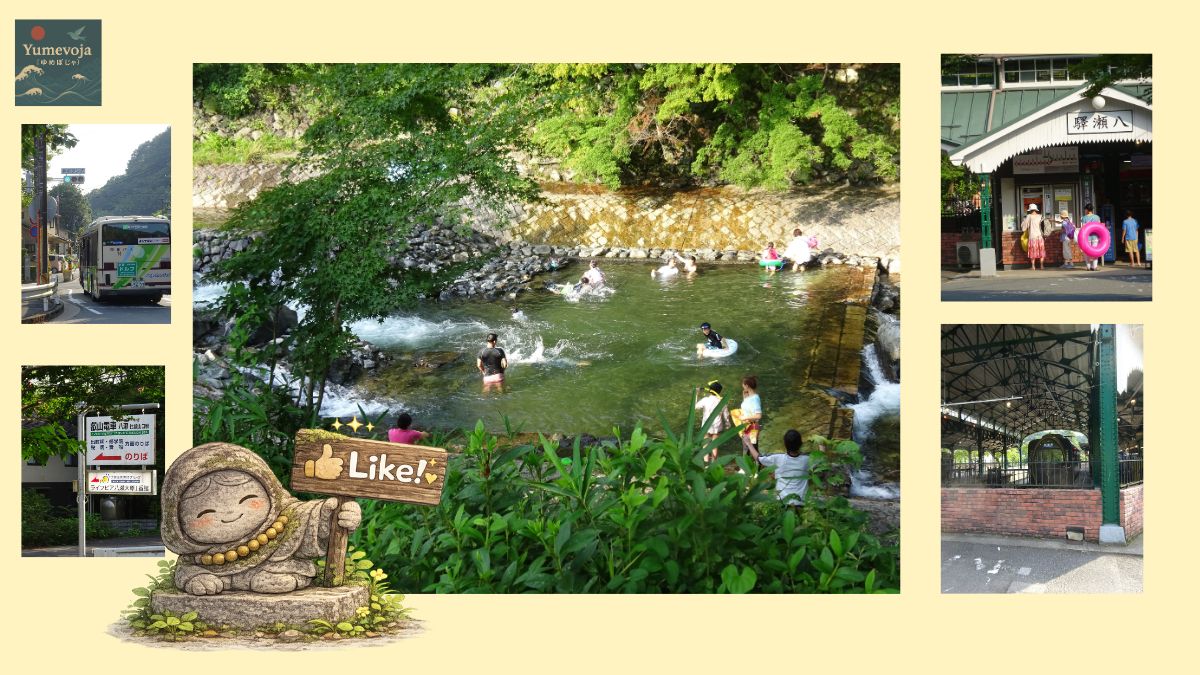
After leaving Jakko-in,
I took a bus from Ohara to Yase.
Families were playing in the river.
From here, I would take the Eizan Railway back toward the city of Kyoto.
I headed toward Yase-Hieizanguchi Station on the Eizan Railway.
But before boarding the train, the nearby river caught my attention.
Families were enjoying themselves in the water.
Children splashing around.
Adults watching over them.
Sanzen-in.
Jakko-in.
The history of the Taira clan.
Prayer.
After spending time with all of that, what I saw here was simply an ordinary summer scene.
Somehow, it made me feel a little relieved.
There was no need to rush onto the train.
So I stopped for a while.
Sometimes, these unplanned moments are the ones that stay in your memory later.
Huh? Is This Really the Eizan Railway?
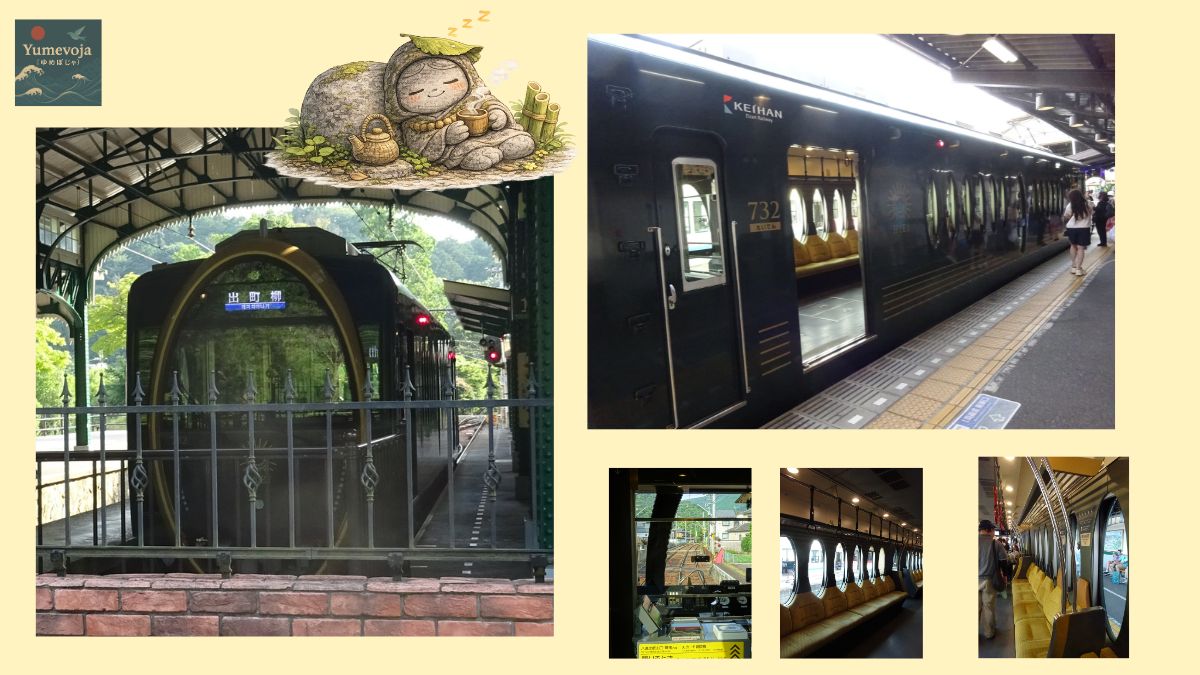
From Yase-Hieizanguchi Station,
I boarded the Eizan Railway train “Hiei,” with its distinctive oval-shaped design.
Even the journey home after a full day in Ohara became another little adventure.
I boarded the Eizan Railway from Yase-Hieizanguchi Station.
When the train arrived, I felt something was a little different.
It looked new.
It did not quite match the image of the “Eizan Railway” I had in my head.
Of course, trains change with the times.
But when something in front of you looks different from the version stored in your memory,
you still think,
“Huh?”
With that small sense of unfamiliarity, the train headed toward Demachiyanagi.
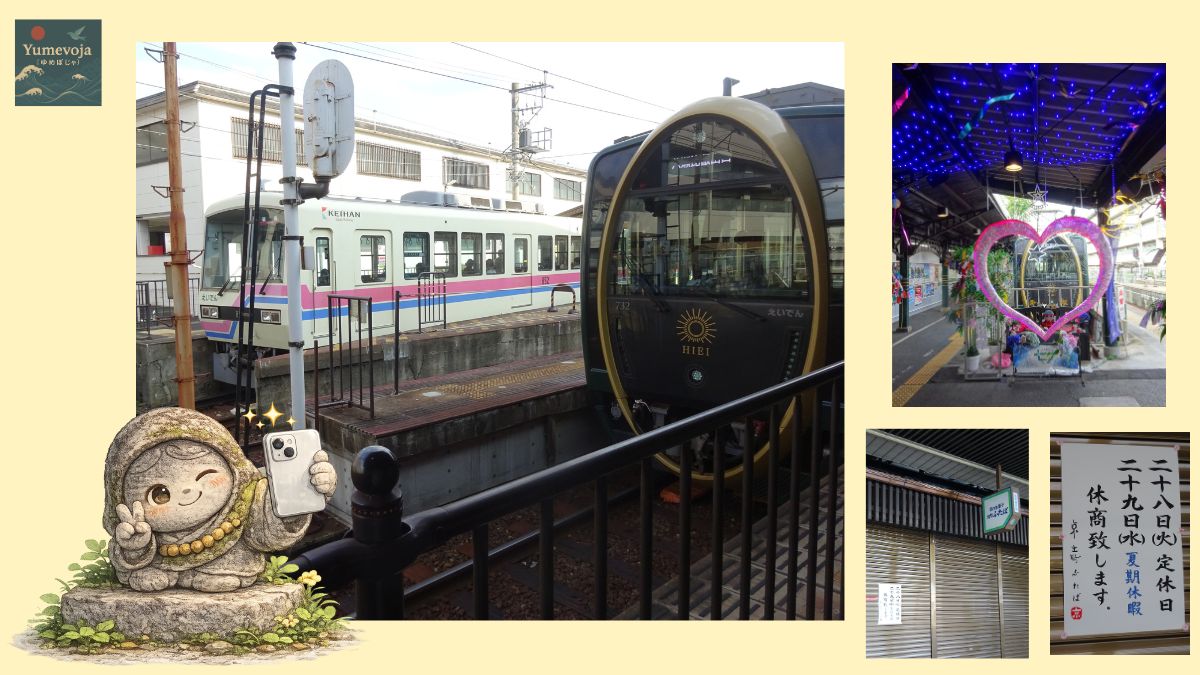
At Demachiyanagi Station,
I found old and new Eizan trains standing side by side.
Then I headed for Demachi Futaba,
looking forward to its famous mame daifuku
—only to find it closed for summer vacation.
Travel doesn’t always go as planned.
👉 Related article(mame daifuku):
▶Stopover Journey | Demachiyanagi and Mame Daifuku — Walking Through Kyoto at Dusk | Kyoto Recovery ③
I arrived at the final stop, Demachiyanagi Station.
There, I saw both a newer train and another train that still carried the atmosphere I remembered from the past.
Old and new Eizan trains stood side by side.
“Ah, yes. This is it.”
I finally met the Eizan Railway that still lived in my memory.
Something new.
Something that has been there for years.
In Kyoto, those two different layers of time sometimes stand side by side in the same place.
And Then, I Walk Again
From here, I could have changed trains and gone home.
But—
I started walking again.
Watching the Kamo River, I headed toward Sanjo.
I had already walked around Ohara since morning, visited Sanzen-in and Jakko-in, taken a bus, and ridden the Eizan Railway.
And yet, in the end, I was back on my own two feet.
Then I reached Sanjo.
By now, I was getting hungry.
So I kept walking while looking for somewhere to eat.
After this, I would end up going into a restaurant I had never planned to visit.
👉 🍵 Beauty & Taste| Soreyuke! Tori Yaro! Kyoto Sanjo | A Solo Traveler Walks Into a Lively Izakaya
There Is Still a Journey on the Way Home
That day in Ohara, I visited two temples.
To me, Sanzen-in felt powerful,
almost as if it were saying,
“Well? Impressive, right?”
Jakko-in, on the other hand, was small and quiet.
What I found there was
prayer.
Two temples in the same Ohara area, yet completely different.
It is not a question of which one is better.
I think the place that stays with us depends on who we are on that particular day.
And then, the journey home.
Instead of returning the way I came, I went to Yase.
I watched families playing by the river, felt slightly puzzled by the newer Eizan train, and then walked again from Demachiyanagi.
Go to Ohara.
Come back from Ohara.
That should have been all there was to the day.
But simply changing the route home made it feel like a slightly longer journey.
A journey does not always end when you finish seeing the destination.
There was still one more small journey waiting on the way back.
🗺️ My Map
I’ve put together a My Map showing the route I walked and the places I stopped at during this trip.
If you are planning your own temple visit or walk around Ohara, feel free to use it as a reference.
👉 Related illustrations here
(Free to use)
▶︎ 🎨View illustration page
👉Choose Kyoto by mood.
▶︎☆View the Kyoto Guide
👉Next time, why not explore Osaka one station at a time?
▶︎☆View the Osaka Loop Line Guide

Today’s bonus capsule!
✨ Gateway to the Shōwa Era
―Summer Trains and the Breeze Through Open Windows
The Showa era (1926–1989) was a time when modern technology and ideas began to transform everyday life in Japan.
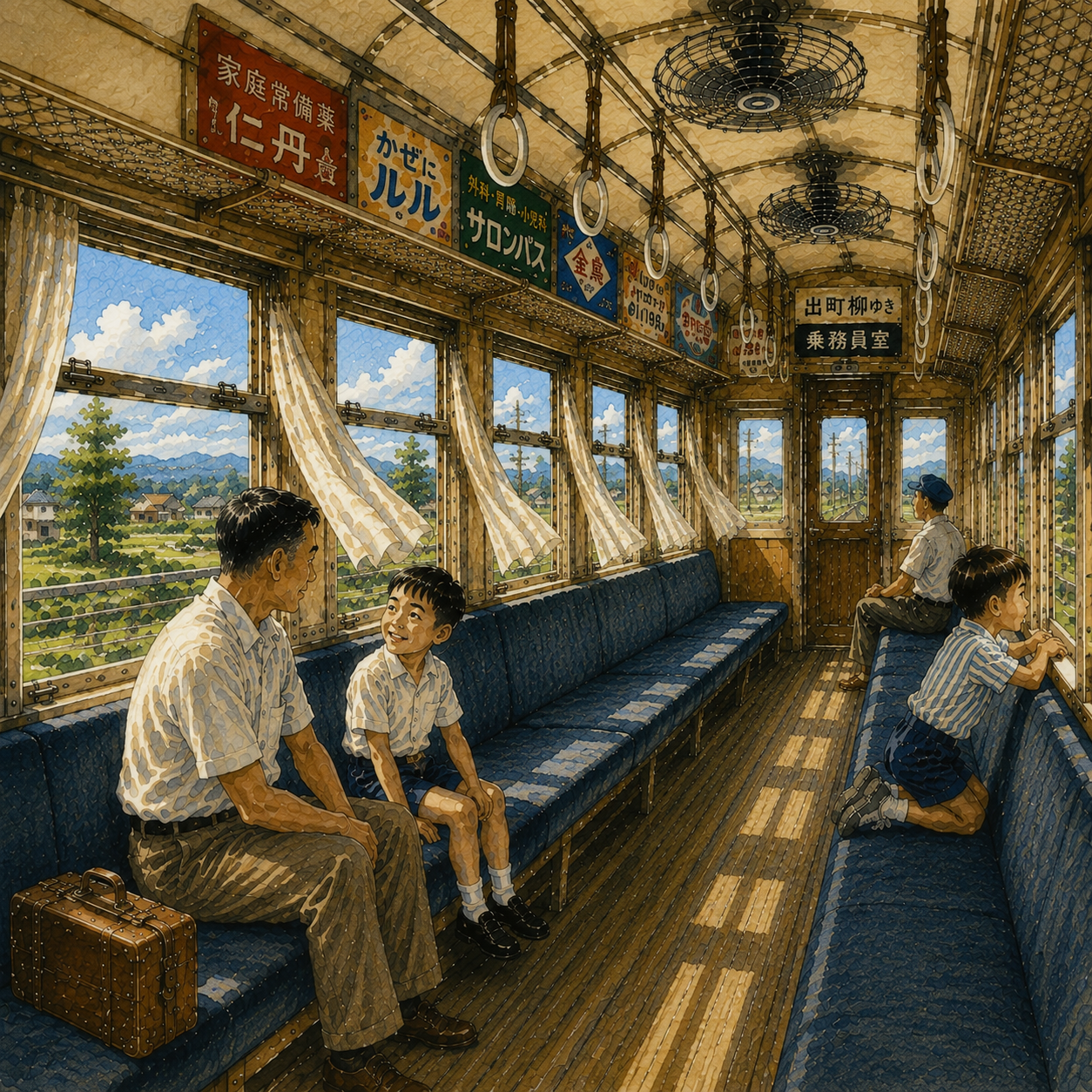
Today, trains are equipped with heating and air conditioning, and for safety reasons, many windows either do not open at all or open only slightly.
But during the Showa era, it was common to see train windows wide open in summer.
On trains without air conditioning, the breeze that rushed in once the train started moving was an important way to escape the heat.
Clickety-clack, clickety-clack.
Through the open windows came not only the wind, but also the sounds and smells from outside.
When the train entered a tunnel, passengers sometimes hurried to close the windows.
Today’s trains are quiet, cool, and comfortable.
But back then, even the wind blowing through the windows was part of the feeling of
“riding a train.”
It was a different kind of journey.