Visit Date: February 1, 2026 (Sunday)
A journey along the Osaka Loop Line.
This time, I decided to get off at Tenma Station.
I had no particular destination in mind.
I simply wanted to wander through the shopping streets and see if I could stumble upon something interesting.
With that casual thought, I started walking.
I have summarized the route I walked on My Maps.
I stepped into the shopping arcade.
Voices calling out to customers.
Narrow side streets.
Bright, flashy signs.
And bicycles everywhere.
People passed by one after another.
To be honest, the sales pitches were a little intimidating.
This was different from Kyoto.
People felt much closer here.
But perhaps that energy is part of what makes Osaka Osaka.
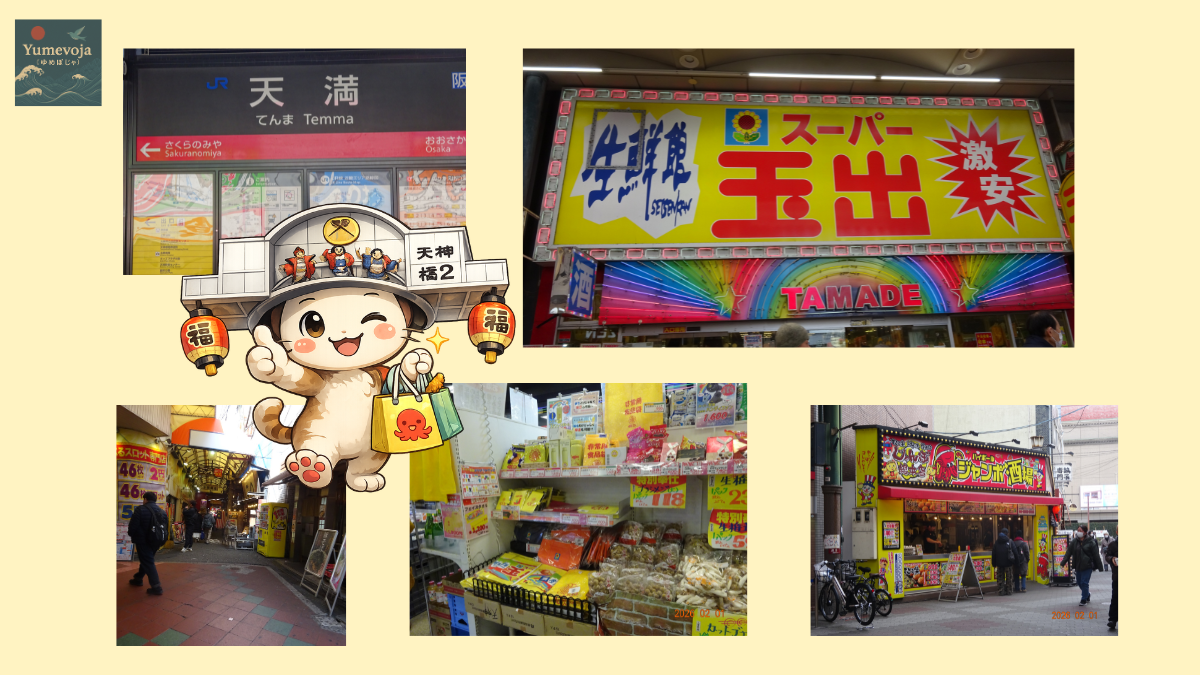
As soon as I stepped out of JR Tenma Station,
I found myself in a district overflowing with Osaka’s unique energy.
Flashy supermarket signs, quirky shops,
and a shopping arcade that seemed to go on forever.
One place immediately caught my attention: Super Tamade.
It is a famous discount supermarket in the Kansai region.
Since I was already here, I decided to go inside.
Announcements echoed through the store in English, Chinese, and Korean.
At the same time, idol songs blasted from the speakers.
Energetic.
Very energetic.
It felt completely different from an ordinary supermarket.
The prices certainly seemed low.
But I had no idea about the quality.
It felt less like shopping and more like a cultural experience.
After wandering around for a while, I finally escaped safely—or so I would like to think.
I returned to the shopping street.
And kept walking.
No matter how far I went, it never seemed to end.
Tenjinbashisuji Shopping Street is known as the longest shopping street in Japan.
At that moment, I was experiencing its length firsthand.
Walk.
Walk some more.
Still not finished.
That was the situation before I knew it.
As I continued, however, the scenery gradually changed.
There were fewer people.
Some storefronts stood empty.
There was more here than just lively crowds.
Even within the same shopping street, there were brighter and quieter sides.
Perhaps this is something visitors rarely notice.
Still, I did not dislike those scenes.
I kept walking.
Surely there would be an interesting shop somewhere ahead.
That was what I told myself.
The problem was that most of the places catching my eye were bars.
I found them difficult to enter.
It wasn’t that there was anything wrong with them.
They simply didn’t match my mood that day.
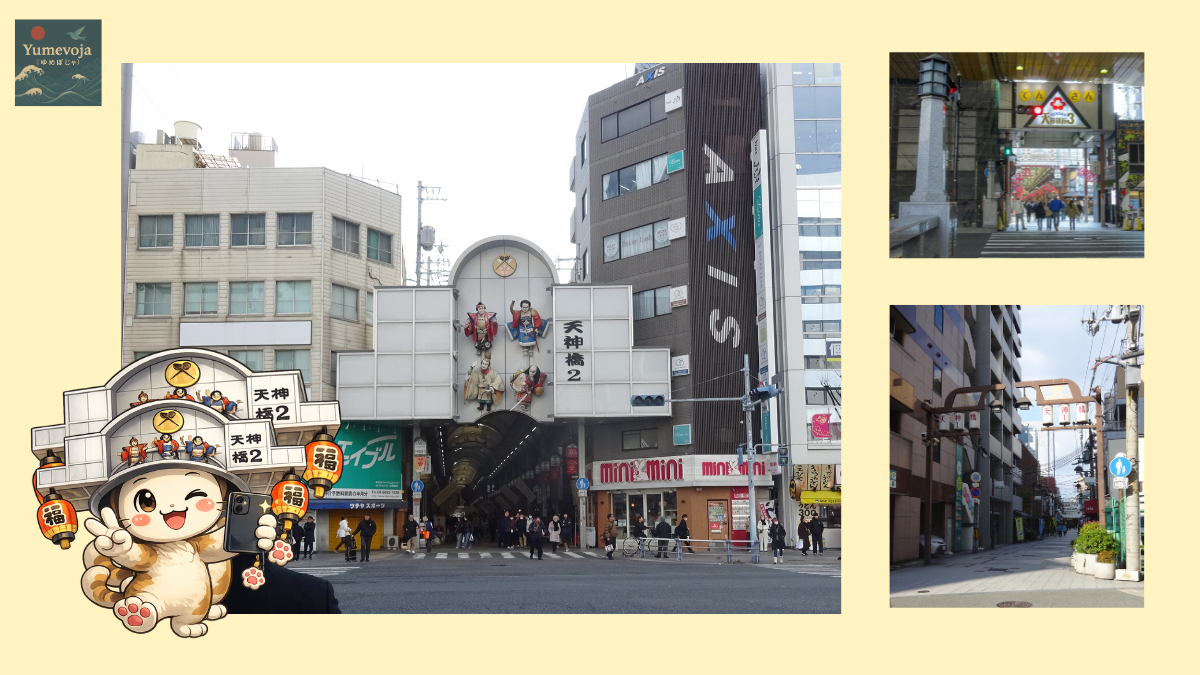
Tenjinbashisuji Shopping Street, known as the longest shopping street in Japan. Beside the busy arcade stretched narrow alleyways,
each one promising a new discovery.
I continued walking until I reached the area around First Street, where the arcade roof finally disappeared.
Even within the same shopping street, the atmosphere felt different.
Since I had come this far, I decided to walk all the way to the end.
And then I turned around.
This time, I stepped outside the arcade.
I was surprised.
Outside the shopping street, there were far fewer shops.
Even though it was a major road, there were not many restaurants.
The lively atmosphere I had just experienced seemed almost unreal.
The scenery changed completely simply by stepping onto a different street.
There are many things you can only discover by walking.
It was getting cold.
I felt it was time for a break.
That was when I found a small set-meal restaurant.
I wrote about lunch in a separate article.
After finishing a warm meal, I stepped outside once again.
I returned to the arcade.
Although it was the same street I had walked earlier, it looked completely different.
The lights of the shops were beginning to stand out.
The district was slowly putting on its evening face.
Sometimes that happens.
Walking in the opposite direction reveals things you missed before.
That day was one of those days.
I kept walking.
This time I discovered an unmanned café.
All you had to do was buy a drink from a vending machine.
There was Wi-Fi.
There were power outlets.
If there had been one near my home, I would probably have become a regular.
That was the kind of place it was.
I eventually returned to the Tenma area.
Yet I kept walking.
As I walked, I found myself thinking.
Apparently, a shop does not become popular simply because it is cheap.
I had assumed that inexpensive places would naturally thrive in Osaka.
But in reality, the restaurants with waiting lines were often the slightly more expensive ones.
Perhaps being average is not enough to stand out.
I thought about that as I continued on.
At some point, I noticed that the shopping street had become narrower.
Which district was I in now?
While wondering that, I came across the Osaka Museum of Housing and Living.
I decided to go inside.
Closing time: 5:00 PM.
I checked my watch.
5:01 PM.
Too late.
I could only laugh.
I decided to think of it as a reason to come back someday.
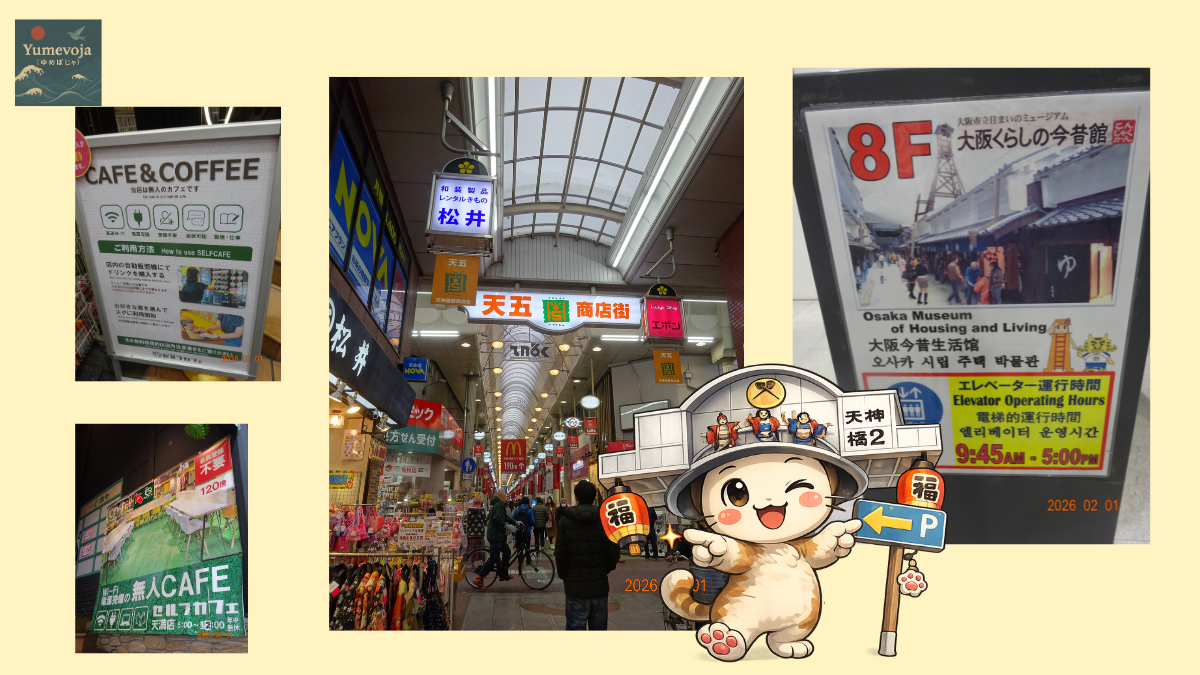
As I continued walking,
I came across an unmanned café
and signs pointing toward the Osaka Museum of Housing and Living.
After that, I kept following signs.
Whenever an alley looked interesting, I turned into it.
Then I came back.
Getting pleasantly lost, I slowly made my way toward Osaka Station.
Eventually, a familiar scene appeared.
I had reached Nakazakicho.
A restaurant that had caught my eye on a previous visit stood right in front of me.
What should I do?
Of course, I went in.
That story continues in the next article.
The voices calling customers.
Super Tamade.
The endless shopping street.
The contrasts within the arcade.
The museum I missed by one minute.
Nakazakicho, reached after wandering without a plan.
Nothing went according to schedule that day.
But somehow, those are the days that stay in memory the longest.
Unpredictable Osaka.
That was the kind of day it was.
👉 Related illustrations here
(Free to use)
▶︎ 🎨View illustration page
👉Choose Osaka by station.
▶︎☆View the Osaka Loop Line Guide
👉How about taking a slow walk through Kyoto today?
▶︎☆View the Kyoto Guide

Today’s bonus capsule!
✨ Gateway to the Shōwa Era―Shopping Arcades
The Showa era (1926–1989) was a time when modern technology and ideas began to transform everyday life in Japan.
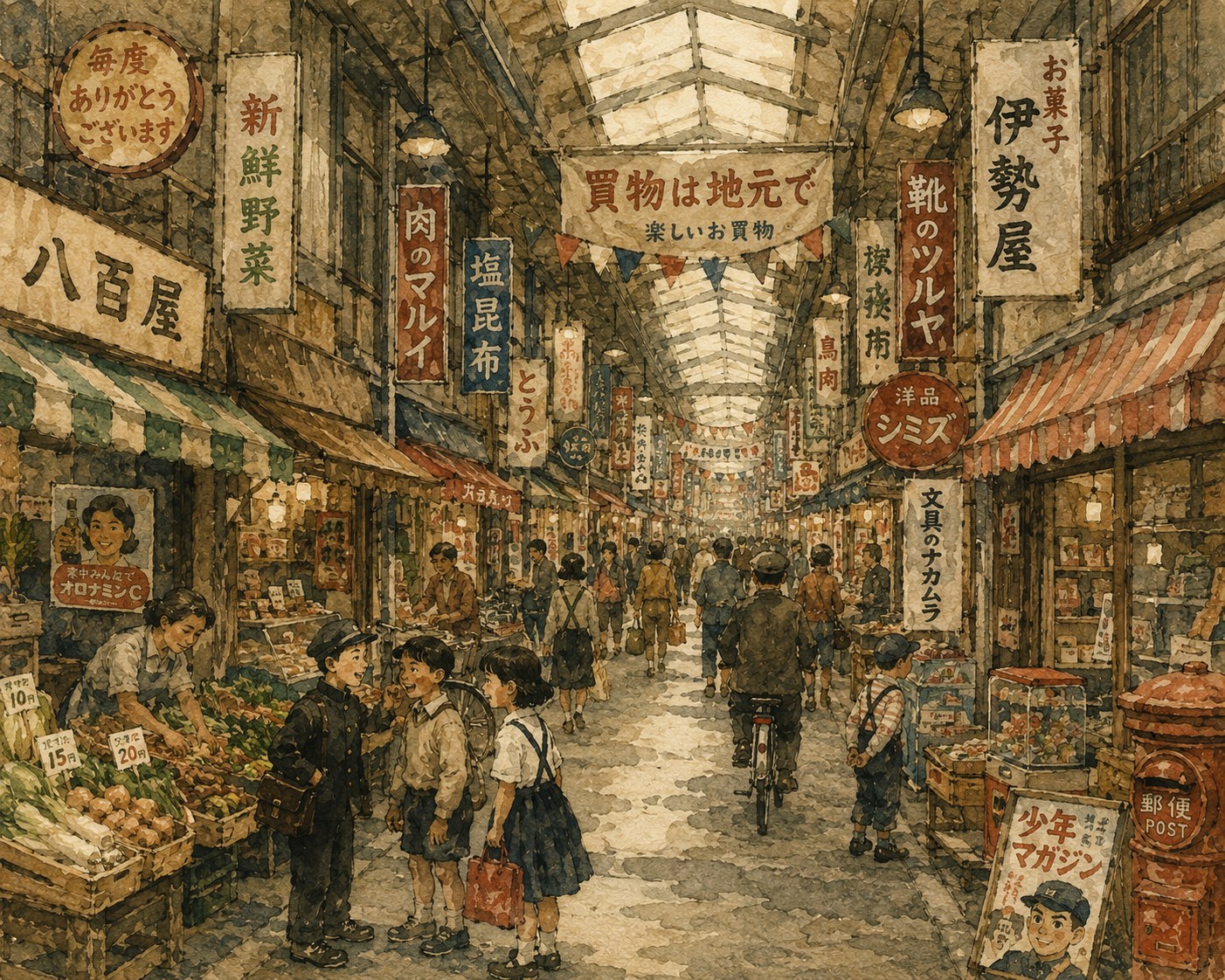
In Showa-era Japan, shopping streets were at the heart of everyday life.
Fishmongers, greengrocers, tofu shops, and stationery stores lined the streets.
Children stopped by on their way home from school, while neighbors gathered to chat.
Scenes like these could be found all across the country.
Today, as large shopping malls have become more common, many traditional shopping streets have gradually disappeared.
Spacious parking lots.
The same services.
The same selection of products.
We now live in an age where we can shop with confidence almost anywhere.
For many people, that convenience has made life easier.
At the same time, traditional shopping streets had a character of their own.
Each shop reflected the personality and dedication of its owner.
Conversations with familiar faces were part of everyday life.
Every storefront had its own atmosphere.
Shopping was not only about buying things—it was also about connecting with people.
In exchange for convenience, perhaps we have given up something valuable.
And yet, places like Tenjinbashisuji Shopping Street continue to thrive.
As you walk beneath its long arcade, you may feel not only the spirit of the Showa era, but also the enduring power of a community where people still come together.