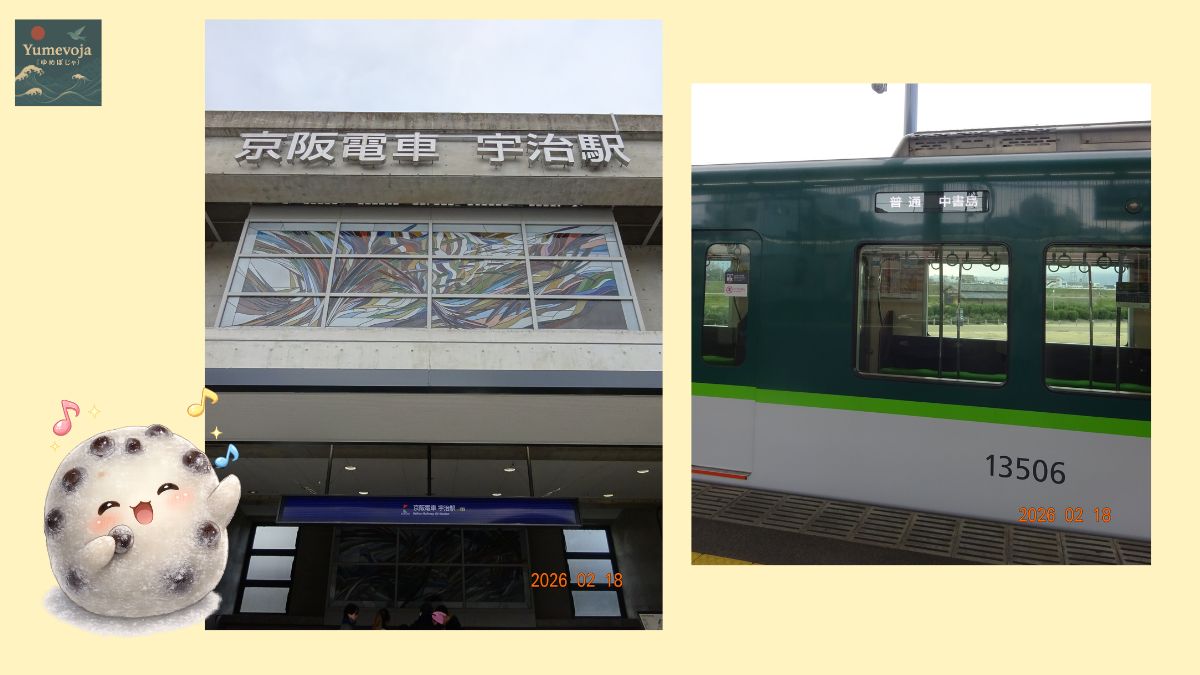
From Uji to Demachiyanagi on the Keihan Railway.
A slightly hurried evening journey in pursuit of mame daifuku.
Visit date: February 18, 2026 (Wednesday)
First, here is the map of the day’s route.
👉 Morning article from the same day
▶︎🚉 Stopover Journey | Byodoin Temple and Uji — A Kyoto Walk Through Memory and Prayer | Kyoto Recovery ①
After visiting Byodo-in Phoenix Hall and The Tale of Genji Museum in Uji, I headed to Demachiyanagi by Keihan Railway.
I had spent more time in Uji than expected.
The mame daifuku from Demachi Futaba is extremely popular.
By this time of day, it might already be sold out.
Feeling slightly anxious, I changed trains at Chushojima.
Once again, I jumped onto a train without checking carefully.
But when I saw the words “For Demachiyanagi,” I felt a little relieved.
Mame daifuku was one of my father’s childhood favorites.
That was exactly why I wanted to buy it.
After getting off the train, I hurried toward the shop.
The moment I saw it was still open, a voice escaped in my mind.
“I made it.”
My relief, however, lasted only a moment.
A much longer line than expected stretched in front of the store.
Several products were already sold out.
The mame daifuku was still available.
But would there be any left by the time my turn came?
Every time someone ahead of me placed an order, I became a little nervous.
(Please order something other than mame daifuku…)
I quietly prayed to myself.
It reminded me of the long bus lines after the Expo, when I wondered,
“Will my turn ever come?”
When my turn finally arrived and I successfully bought some, I felt more relieved than I had expected.
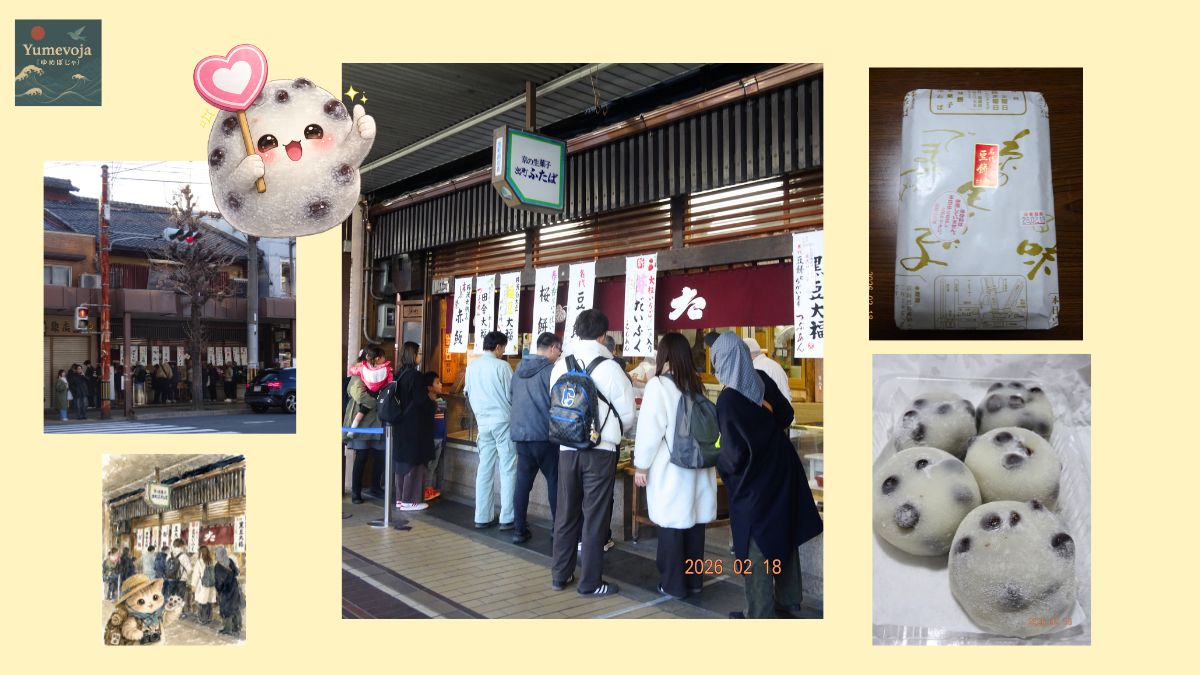
Waiting in line, worried they might sell out.
Getting the mame daifuku felt more reassuring than expected.
A simple Kyoto flavor that quietly makes you want to come back for more.
The customers were not only tourists.
People who looked like local residents kept arriving one after another.
It must be a shop that has been loved for many years.
The mame daifuku was not overly sweet.
If anything, it carried a slight hint of saltiness.
Even people who do not usually enjoy sweets might find it easy to eat.
My father loved these mame daifuku too, and we ate them together several times.
Sometimes they are sold for a limited period at a department store inside Kyoto Station.
Even now, whenever I pass through Kyoto Station, I find myself looking for them.
There is nothing flashy about them.
Yet before you know it, you want to eat them again.
It was a quiet flavor.
I wanted to eat the mame daifuku immediately.
But it was cold that day, and I did not feel like sitting outside for long.
So I started walking again in search of dinner.
As usual, I wandered into side streets and followed whatever route caught my eye.
Before long, I had no idea where I was going.
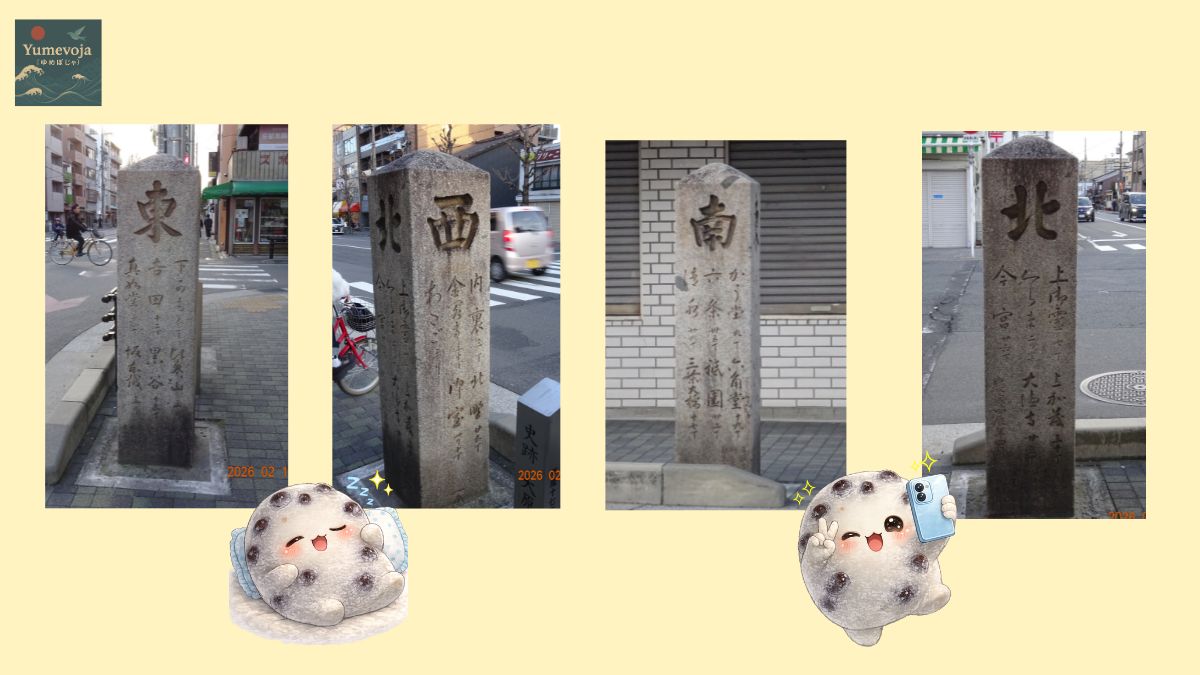
East, West, South, North.
Did travelers long ago also find their way by these markers?
In the end, I simply chose a direction and kept walking.
At that moment, I noticed an old stone guidepost by the roadside.
“East,” “West,” “South,” and “North.”
Each side was carved with directions and place names.
Perhaps travelers of the past relied on these markers as they walked.
But without any sense of the local geography, I could make little sense of them.
In the end, I simply thought,
“Probably this way.”
And kept walking.
It felt less like tourism and more like a pilgrimage.
Even if I was unsure whether I was on the right road, I knew that if I kept walking, I would eventually arrive somewhere.
The feeling reminded me of my pilgrimage journeys.
At the end of a long day of walking, I finally arrived at a tonkatsu restaurant in Sanjo Meitengai.
👉 Related illustrations here
(Free to use)
▶︎ 🎨View illustration page
👉Choose Kyoto by mood.
▶︎☆View the Kyoto Guide
👉Next time, why not explore Osaka one station at a time?
▶︎☆View the Osaka Loop Line Guide

Today’s bonus capsule!
✨ Gateway to the Shōwa Era
―Round Red Postboxes
The Showa era (1926–1989) was a time when modern technology and ideas began to transform everyday life in Japan.
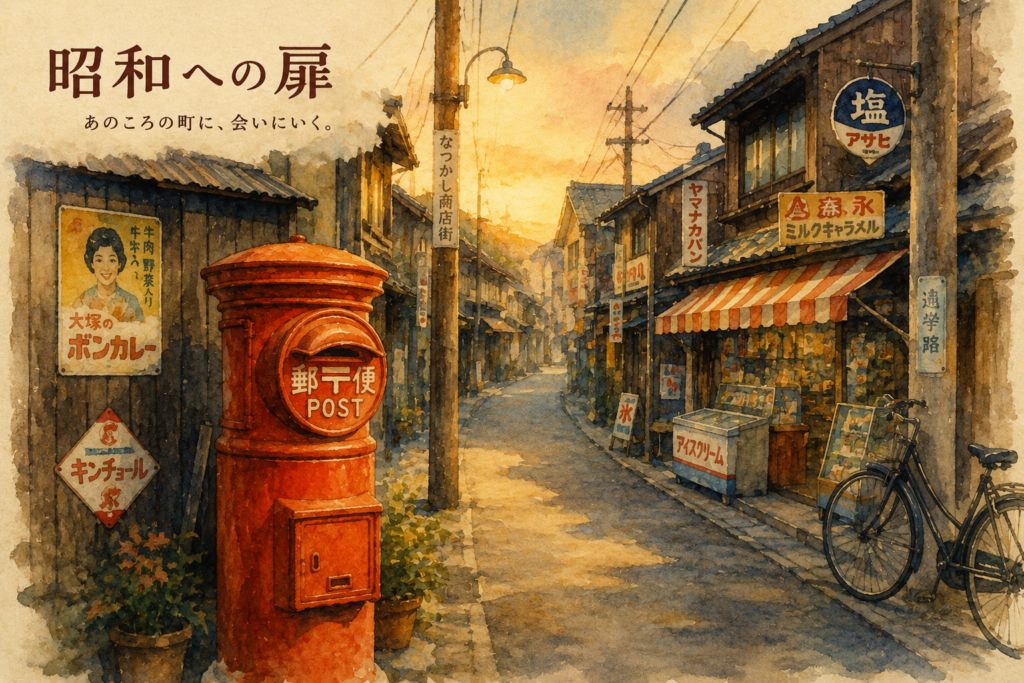
In Showa-era Japan, round red postboxes could be found almost everywhere.
In front of stations.
Along shopping streets.
Near schools.
Wherever you went, they had the same shape and the same bright red color.
You could spot one from a distance and immediately think, “There’s a postbox.”
Today, more stylish postboxes designed to blend into the surrounding scenery have become common.
They fit naturally into the townscape and are enjoyable to discover.
Sometimes, though, I find myself wondering,
“Is that really a postbox?”
In recent years, some convenience stores have even begun installing postboxes.
People say fewer letters are written these days.
Yet despite changing with the times, postboxes continue to remain quietly in towns across Japan.