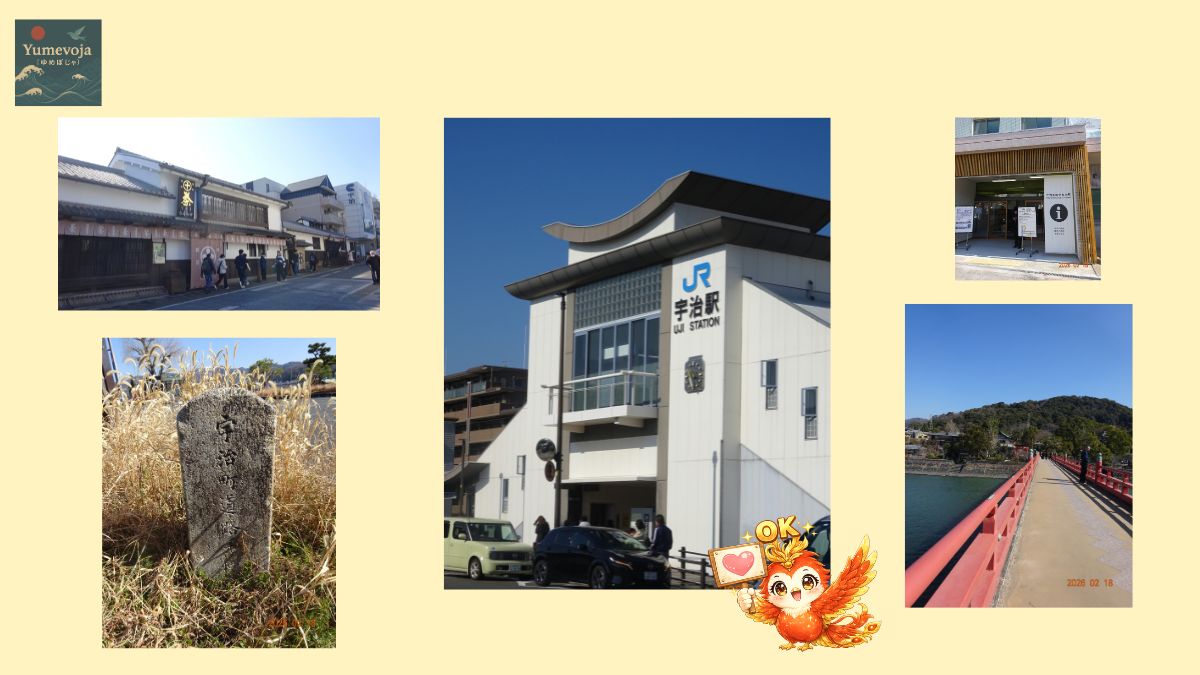
Arriving at Uji Station.
In the daylight, memories of the town slowly begin to return.
Crossing the bridge, the journey toward Byodo-in begins.
Visit date: February 18, 2026 (Wednesday)
First, here is the map of the day’s route.
👉 The afternoon article for this day is here
▶︎🚉 Stopover Journey | Demachiyanagi and Mame Daifuku — Walking Through Kyoto at Dusk | Kyoto Recovery ③
It had been a while since I experienced the morning commuter rush.
I stepped into the women-only car and felt strangely relieved.
I usually commute by car,
so even traveling by train felt a little like a journey.
At Kyoto Station, I transferred to the Nara Line.
Without checking properly, I jumped onto the train and suddenly wondered, “Wait… is this the right one?”
Thankfully, it was bound for Uji.
The train was crowded, but many passengers got off at Inari Station.
The last time I came, it was nighttime,
so the scenery outside the window felt completely different.
Today was cold.
Among the many tourists,
I noticed a man so tall that his head almost touched the ceiling.
I wondered if the world looked different from his height.
But at the same time, I thought life in Japan must be inconvenient for him in many ways.
I arrived at Uji Station.
The restrooms at Kyoto Station had a huge line, but the ones in Uji were empty.
Still, something bothered me.
The restroom was supposed to be new and clean, yet it was surprisingly dirty.
Perhaps the cleaning staff simply could not keep up.
The restroom at Fushimi Inari Taisha, when I visited at night before, had felt like a scene from hell.
I wondered if it was only a matter of cultural differences.
In front of the station were not only shops for tourists,
but also cram schools and a ChocoZAP gym.
Even in a travel destination, ordinary daily life quietly existed.
As I walked, memories slowly began returning.
“Oh right, that supermarket was here.”
The shape of the town, unnoticed at night, emerged clearly in the daylight.
A familiar torii gate.
Three people came out of a nearby shop, carrying paper bags in their hands.
Souvenirs, perhaps.
I could not catch the French they were speaking, and felt slightly frustrated.
In his later years, my father disliked walking.
But he always loved eating,
so the two of us often traveled together.
To keep walking.
I headed toward Byodo-in.
My father had said, “I don’t want to walk,”
and in the end, he never came here.
On the other hand, when my children were small, I brought them here.
“Look, it’s the place on the 10-yen coin.”
I remember saying that.
I entered Byodo-in.
Entering the Phoenix Hall itself required an additional fee, and admission was limited to 50 people every 20 minutes.
I did not feel like waiting, so I decided to admire it from outside instead.
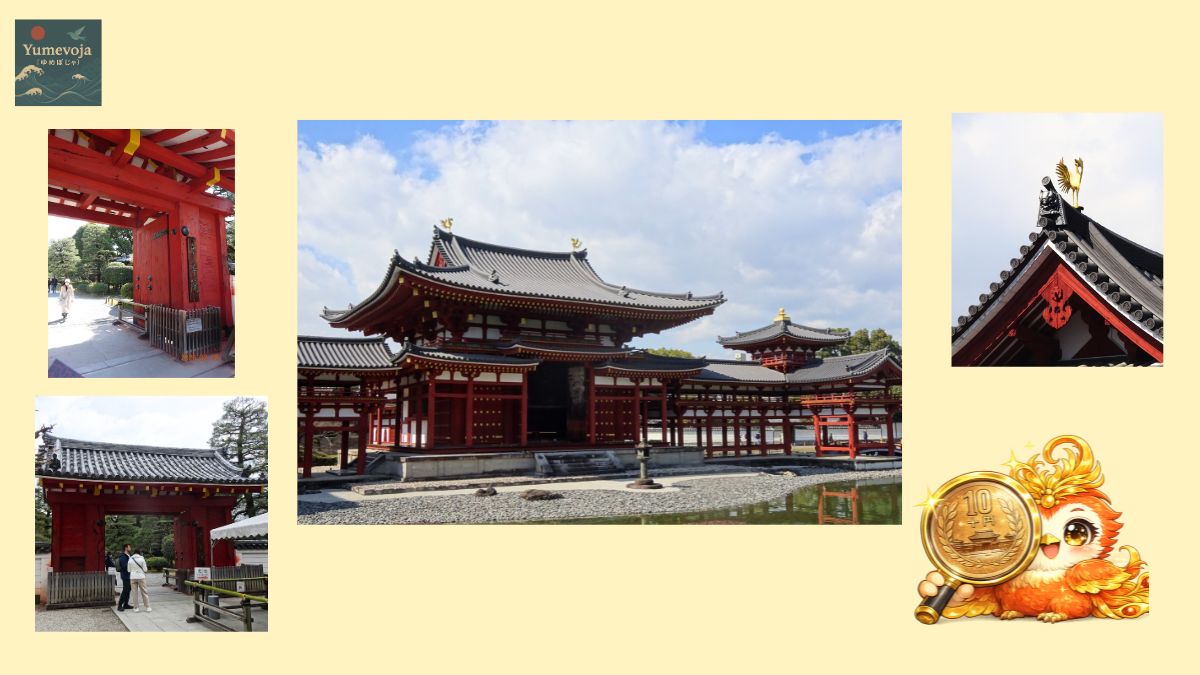
Byodo-in Phoenix Hall, famous from the 10-yen coin.
In the quiet atmosphere, perhaps people long ago also dreamed of the Pure Land Paradise.
The museum was quiet.
The Buddha’s face felt incredibly gentle.
Different from Buddhist statues in India.
People in the past also dreamed of paradise.
Even now, that feeling has not changed.
They say that when we die,
the Buddha appears in the form of the person we most wish would come for us.
Before my mother passed away,
her face had begun to resemble my grandmother’s so closely that it surprised me.
When my own time comes,
I feel certain my parents will come for me.
At least, that is what I quietly believe.
Just as tears were beginning to well up,
a mother beside me started explaining Fujiwara no Yorimichi to her child.
The tears stopped. Haha.
Then another thought crossed my mind.
Hanging scrolls are vertical.
Just like today’s social media feeds.
Social media may have originated in America,
but perhaps Japan had already invented vertical scrolling culture a thousand years ago.
The current of the Uji River was faster than I expected.
I headed toward The Tale of Genji Museum.
Whenever I see a museum, I feel drawn to enter,
even while wondering whether there is really any meaning in doing so.
To be honest, the result was a little disappointing.
The exhibits, videos, and merchandise all felt somewhat light.
There must be people overseas who deeply love The Tale of Genji.
That made it feel a little unfortunate.
Still, the final animated presentation remained in my memory.
The loneliness of losing family.
By creating stories,
by entertaining others,
perhaps Murasaki Shikibu herself found happiness.
That was how the exhibition concluded.
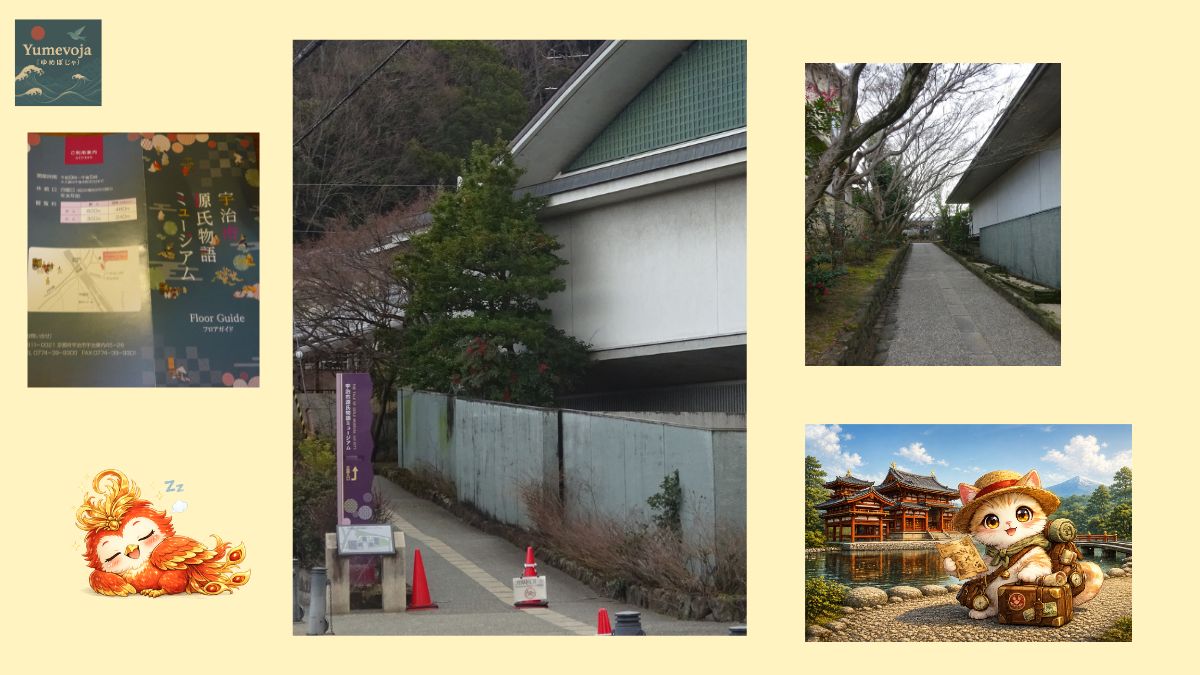
The world of The Tale of Genji still lingers in Uji.
Walking along the quiet paths feels like gently touching a story from the Heian period.
I headed toward the Fukujuen tea salon, filled with memories.
👉 Article here
▶︎🍵 Beauty and Taste | Uji Tea Soba and Fukujuen — A Quiet Kyoto Lunch Filled with Memories | Kyoto Recovery ②
👉 Related illustrations here
(Free to use)
▶︎ 🎨View illustration page
👉Choose Kyoto by mood.
▶︎☆View the Kyoto guide

Today’s bonus capsule!
✨ Gateway to the Shōwa Era
―Milk in glass bottles
The Showa era (1926–1989) was a time when modern technology and ideas began to transform everyday life in Japan.
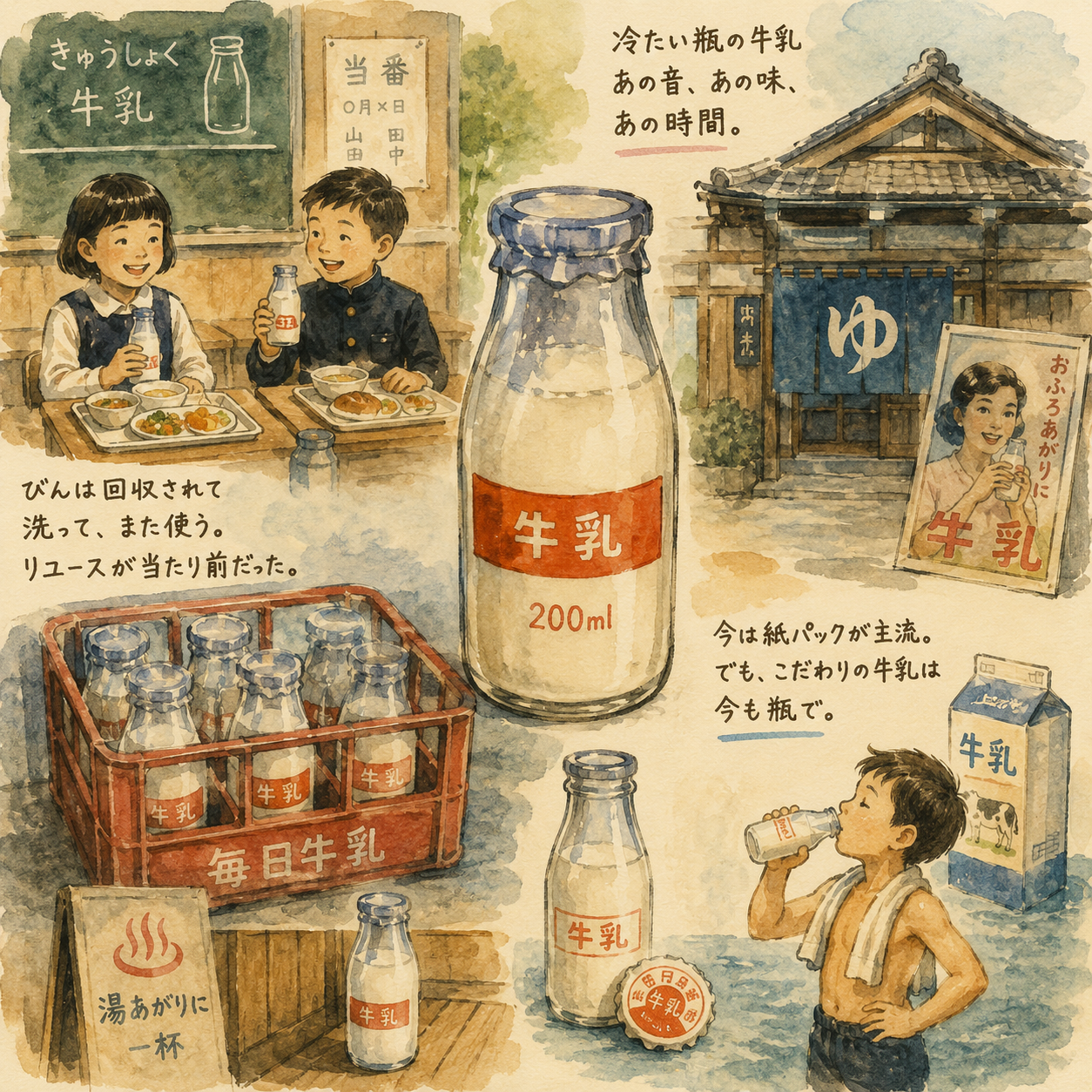
School lunches in Showa-era Japan often came with milk in glass bottles.
Classroom helpers would carry heavy metal cases filled with milk bottles to each class.
After drinking, the bottles were collected, washed, and reused.
What we now call “reuse” was simply part of everyday life back then.
Today, paper cartons are more common.
They are lighter, safer, and easier to manage.
In many ways, they fit modern life better.
Still, some specialty milk shops continue to use glass bottles.
And at certain public bathhouses, bottled milk remains part of the post-bath tradition.
The cold feel of the glass.
The small sound of opening the cap.
The familiar pose of drinking with one hand on your hip.
Even in a more convenient age, many people still feel nostalgic when they see bottled milk.
Perhaps it is not only the taste they remember, but also the texture, the sound, and the feeling of those moments.