Date visited: Saturday, April 11, 2026
I had plans in Akashi that evening.
Since I was going there anyway, I decided to arrive a little early.
With no particular expectations, I boarded a train in the early afternoon.
I had no plans to visit the ruins of Akashi Castle.
I had no plans to visit the Akashi Municipal Planetarium either.
I had only a few hours before the evening.
This time, my journey was a small one, found between one plan and the next.
First, a Late Lunch
I arrived at Akashi Station.
First, I decided to look for somewhere to have a late lunch.
Since I had come all the way to Akashi, I wanted to eat something characteristic of the city.
I walked around the station area, hesitating between several restaurants.
Eventually, I chose Sushi Saemon.
👉Google Maps: Sushi Saemon
👉Official page: Sushi Saemon
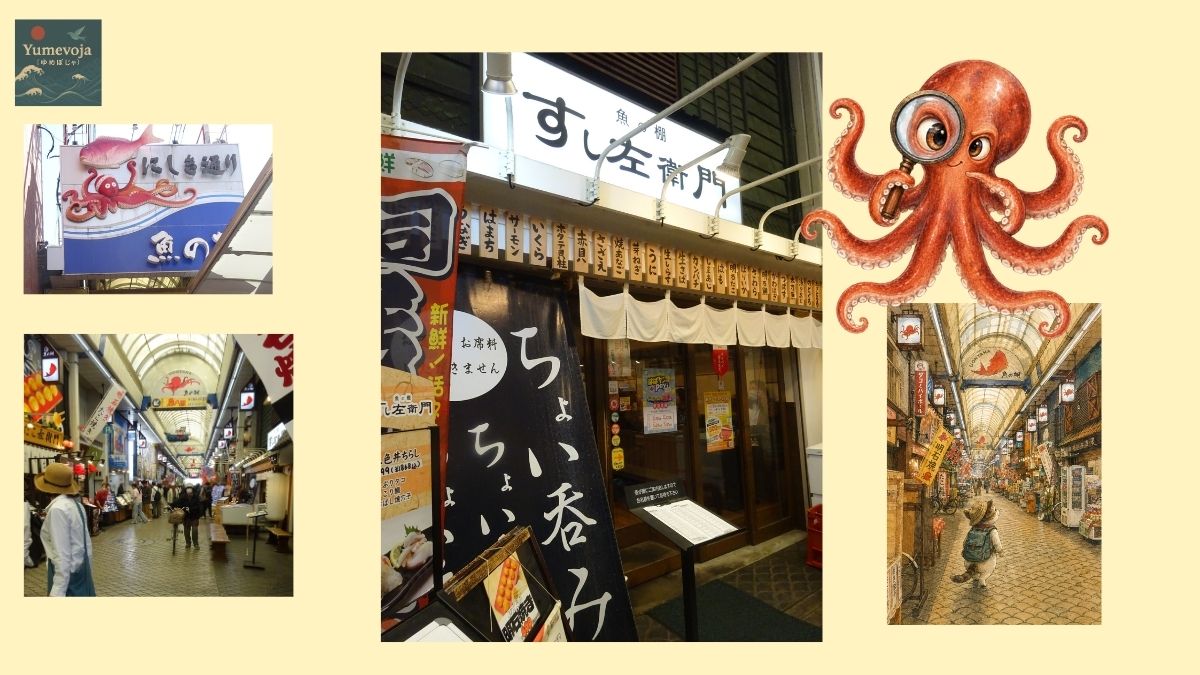
From Akashi Station, I walked to Uontana Shopping Street.
After exploring the covered arcade lined with seafood shops,
I stopped for lunch at Sushi Saemon inside the market.
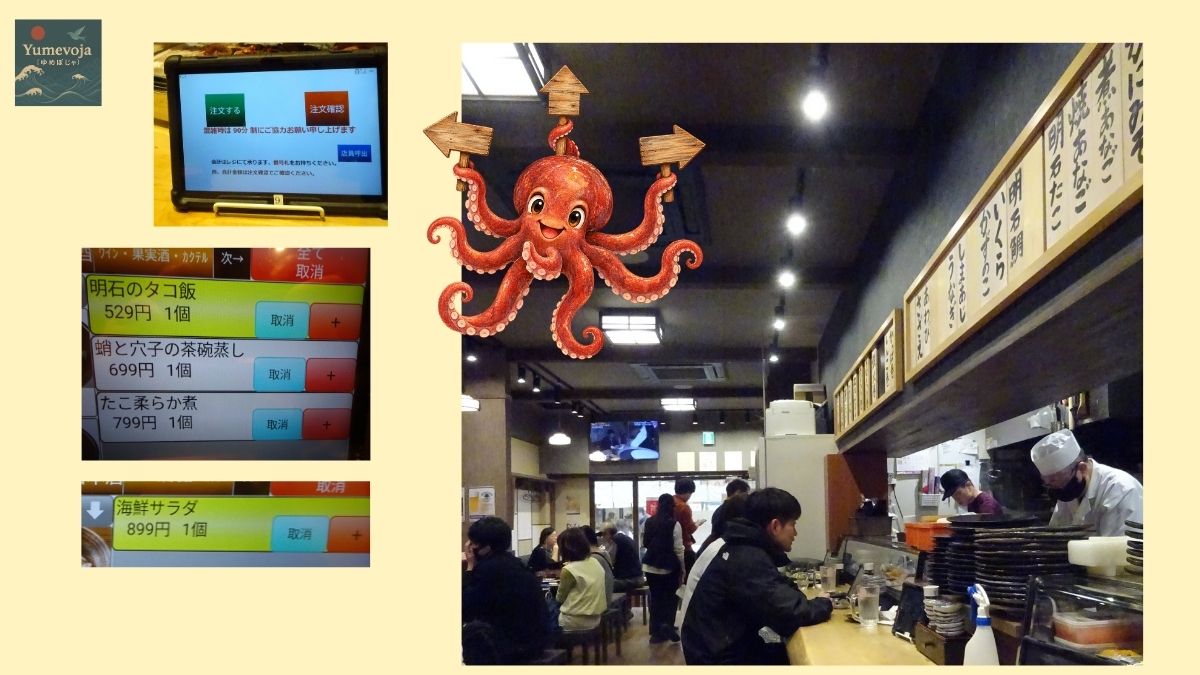
Sushi Saemon was lively,
with customers filling even the counter seats.
Using the tablet, I ordered Akashi octopus rice,
chawanmushi with octopus and conger eel,
tender simmered octopus, and a seafood salad.
I ordered:
- Akashi octopus rice
- Chawanmushi with octopus and conger eel
- Tender simmered octopus
When the dishes arrived, my first thought was:
They’re small.
Much smaller than I had expected.
And they were not especially inexpensive.
This might not be enough.
Then I took a bite.
…It was delicious.
Small, but Delicious
My favorite dish was the tender simmered octopus.
It had a slightly sweet seasoning.
But the sweetness did not hide the flavor of the main ingredient. Instead, it brought out the delicious taste of the octopus.
More than anything, the octopus itself was excellent.
Only moments earlier, I had been thinking:
“This isn’t enough food.”
But that thought soon changed to:
“I want to try some of the other dishes.”
At that point, there was nothing else to be done.
I decided to increase my budget a little.
Chawanmushi with Octopus and Conger Eel
Unlike the simmered octopus, the chawanmushi was not sweet.
It had a fairly strong salty flavor.
Inside were large pieces of octopus and conger eel.
The chawanmushi was soft and delicate, while the ingredients inside had enough substance to chew and savor.
It was the same octopus, yet completely different from the simmered dish.
As I tried each dish, the meal became more and more enjoyable.
One More Dish: Seafood Salad
Having come this far, I wanted to try just a little more.
So I added a seafood salad.
When it arrived, I was slightly surprised.
It was large.
The earlier dishes had all been fairly small, but the seafood salad was a generous size.
Slices of sashimi rested on a bed of lettuce.
On top was a generous scattering of thickly shaved bonito flakes.
The dressing was refreshing, with a fairly strong acidity.
Even so, it did not overpower the flavor of the sashimi.
There was also something that may have been tobiko, or flying fish roe.
It added little pops of texture.
The aroma of bonito flakes.
The sashimi.
The acidity.
The tiny popping sensation.
So many different flavors and textures.
Somehow, the meal was becoming increasingly fun.
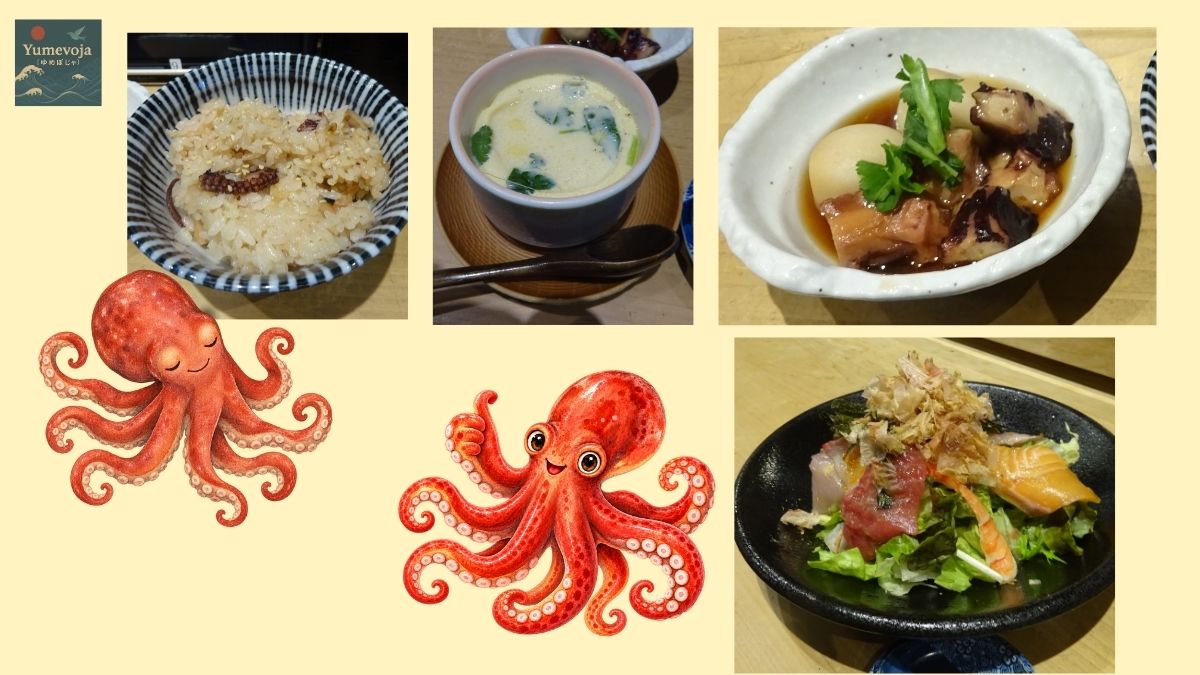
Akashi octopus rice, chawanmushi with octopus and conger eel,
tender simmered octopus, and a seafood salad.
I took my time enjoying an Akashi-style lunch centered on the city’s famous octopus.
The Food of Akashi—Neither Kyoto nor Osaka
At first, I thought:
“These dishes are small.”
And yet, with every plate I finished, I wanted to try something else.
This was not Kyoto.
This was not Osaka.
Akashi has a food culture of its own.
I was won over.
I do not usually recommend restaurants very strongly.
Everyone has different tastes, and the kind of atmosphere that feels comfortable also varies from person to person.
But unusually for me, the food that day made me want to recommend the restaurant to someone else.
On the other hand, the restaurant also had the lively atmosphere of a Japanese izakaya.
People who prefer a quiet place for a leisurely meal may feel differently about it.
I would have liked to try a few more dishes.
But I also had plans that evening.
It was time not to be too greedy.
Thank you for the meal.
After Lunch, I Headed for the Sea
I left the restaurant and walked through the streets of Akashi.
I had not chosen any particular destination.
I simply continued toward the sea.
Awaji Island lay in front of me.
I could also see the Akashi Kaikyo Bridge.
But what I heard was not the sound of waves I had imagined.
Perhaps it was because I was standing beside an inner harbor.
There was almost no sound of waves.
Instead, I heard the engines of boats.
It was a little different from the “sea” shown in sightseeing photographs.
This was a sea that existed alongside everyday life.
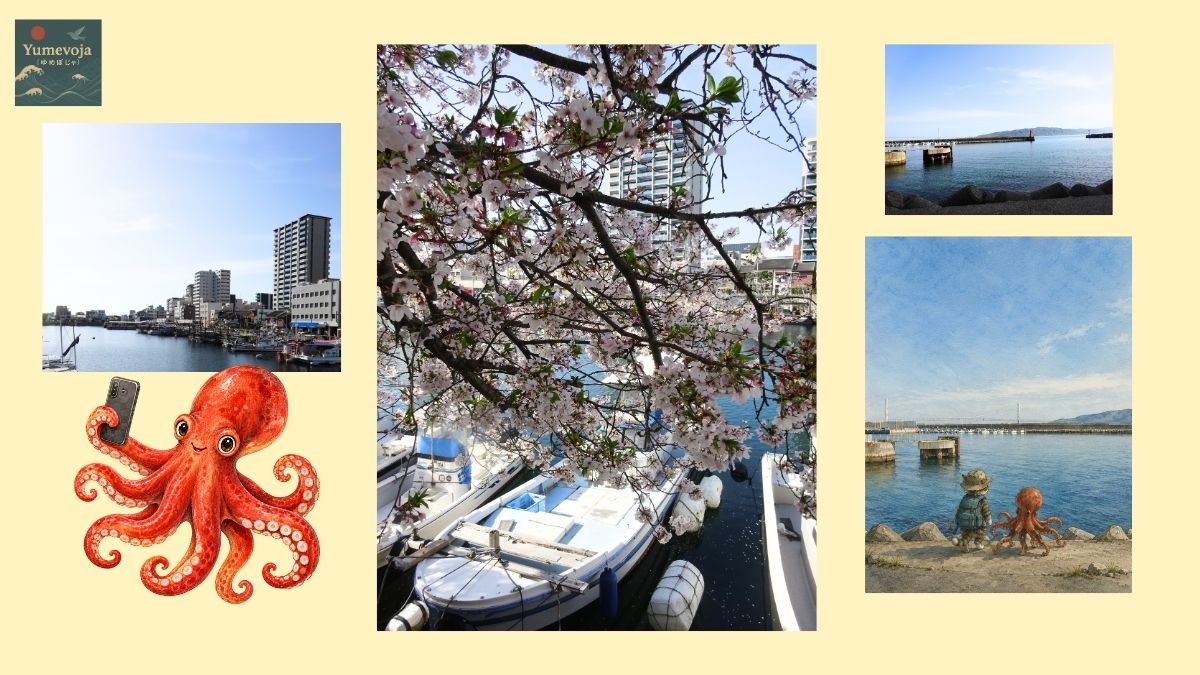
After enjoying the octopus dishes, I walked to Akashi Harbor.
Boats rested beyond the cherry blossoms,
and I enjoyed a little journey between one plan and the next while strolling beside the calm water.
A Father and Child by the Sea
A father and child were fishing by the water.
I could hear the child’s cheerful voice.
As far as I could see, they did not catch any fish.
Even so, they seemed to be having fun.
Perhaps the child was enjoying the time spent with their father more than the act of catching fish.
Of course, I do not know what they were really thinking.
But watching them reminded me of the times I had taken my own children fishing long ago.
As I continued walking, I passed someone riding a bicycle with a fishing rod.
Then another person.
And then one more.
The sea was not simply a special tourist attraction here. It was part of everyday life.
I felt as though I had glimpsed another side of the city.
A City of Strollers and the Sea
As I walked through the city, I passed several people pushing baby strollers.
At the water’s edge, a father and child were fishing.
The station was only a short walk away, with shops clustered around it.
I had only spent a few hours walking around, so I could hardly claim to understand the city of Akashi.
Even so, I found myself thinking:
“For the people who live here, this sea is part of everyday life.”
The sea seen as a traveler and the sea that exists within daily life.
It was the same sea, yet it looked a little different.
From the Sea, Back to the Station
It was almost time for my evening plans.
I headed back toward the station and looked for somewhere to rest.
The cafés were crowded, so I went to the ZETTERIA near the station.
I ordered a café au lait.
It was a medium, but larger than I had expected.
A counter seat overlooking the street was also available.
Only a short while earlier, I had been looking at the sea.
Now, cars were passing beneath the elevated railway outside the window.
The scenery had changed completely.
There was even a power outlet at my seat.
I had brought a heavy portable battery for my laptop, but…
Well, never mind.
I opened my laptop.
Although I had come all the way to Akashi, I was creating Pinterest pins for an article about Kyoto.
Writing about one journey while traveling through another.
It felt a little strange, but this kind of time was not bad either.
There Is Travel Between One Plan and the Next
This time, I did not visit Akashi Castle or the planetarium.
I did not tour any famous attractions.
I ate a late lunch.
I walked to the sea.
I watched a father and child fishing.
I opened my laptop for a while as I drank a café au lait.
That was all.
But it was enough for a small journey.
You do not need to set aside an entire day.
Sometimes, you can simply take a walk between one plan and the next.
If you find something delicious or discover a view you have never seen before, that is enough.
The next time I visit Akashi, I would like to see Akashi Castle and the planetarium.
Perhaps I will discover a different side of the city then.
That is all for today.
It is almost time to head to my next engagement.
👉 Related illustrations here
(Free to use)
▶︎ 🎨View illustration page

Today’s bonus capsule!
✨ Gateway to the Shōwa Era
―Do Osaka’s Takoyaki Have Roots in Akashi?
The Showa era (1926–1989) was a time when modern technology and ideas began to transform everyday life in Japan.
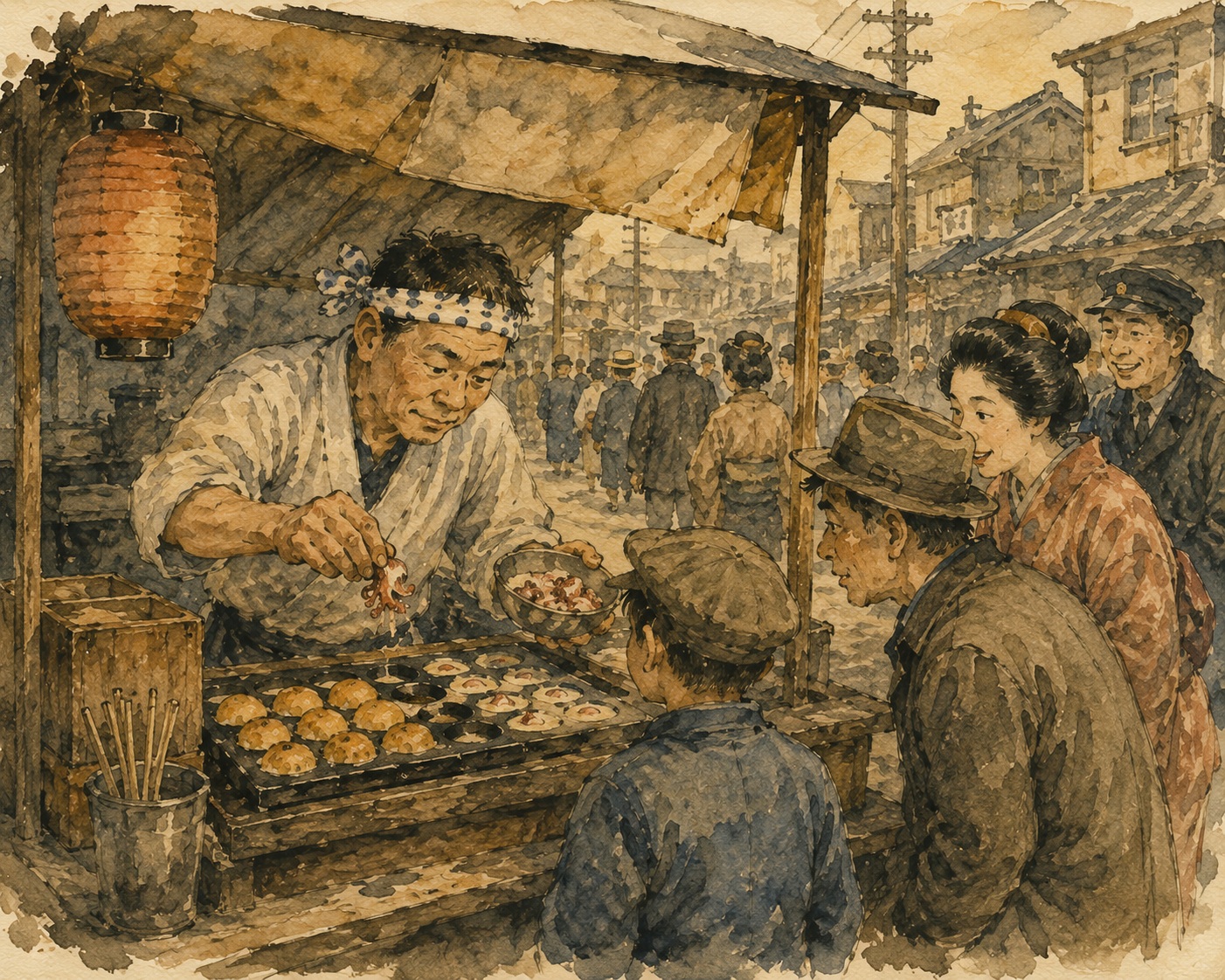
Takoyaki is one of Osaka’s best-known foods, but its story leads back to Akashi.
During the Meiji and Taisho eras, Akashi was known for producing imitation coral beads called Akashi-dama, which used egg whites. The leftover yolks, together with locally caught octopus, are said to have inspired Akashi’s soft egg-based tamago-yaki, now widely known as Akashiyaki.
Then, in early Showa-era Osaka, octopus was added to radio-yaki after inspiration from Akashi.
From Akashi-dama to Akashiyaki, and finally to Osaka’s takoyaki.
A familiar little round snack carries a surprisingly long history.