Visit Date: January 25, 2026 (Sunday)
From Osaka Station to Nakazakicho.
A half-day walk through winter skating rinks, railway underpasses, and the search for okonomiyaki.
I arrived at Osaka Station.
In front of the station, a seasonal outdoor ice-skating rink had been set up for winter.
A small rink.
But it looked fun.
Children laughing as they nearly fell.
Couples holding hands.
Parents quietly watching nearby.
I had imagined winter in Osaka as fast and busy.
But apparently, there is still time here to slow down for a moment.
Watching that scene,
I headed toward Nakazakicho.
It is only a short walk from Osaka Station.
But in truth, the journey had already begun the moment I stepped outside the station.

A seasonal outdoor skating rink in front of Osaka Station.
Surrounded by skyscrapers,
families and couples quietly enjoyed a winter moment in the middle of the city.
Under the railway tracks on the way to Nakazakicho.
Old signs.
Restaurants.
Small shops.
People passing by.
There was so much to look at that I did not know where to focus.
But that was exactly what made it interesting.
Light and shadow.
Old and new.
Different smells mixing together.
Nothing felt organized.
And because of that, every step revealed something unexpected.
Nakazakicho was the same.
It is not a neatly arranged neighborhood.
If anything, it is a mixture of everything.
Old Showa-era row houses.
Traditional shops.
Cafés filled with younger people.
Tiny variety stores.
Before I realized it, all of them had naturally blended together.

Walking through the railway underpasses toward Nakazakicho.
Old wooden houses, narrow alleys,
and modern cafés blend together in Osaka’s wonderfully chaotic atmosphere.
Osaka, I think, is not a polished city like Tokyo.
Of course, there are many stylish places.
But the entire city is not moving in the same direction.
An old building beside a skyscraper.
A traditional izakaya next to a modern café.
An elderly woman returning from shopping walking beside foreign tourists.
There is no sense of unity.
Honestly, it feels a little chaotic.
But that chaos feels very Osaka.
Not a landscape carefully designed by someone,
but one that has naturally accumulated over a long period of time.
That is why it feels somehow human.
As I walked, I thought:
Osaka is not a beautiful city.
But perhaps it is an honest city.
It does not try to impress.
It does not pretend to be something else.
Messy as it is,
the city keeps moving forward.
I continued walking through Nakazakicho.
It is not a famous tourist destination.
There are no grand landmarks.
And yet, somehow, it is enjoyable.
I do not fully know why.
Maybe because there is no “correct” way to experience the neighborhood.
You wander.
Peek into side streets.
Turn back.
Walk again.
It felt like a city made for that kind of time.
After this,
I headed off to search for a very Osaka-style lunch.
👉 🍵 Beauty & Taste | Momotaro Okonomiyaki | Osaka Loop Line (Outer Loop) ①
Next time, I will explore the area around Temma Station on the Osaka Loop Line (Outer Loop) ②.
👉 Related illustrations here
(Free to use)
▶︎ 🎨View illustration page
👉Choose Osaka by station.
▶︎☆View the Osaka Loop Line Guide
👉How about taking a slow walk through Kyoto today?
▶︎☆View the Kyoto Guide

Today’s bonus capsule!
✨ Gateway to the Shōwa Era
―Enamel Advertising Signs
The Showa era (1926–1989) was a time when modern technology and ideas began to transform everyday life in Japan.
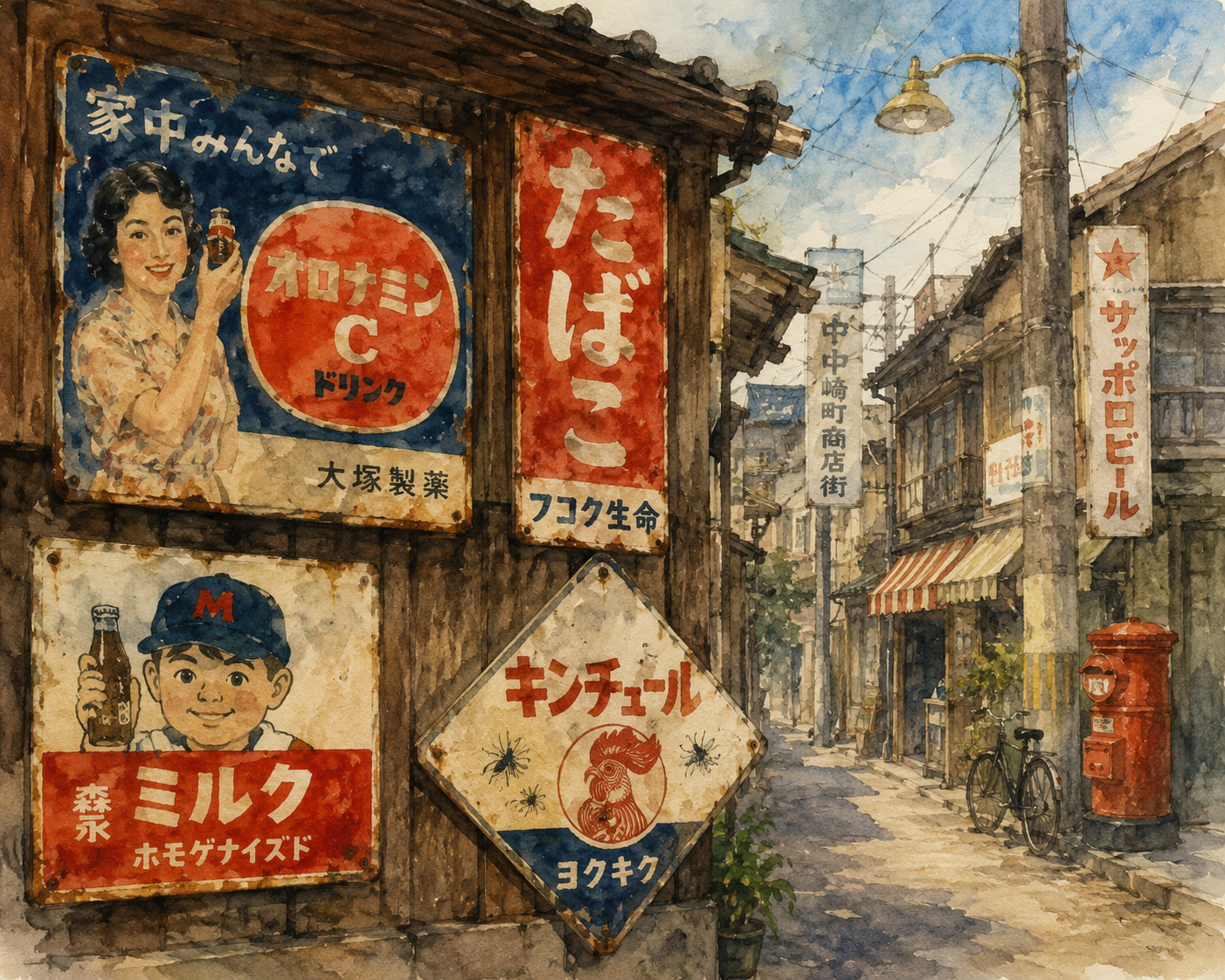
In Japan’s Showa era, enamel advertising signs were a common sight in shopping streets. They often featured advertisements for medicines, drinks, or everyday products.
Made of metal and coated with enamel, these signs were built to last. Even after years of exposure to sun and rain, many still remain with their faded colors intact.
They have largely disappeared from everyday life, but finding one during a journey can bring a surprising sense of comfort.
Even people who never experienced the Showa era sometimes feel a strange sense of nostalgia when they see them.
If you wander through an old shopping street or a quiet back alley, you may still come across one today.