Date visited: April 30, 2026 (Showa Day)
After leaving Sanjūsangen-dō, I stopped for duck nanban udon for lunch.
My next destination was Tō-ji Temple.
I began walking south from Kyoto Station.
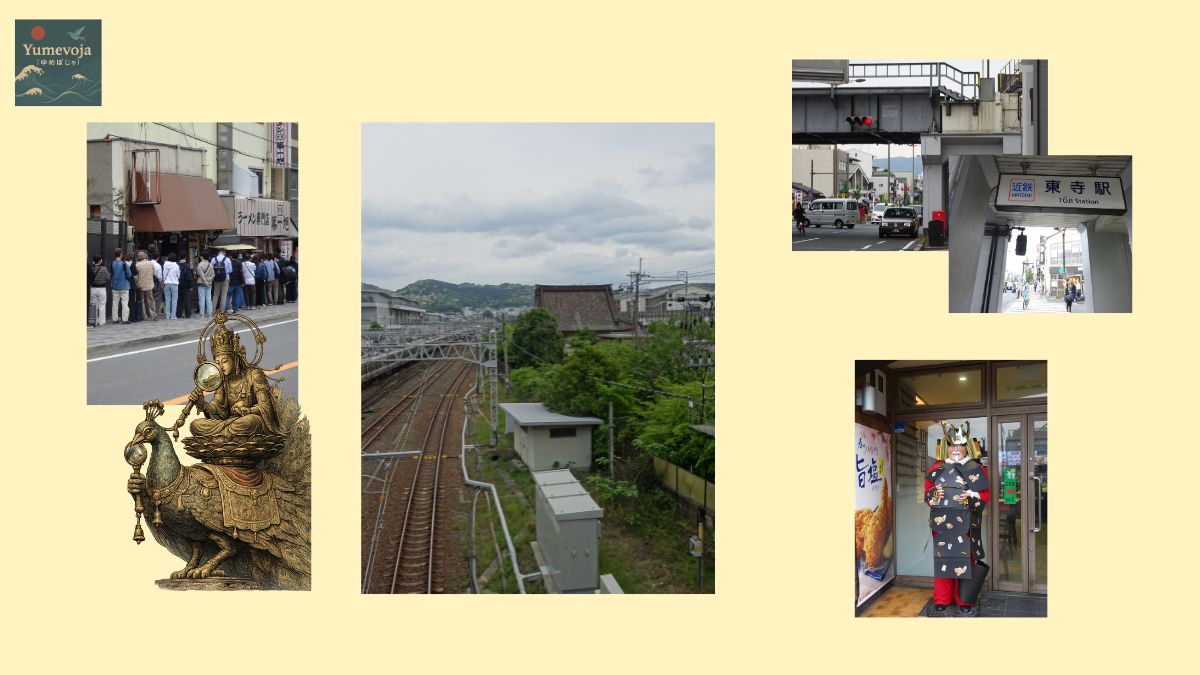
Walking from Sanjūsangen-dō toward Tō-ji,
I discovered another side of Kyoto beyond the main tourist streets.
When people think of Kyoto Station, they probably picture the busy area in front of the station, crowded with tourists.
But once I walked around to the other side, the atmosphere changed.
Business hotels.
Residential buildings.
Even though I was only about a hundred meters from the station, the unmistakable feeling of Kyoto suddenly faded.
The area even looked slightly worn and quiet.
Really?
Was this truly right behind Kyoto Station?
Kyoto is not made up only of places carefully arranged for visitors.
There is also a Kyoto where people live and work.
Walking allows you to encounter places like that.
Following the Five-Story Pagoda to Tō-ji
As I walked, the five-story pagoda gradually came closer.
Rising beyond the ordinary streets of Kyoto, it had an unmistakable presence.
I thought I had arrived.
But I could not enter from the side facing me.
Tō-ji has several gates, and apparently one of them would have offered the shortest route inside.
Not knowing this, I continued to another gate and ended up walking across part of the temple grounds.
Ha ha.
Still, the detour was not a bad one.
Even though it was Golden Week, almost no one else was walking there.
I continued slowly along the quiet road.
It seemed to be that kind of day.
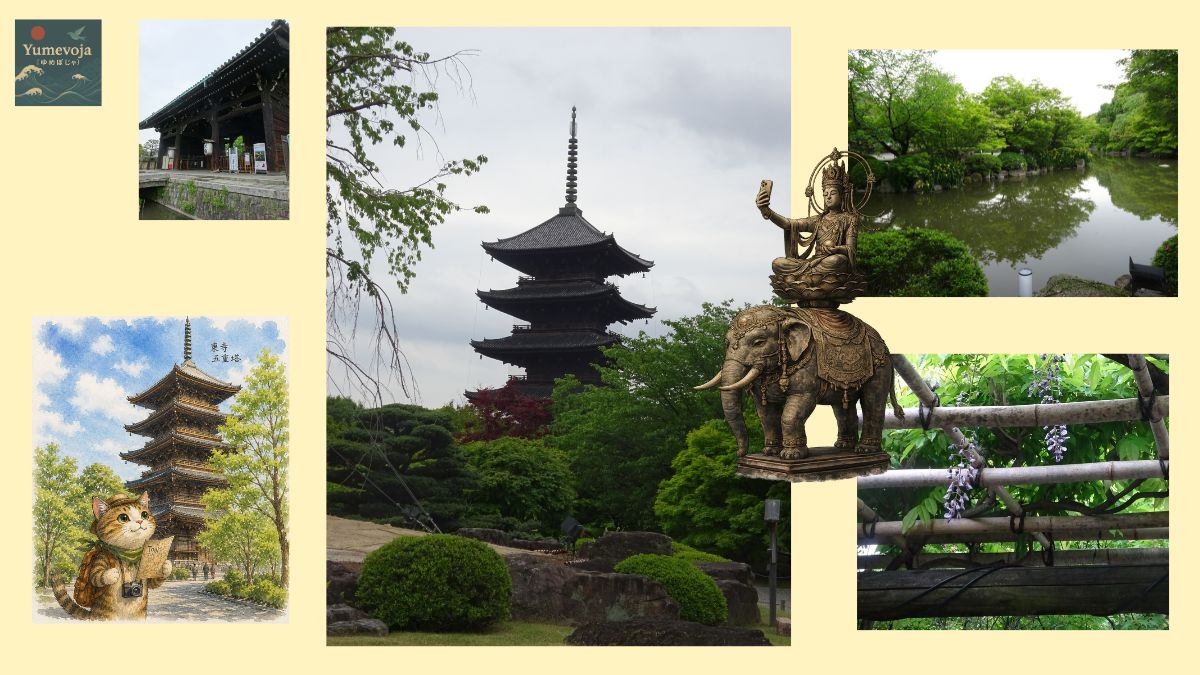
Surrounded by fresh greenery,
Tō-ji offered a peaceful atmosphere just a short walk from Kyoto Station.
Walking Through the World Heritage Site of Tō-ji
Tō-ji’s formal name is Kyōō Gokoku-ji.
It is the head temple of the Shingon school and one of the temples included in the UNESCO World Heritage Site known as the Historic Monuments of Ancient Kyoto.
(🌐Official Website To-ji Temple )
I was walking through a place that had existed since the days of Heian-kyō.
Thinking about that made it difficult to believe I was still so close to Kyoto Station.
A modern railway station.
Business hotels and residential buildings.
And beyond them, Tō-ji, carrying a history that stretches back more than a thousand years.
Feeling Seen Through in the Lecture Hall
I entered the Kōdō, or Lecture Hall, first.
(🌐Official Website Tō-ji-Kōdō )
Photography was not permitted inside.
Standing before the large Buddhist statues, I felt as though they could see straight through me.
What was I thinking?
What feelings had brought me here?
Although I had said nothing, it felt as if everything was already known.
Perhaps prayer is not the only reason people grow quiet in front of Buddhist statues.
A Different Atmosphere Inside the Kondō
Next, I entered the Kondō, the Main Hall.
(🌐Official Website To-ji- Kondō)
The atmosphere was different from that of the Lecture Hall.
Three Buddhist statues stood before me.
But it was not only the statues themselves.
The colors of the walls behind them and the wooden framework of the building all came together to form a single space.
Rather than feeling gently embraced, I felt slightly enclosed.
There seemed to be nowhere to escape.
It almost felt as though I had been captured inside the space.
Even within the same temple, the atmosphere changes from one building to another.
It is not simply a matter of how many statues are present.
Their arrangement, the colors, the light, and even the way the timbers are assembled can change how a person feels.
More Interested in the Gardener Than the Buildings
While walking through the grounds, I noticed someone tending the garden.
Perhaps a gardener.
Whenever I see someone doing this kind of work, I cannot help stopping to watch.
Most visitors look up at the Kondō, the Lecture Hall, or the five-story pagoda.
I find myself watching the gardener’s hands.
Where will they cut?
What will they leave untouched?
How are they viewing the garden as a whole?
The pond and the gardens were beautifully maintained.
It is not only the old buildings that are being preserved.
The scenery surrounding them is also protected by human hands.
Jardin et bâtiments du Kanchi-in, rattaché au Tō-ji à Kyoto
I Almost Missed the Five-Story Pagoda
I took a photograph of the five-story pagoda.
I had seen it.
Or so I thought.
I was about to continue walking.
Then I noticed another visitor heading toward the side of the pagoda.
What was over there?
Curious, I followed.
It was possible to enter.
Really?
I had no idea.
That was close.
I had almost walked straight past it.
Ha ha.
Tō-ji’s five-story pagoda stands approximately 55 meters tall.
It is the tallest surviving wooden structure in Japan.
On the day of my visit, the first floor was open as part of a special exhibition period.
The interior is normally accessible only during limited seasonal openings and special exhibitions.
There were Buddhist statues inside, and traces of color still remained on the walls.
It was a completely different world from the pagoda I had seen from outside.
Within the heavy wooden structure, hints of its former vivid colors survived.
Had I not seen that single visitor walk toward the side of the tower, I would never have noticed.
I might have taken a photograph, felt satisfied, and left without knowing what was inside.
(🌐Official Website To-ji-Five-Story Pagoda )
Kūkai and Memories of the Shikoku Pilgrimage
Tō-ji is closely associated with Kōbō Daishi Kūkai.
It is also the head temple of the Shingon school.
The Heart Sutra.
A statue of Kūkai.
Everything I saw seemed to connect back to my Shikoku pilgrimage.
At Sanjūsangen-dō, I had used the one-yen coins I carry for the pilgrimage and had worn my father’s watch and my mother’s bracelet.
At Tō-ji, I encountered Kūkai once again.
There were many connections to the pilgrimage that day.
I was not walking through Shikoku.
Even so, it felt as though the journey that had come to a stop was beginning to move again, little by little, here in Kyoto.
A Small Companion Found at the Treasure Museum
I made my way to the Treasure Museum.
(🌐Official Website To-ji -Treasure Museum)
I had purchased a combined ticket covering Tō-ji, the Treasure Museum, and Kanchi-in, so I continued inside.
In the museum shop, a braided kumihimo smartphone strap caught my eye.
A label said that it had been blessed through prayer.
Its colors were bright but not overly showy.
It was elegant.
And it was made from pure silk, which I love.
The strap I had used before was shaped like a tiny woven pilgrim’s sandal.
After losing it, I had been searching for a replacement.
I wanted to avoid metal charms or anything large that might strike the screen of my phone.
At the same time, something loudly declaring, “Look at me!” did not feel right either.
At last, I had found one.
This strap would be unlikely to damage the screen.
Rather than simply being a souvenir from the journey, it felt as though it might become a small companion that would walk with me from now on.
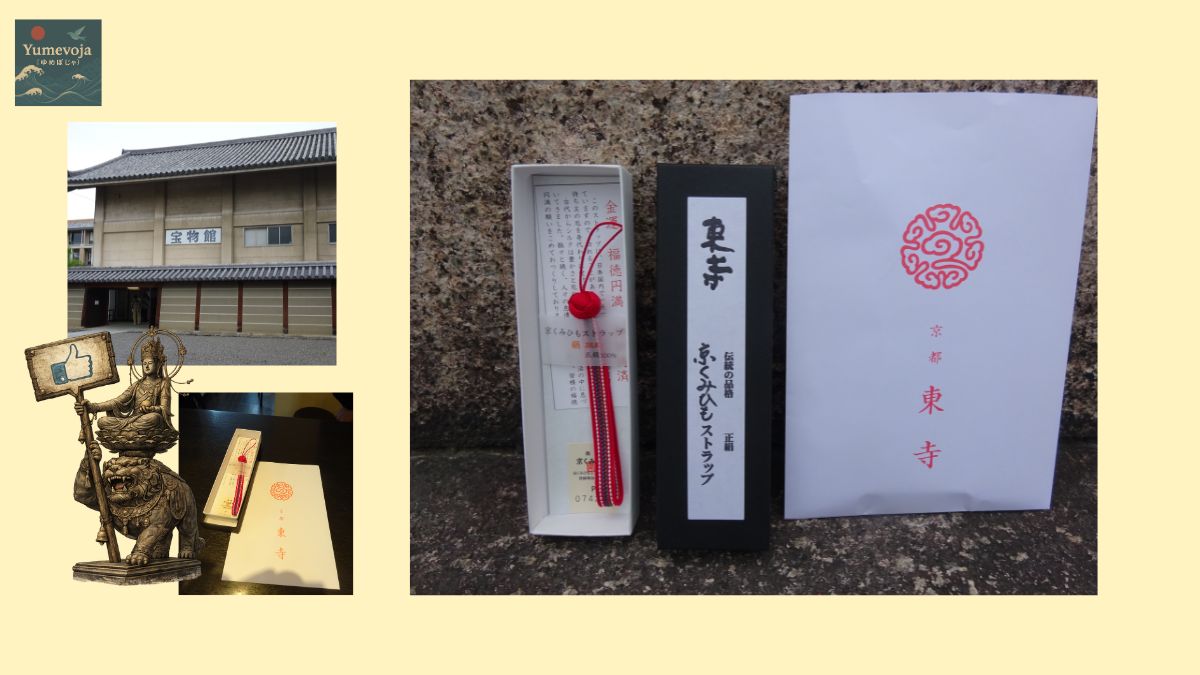
After visiting the Treasure Museum,
I chose a traditional kumihimo strap as a small souvenir from Kyoto.
The second half begins with Kanchi-in, the Five Great Kokūzō Bodhisattvas, and my unexpected encounter with paintings by Miyamoto Musashi.
Taking Off My Shoes and Entering Kanchi-in
Finally, I made my way to Kanchi-in.
(🌐Official Website To-ji-Kanchi-in )
Kanchi-in is a sub-temple of Tō-ji and a special head temple of the Tōji Shingon school.
It was also once an important center for the study of esoteric Buddhism.
I took off my shoes and stepped inside.
After walking all day, my feet immediately felt a little more comfortable.
I moved slowly through the building while looking out at the garden.
The silence here felt different from the stillness of the main Tō-ji grounds.
The principal images are the seated statues of the Five Great Kokūzō Bodhisattvas.
Five Buddhist figures sit in a row, each mounted on a different animal.
Their unusual appearance immediately caught my attention.
But there was another unexpected encounter waiting for me here.
Miyamoto Musashi.
Miyamoto Musashi Was More Than a Swordsman
The National Treasure Guest Hall preserves two paintings attributed to Miyamoto Musashi: Eagle and Bamboo Grove.
(🌐Official Website To-ji-Kanchi-in-Miyamoto Musashi )
Really?
Miyamoto Musashi?
He is known as the legendary swordsman who fought with two swords.
But he also painted.
And these did not feel like casual works created merely as a hobby.
Both the eagle and the bamboo were full of movement and force.
In the quiet room, it seemed as though Musashi’s strength still remained.
Why were paintings by Miyamoto Musashi here at Kanchi-in?
Curious, I decided to ask a member of staff before leaving.
The Story of Miyamoto Musashi Told by a Staff Member
According to the story I heard from a staff member, Miyamoto Musashi came to Kyoto and challenged martial arts schools in order to make a name for himself.
Although he won, he later became a target of many disciples from the defeated school.
Kanchi-in then gave him shelter.
Many different kinds of people passed through Kanchi-in.
Among them were artists, and Musashi learned about painting from them.
Eventually, he wanted to try painting for himself and picked up a brush.
The works he created are said to remain here today.
A swordsman is hunted and forced to hide inside a temple.
There, he encounters painting and leaves behind works of his own.
Perhaps even when life corners us, it can open a path toward something entirely different.
This story is based on what a staff member told me during my visit.
The Five-Story Pagoda Beyond the Rock Garden
The staff member also told me about a recommended viewpoint at Kanchi-in.
It was a place where the five-story pagoda appears beyond the rock garden.
The garden alone is beautiful.
The pagoda alone is beautiful.
But when the pagoda rises beyond the rock garden, Kanchi-in and Tō-ji become part of a single landscape.
Had I been exploring alone, I might have walked past without noticing.
At Sanjūsangen-dō, another visitor had shown me the arrow still lodged beneath the eaves.
At Tō-ji, I discovered that the pagoda was open only because I saw someone walking toward it.
At Kanchi-in, a staff member shared both the view and the story of Miyamoto Musashi.
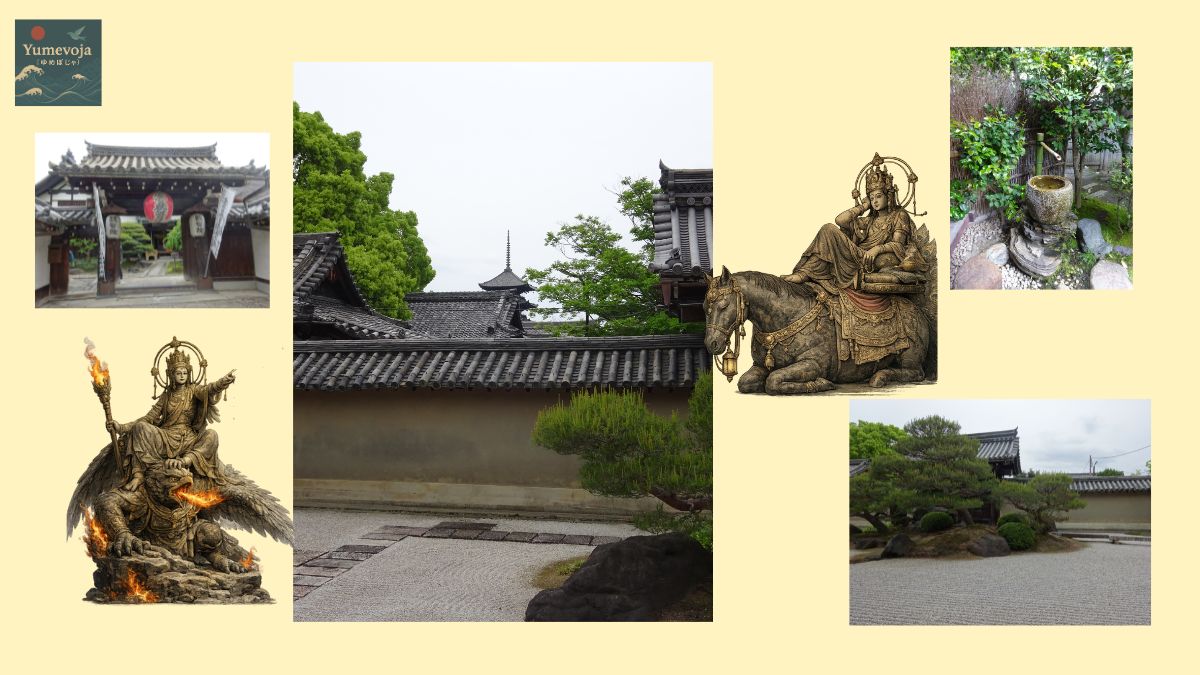
At Kanchi-in, I took my time enjoying the quiet garden,
the traditional buildings, and the unhurried rhythm of Kyoto.
That day, many of my discoveries came through other people.
Not knowing something can feel a little embarrassing.
But because I did not know, I asked.
Because I did not know, I followed someone for a few steps.
And beyond that were scenes I could never have found on my own.
Leaving the Quiet Grounds of Tō-ji
It was almost 5:00 p.m.
The closing time for Tō-ji was approaching.
Opening hours for the first floor of the five-story pagoda, the Treasure Museum, and other special exhibitions vary by season, so it is best to check the official information before visiting.
(🌐Official Website To-ji -Admission)
One gate after another began to close.
Perhaps they were gradually narrowing the available exits.
Before I knew it, the gate I had passed through earlier was already shut.
That evening, the temple was scheduled to reopen for a special nighttime illumination.
The daytime visit would end first, and then Tō-ji would transform into its nighttime setting.
For travelers trying to fit many places into a short trip, an evening opening may be convenient.
But I was glad I had visited Tō-ji during the day.
Even though it was Golden Week, there were few people.
I felt the different atmospheres of the Lecture Hall and Main Hall.
I watched the gardener’s hands.
I entered the five-story pagoda.
And at Kanchi-in, I encountered Miyamoto Musashi.
Because it was quiet, I had time to stop.
Walking Through a Kyoto I Had Never Known
The area behind Kyoto Station was different from the Kyoto I had imagined.
I did not know where the entrance to Tō-ji was.
I did not know that visitors could enter the five-story pagoda.
I did not know that paintings by Miyamoto Musashi remained at Kanchi-in.
There was so much I did not know.
But because I did not know, I walked.
Because I did not know, I stopped.
Because I did not know, I asked someone.
Tō-ji was a temple filled with things to see.
Yet what stayed with me in the end was not information, but a series of small discoveries.
A single visitor walking toward the side of the pagoda.
The moment I spoke to a staff member.
The five-story pagoda appearing beyond the rock garden.
Perhaps I am finally becoming a little more experienced at traveling in Kyoto.
Just kidding.
🗺 Walking Route for the Day
That day, I walked from Kyoto Station to Sanjūsangen-dō, stopped for lunch at Kamogawa Seimensho, and then continued on foot to Tō-ji.
For dinner, I visited a Kyoto-style restaurant near Kyoto Station.
I ended the day with one more meal at Yamashina Station.
🚉 Previous Article | Stopover Journey
Standing before the thousand Kannon statues, I offered the one-yen coins I carry for the Shikoku pilgrimage.
It was the day when the pilgrimage that had come to a stop began to move again, just a little.
👉 🚉 Stopover Journey | Sanjūsangen-dō: The Day My Shikoku Pilgrimage Began Again
🍵 Related Article | Beauty & Taste
After leaving Tō-ji, I visited a Kyoto-style restaurant I had noticed near Kyoto Station.
The restaurant was already fully booked, but the staff kindly offered me a table for a short time before the next reservation.
👉 🍵 Beauty & Taste|Kyomon: A Kyoto Restaurant Worth Returning To Near Kyoto Station
I thought Kyoto cuisine and sake would bring the day to a perfect close.
But after walking more than 20,000 steps, it was not quite enough.
On the way home, I ended up eating udon once more at Yamashina Station.
👉 🍵 Beauty & Taste|Menya Yamashina: Chicken Tempura Set and the Perfect Station Udon to End the Day
👉 Related illustrations here
(Free to use)
▶︎ 🎨View illustration page
👉Choose Kyoto by mood.
▶︎☆View the Kyoto guide

Today’s bonus capsule!
✨ Gateway to the Shōwa Era
―The Spray Bottle and the Iron
The Showa era (1926–1989) was a time when modern technology and ideas began to transform everyday life in Japan.
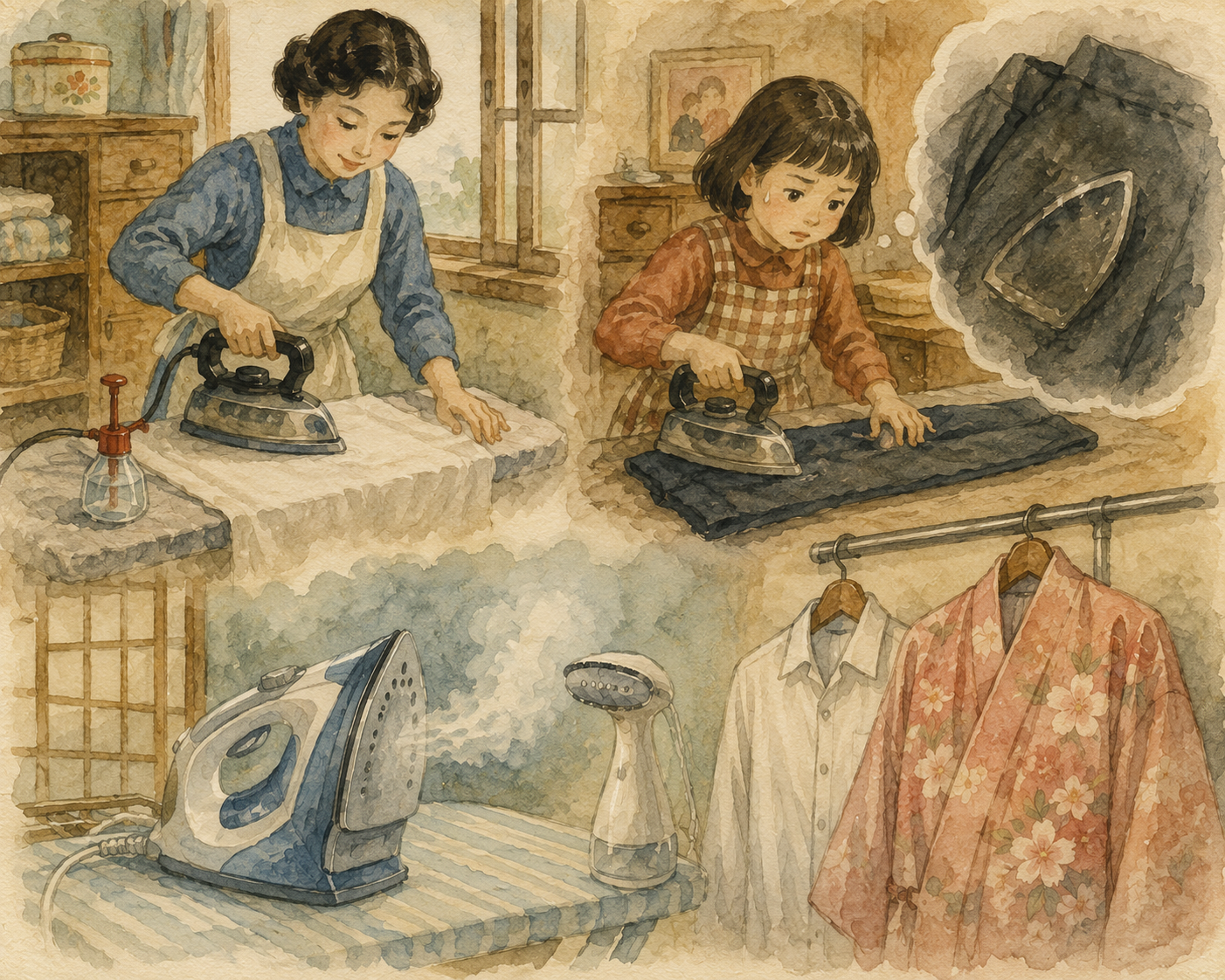
In the Shōwa era, many households kept a spray bottle next to the ironing board.
My mother would lightly mist our clothes with water before slowly moving a heavy iron across the fabric.
When I was a child, I once tried to iron my older brother’s school uniform trousers.
I forgot to use a pressing cloth and set the iron too hot.
The shape of the iron was burned into the fabric.
Since then, I’ve always been a little afraid of ironing.
Today, steam irons are standard, and garment steamers can even remove wrinkles while clothes are hanging.
Steam irons are now common around the world, and in countries where clothes dryers are widely used, people may iron less often than in Japan.
Even so, whenever I iron one of my kimono, I still feel a little nervous.
“Did I remember the pressing cloth?”
“Is the temperature set correctly?”
Technology has made ironing much easier, but childhood mistakes have a funny way of staying with us forever.