Visit date: April 30, 2026 (Showa Day)
Weather: Cloudy
I arrived in Kyoto.
I had returned to the heavenly world.
Haha.
The forecast had said rain.
But the sky was cloudy.
The wind was strong, and the morning felt a little chilly.
As soon as I stepped out at Kyoto Station, I noticed many foreign tourists.
“Ah, this is Kyoto.”
Lately, whenever I see visitors from overseas, I find myself thinking that.
Since it was Golden Week, there were also many Japanese families traveling together.
People from abroad.
Families on holiday.
Groups of students.
Many different kinds of time were crossing paths in this city.
Today, I wore an old digital camera around my neck.
It was the camera I had once bought for my child’s school trip.
Research mode: on.
A smartphone is convenient.
But during my Shikoku pilgrimage, I used Google Maps so much that my battery ran out, and I had to give up taking photos.
In midsummer, my phone once overheated so badly that I couldn’t take pictures at all.
And besides, I want to use things that have been sitting unused for a long time once in a while.
Today,
photos would be for the digital camera.
Navigation would be for the smartphone.
I decided to divide their roles and start walking.
On the way to Sanjūsangen-dō, I walked while looking for a place where I might be able to have lunch later.
It was still early, and many shops had signs saying “Preparing to Open.”
Many of the menus displayed outside had English written on them.
Kyoto is not only a city of old Japanese culture.
It is also a city that welcomes people from all over the world.
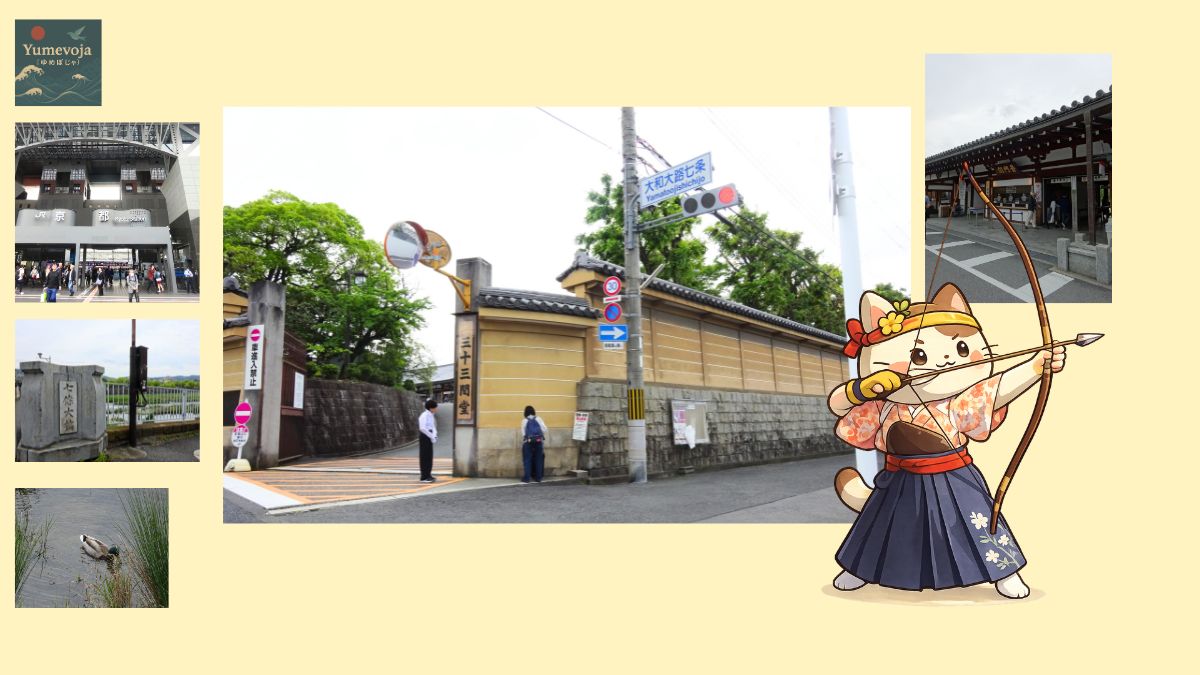
Walking from Kyoto Station to Sanjūsangen-dō.
The journey begins by crossing Shichijō Bridge
and passing through the historic gate.
What Was Waiting Beyond the White Wall
I entered Sanjūsangen-dō.
(🌐Official Website Sanjūsangen-dō)
A small group of students, probably high school students, walked in happily in their uniforms.
One student who seemed to be the leader was buying admission tickets for everyone.
A little farther on, I saw another group of students who had arrived by bus.
“A school event during Golden Week?”
I wondered about that a little as I began walking.
I followed the path and stepped slightly away from the main route.
Along the vermilion corridor, wooden chairs were placed at regular intervals.
No one was sitting there.
It was a quiet moment.
I learned later that this place is apparently the corridor of Rengeō-in.
Even when there are many people, Kyoto can become quiet if you step just a little off the main path.
It felt very Kyoto.
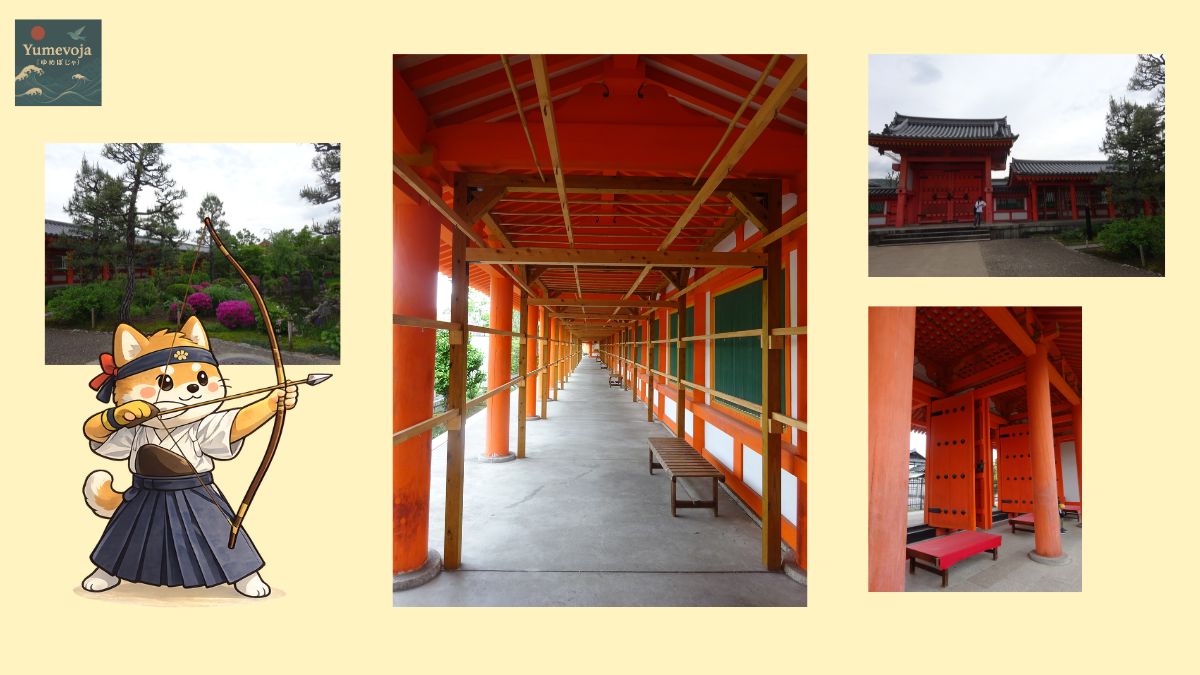
Sanjūsangen-dō is not only about the main hall.
As I walked through the garden,
a quiet Kyoto time flowed around me.
When I entered the main hall, the first thing I noticed was not a Buddhist statue.
It was a white, faded wall.
I could hear a group guide explaining.
“In the past, this wall was painted in vivid colors.”
Now, almost none of the colors remain.
Even so, a long stretch of time was engraved into that wall.
Meeting the Thousand-Armed Kannon from Behind
My encounter with the Thousand-Armed Kannon began from the back.
I entered from the side and slowly walked toward the front.
It felt like a slightly unusual way to visit.
Then, before my eyes, one thousand Kannon statues spread out.
I caught my breath.
It was overwhelming.
Beautiful.
But not only beautiful.
If I had been standing there completely alone, I might have felt a little afraid.
That was how powerful their presence was.
For a very long time, this place must have received people’s worries and prayers.
Illness.
Family.
Work.
War.
Farewell.
Even as times change, the worries people carry may not change very much.
With those thoughts in mind, I looked up at the Thousand-Armed Kannon.
At each bay of the hall, different Buddhist statues were displayed.
In front of the Ashura statue, which my father had loved, my feet stopped naturally.
Within the great flow of history, my own family memories overlapped.
It was that kind of moment.
One-Yen Coins Reminded Me of the Pilgrimage
There was an offering box at each bay.
I walked forward, placing one-yen coins one by one into the boxes.
They were coins I had carried for my Shikoku pilgrimage.
On the pilgrimage, every temple has offering boxes.
When you walk from temple to temple, there are far more of them than I had expected.
Feeling a little apologetic, I had prayed with one-yen coins.
The one-yen coins I had carried in the small drawstring pouch I received during my very first osettai offering were now useful again in Kyoto.
👉 🕯️ Solo Shikoku Pilgrimage | My First Osettai: One-Yen Coins and Memories in a Small Drawstring Pouch
I placed a one-yen coin in the box,
put my hands together,
and walked on.
That repeated motion felt nostalgic.
It felt as if my paused pilgrimage had started moving again, just a little.
The statues begin with Fūjin, the Wind God, and end with Raijin, the Thunder God.
Awe toward nature.
The prayers of people.
Walking between them, I felt as if I were inside the long history of Japan.
May Japan remain peaceful forever.
That prayer naturally came to mind.
My Father’s Watch and My Mother’s Bracelet
As I walked with my hands together in prayer, I suddenly wished I had brought Buddhist prayer beads.
Instead, I took out my mother’s bracelet and my father’s wristwatch from my bag.
They were keepsakes.
During my pilgrimage, I had always worn them.
I put them on my wrist for the first time in a long while.
The watch was still working.
Seeing that made me a little happy.
Even without prayer beads,
I felt as if my father and mother were walking with me.
Learning About Tōshiya
Behind the Thousand-Armed Kannon, there was an exhibition about Tōshiya.
Tōshiya is an archery event held under the long eaves of Sanjūsangen-dō.
During the Edo period, an event called Ōyakazu was held here, in which skilled archers attempted to shoot arrows across the full length of the hall, about 120 meters from one end to the other.
Even today, on Coming of Age Day, the National Archery Tournament for new adults is held here, continuing as one of the representative events of Sanjūsangen-dō.
My older brother began kyudo when he was a student, and he still continues it today.
I’m sure that if he came here, he would see a different landscape than I did.
Even in the same place, what remains in the heart differs from person to person.
Thinking about that, I continued through the exhibition.
A Gentle Kyoto Moment
On this day, I heard French often.
I couldn’t understand what was being said.
But just hearing it made me feel a little happy.
In front of the shop, two children from overseas were playing happily on an indoor slope.
Well, at that age, a slope is probably more fun than Kannon statues.
Haha.
It was not crowded at that moment, so no one scolded them.
A calm atmosphere drifted through the space.
However, although this slope was covered with carpet, the surface was quite smooth and more slippery than I expected.
I was a little surprised when I walked on it myself.
It may be better to watch your step.
Looking for a Single Arrow
I decided to walk behind the main hall.
There were very few visitors there.
It was remarkably quiet.
Then, an elderly visitor with a camera around his neck spoke to me.
“There’s an arrow stuck up there. Go and take a look.”
“Really? Where?”
I walked back and forth, looking carefully beneath the eaves.
I couldn’t find anything that looked like it.
Just as I was about to give up,
I finally saw it.
A single arrow remained lodged beneath the eaves.
I was told it had missed its target during a Tōshiya archery event.
“I found it.”
I couldn’t help smiling.
If that person hadn’t told me about it,
I would have walked right past without ever noticing it.
Finding that single arrow made the history I had just learned in the exhibition feel much more real.
This is why I enjoy traveling.
Sometimes, the smallest encounters become the most memorable ones.
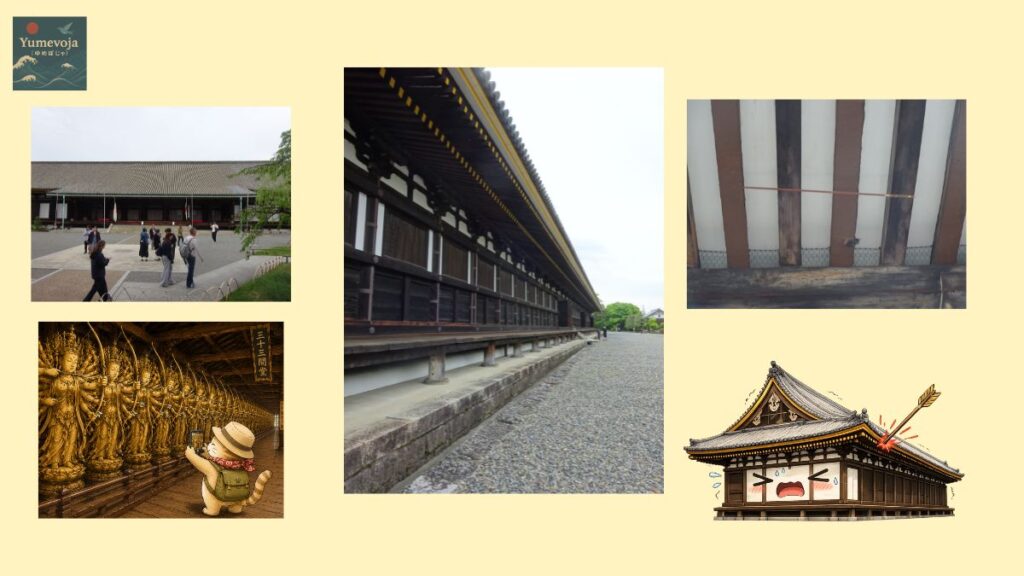
There was another discovery behind the building.
Thanks to a chance encounter,
I found another side of Sanjūsangen-dō.
Leaving Sanjūsangen-dō
The restrooms were modern and exceptionally clean.
If you’re planning to continue sightseeing afterward, it’s a convenient place to stop first.
Well then.
Leaving Sanjūsangen-dō behind,
I began walking toward Tō-ji while looking for somewhere to have lunch.
It was already past noon.
Hopefully, I wouldn’t become a “lunch refugee.”
Haha.
The rain that had been forecast never came.
There were plenty of visitors.
Even so,
Sanjūsangen-dō was filled with a quiet sense of peace.
And on that day,
it wasn’t only my feet that began moving again.
The memories of my Shikoku pilgrimage had started to move as well.
As I stood praying in Kyoto,
I found myself wanting to walk through Shikoku once more.
Sanjūsangen-dō is more than a place to admire Buddhist statues.
It is a place that gently sets something still within your heart back into motion.
🗺 Walking Route
I have created a My Map of the route I walked that day.
It records my journey around Kyoto Station, from Sanjūsangen-dō to Tō-ji.
🍵 Related Article | Beauty & Taste
This was the lunch I enjoyed along the way.
A comforting Kyoto-style bowl of udon, whose gentle broth gave me fresh energy for the rest of my walk.
👉 🍵 Beauty & Taste| Duck Udon at Kamogawa Seimenjo – A Kyoto Bowl That Gave Me Energy for the Next Walk
🚶 Next Journey | Stopover Trip
After leaving Sanjūsangen-dō,
I walked to Tō-ji.
Inside the five-story pagoda,
I encountered more Buddhist statues.
Together with Tō-ji, a temple closely associated with Kūkai, and the peaceful Kanchi-in,
it became another day that reconnected me with the memories of my Shikoku pilgrimage.
👉🚉Stopover Journey|Walking from Kyoto Station to Tō-ji Temple: Discovering an Unexpected Side of Kyoto
👉 Related illustrations here
(Free to use)
▶︎ 🎨View illustration page
👉Choose Kyoto by mood.
▶︎☆View the Kyoto guide

Today’s bonus capsule!
✨ Gateway to the Shōwa Era
―The Sound of the Ticket Punch
The Showa era (1926–1989) was a time when modern technology and ideas began to transform everyday life in Japan.
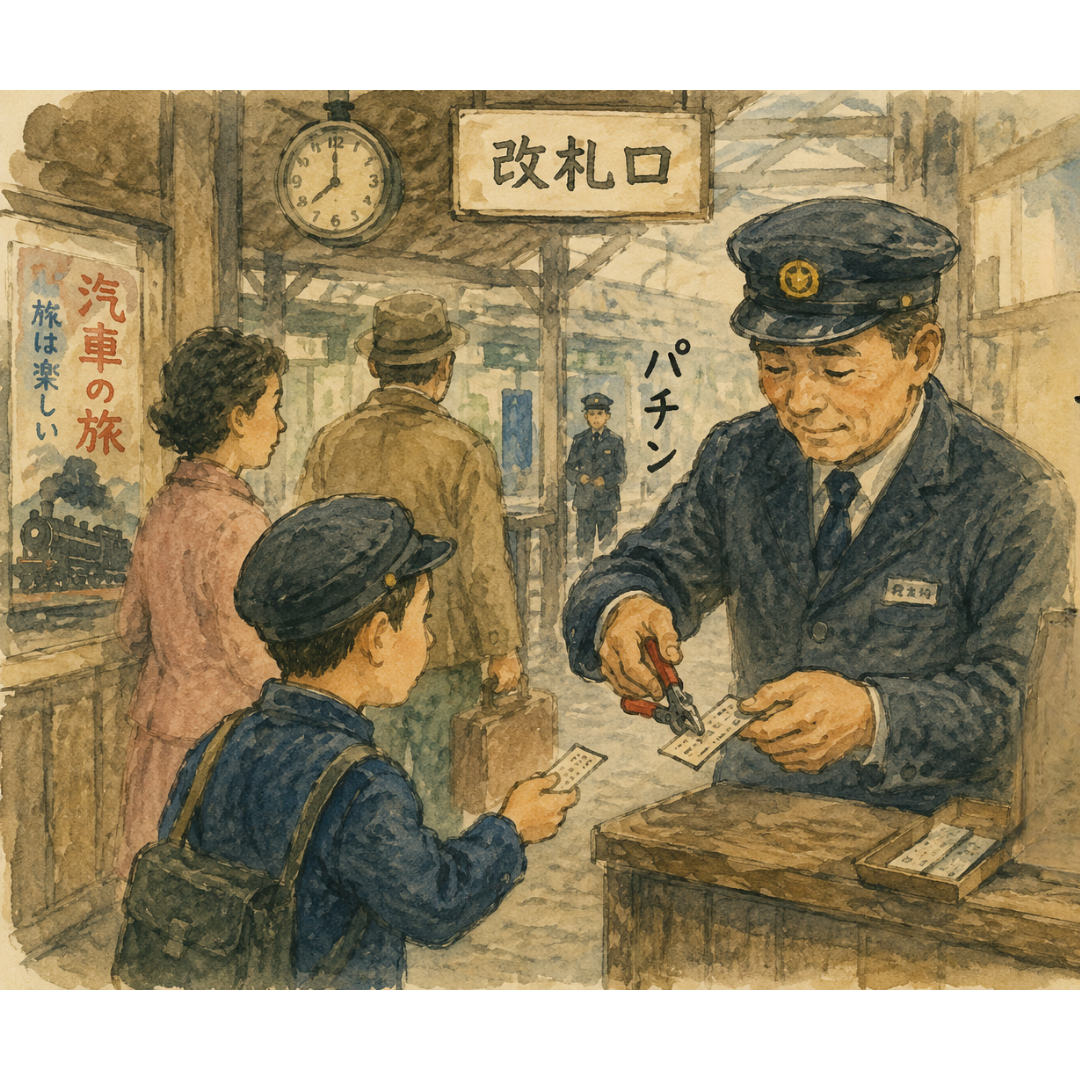
Today, we simply tap an IC card or a smartphone at the ticket gate.
But during Japan’s Showa era, station staff checked every paper ticket by hand with a ticket punch.
Click. Snip.
That familiar sound was part of every train journey.
Some station staff used the punch only when clipping tickets.
Others absentmindedly clicked it open and closed while waiting for the next passenger.
Each person seemed to have their own rhythm.
As a child, hearing that sound alone made me feel that my journey had begun.
Walking through Kyoto Station today, I suddenly found myself remembering the sound of those old ticket punches—a small memory from the Showa era that has quietly disappeared.