When I got married,
my mother prepared a tomesode, mourning kimono, and houmongi for me.
At the time,
I knew almost nothing about kimono.
“I don’t need all of this…”
I remember thinking that.
But my mother said,
“I don’t want anyone saying anything hurtful to you later.”
Perhaps today,
fewer people worry about such things.
Still, at the time,
there was a quiet expectation
to “properly prepare oneself” for weddings and family ceremonies.
My mother prepared the tomesode
with a women’s family crest.
Because making a tomesode takes time,
it seems that sometimes a kimono is prepared using the woman’s crest
before the groom’s family crest is decided.
The customs probably differ
depending on the family or region.
At the time, though,
I understood none of this.
I only felt guilty for causing so much trouble.
Back then,
I even attended a short kimono dressing class.
But between raising children and daily life,
the kimono slowly disappeared into the back of a chest drawer.
Many years passed.
After my children became independent,
I started learning kimono dressing again a year ago
from a beauty salon teacher.
And now,
my niece is getting married.
For the first time,
I will wear a tomesode.
Honestly,
I still lack confidence.
I do not want to inconvenience anyone,
so on the wedding day,
I plan to have a professional dress me.
I think that itself will also become a learning experience.
Recently,
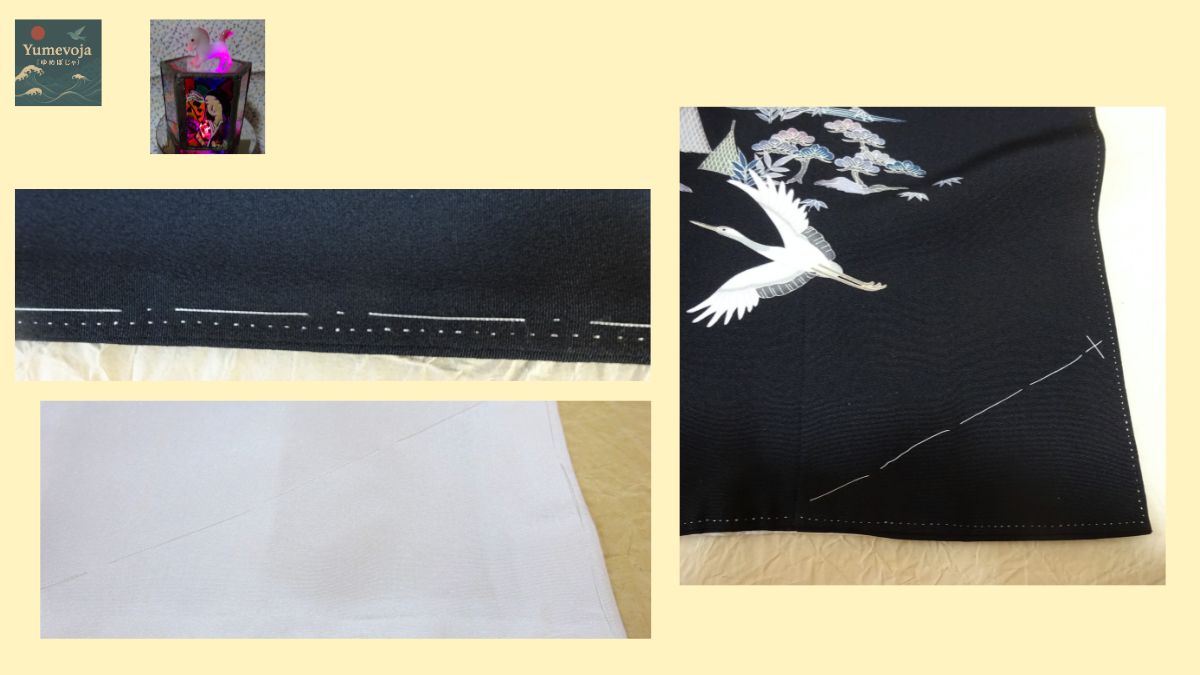
I began removing the temporary basting threads from the tomesode.
I thought it would be simple.
But it looked almost like Morse code.
-・-・-・-・-・・・-・-・-・-・-・・・
Small stopping stitches (・・・)
were added repeatedly
to stabilize the threads.
The fabric is delicate,
so I could not pull carelessly.
And there were far more places than I expected.
Each time I thought I had finished,
another section appeared.
Behind the quiet beauty of a tomesode,
there were layers of tiny, careful work.
I also removed the cover
protecting the family crest.
Until now,
I had intentionally left the temporary threads in place
while practicing dressing.
This was my first tomesode,
and I was still unfamiliar with it.
If I failed or damaged something during practice,
I wanted to avoid harming the kimono as much as possible.
A tomesode is considered
the highest formal kimono for married women,
often worn at family weddings.
Family crests appear on the back and sleeves,
making it feel less like ordinary clothing
and more like attire meant to “prepare one’s role.”
I have not even worn it yet.
And still,
simply removing the threads
made me feel the quiet weight of the culture.
I have already started practicing the dressing itself.
But that story
will be for another time.