From here, something quietly shifts
Visit date: March 11, 2026 (Wednesday)
After walking through Nanzen-ji,
my body felt slightly cold.
Up on the Sanmon gate, the wind had been strong.
Sitting there, the warmth slowly left my body.
Kyoto’s air is quiet—
but it is still cold.
After warming myself with a bowl of hot soba,
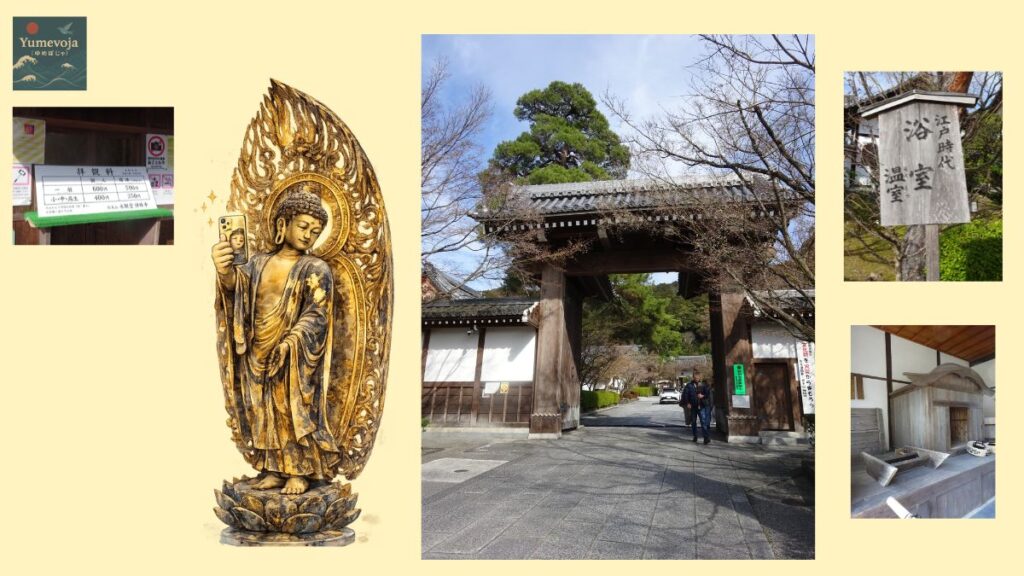
I headed to Eikando.
From Nanzen-ji to Eikando.
It’s an easy walk at a relaxed pace.
The route connects naturally as part of a sightseeing flow,
making it easy to continue on foot.
👉 Walking Nanzen-ji and the Aqueduct
🚉 Walking Nanzen-ji and the Aqueduct: A Quiet Kyoto Route from a Hidden Path
🧭 Highlights & Time
✔ Highlights of Eikando
Eikando has many points of interest,
and the grounds are quite spacious.
Garyōrō (covered corridor)
View from the Tahoto Pagoda
The “Mikaeri Amida” (Looking-Back Amida)
A circular layout connecting multiple buildings
You move through the temple step by step as you walk.
✔ Time required
From experience:
👉 About 1 to 1.5 hours
If you stop for photos,
it can take even longer.
It took more time than expected.
Larger than expected
The first impression after entering
was how large it felt.
Several buildings are connected,
and you follow a set path through them.
But as you continue walking,
a slight restlessness begins to build.
There is simply a lot to see.
A maze-like temple
The grounds feel almost like a maze.
Corridors stretch on,
stairs appear,
and lead into yet another building.
You step outside,
only to go back inside again.
Little by little,
your sense of direction fades.
Even though it is meant to be a quiet temple,
there is not always space to stop and pause.
The flow of people
On this day,
there seemed to be more international visitors than Japanese.
It is a quiet space,
but not completely silent.
There is movement—
the rhythm of a place people visit.
Toward Garyōrō
I made my way up the long covered corridor, Garyōrō.
Gradually, the elevation changes,
and the view of Kyoto begins to open.
Even here,
the maze-like feeling continues.
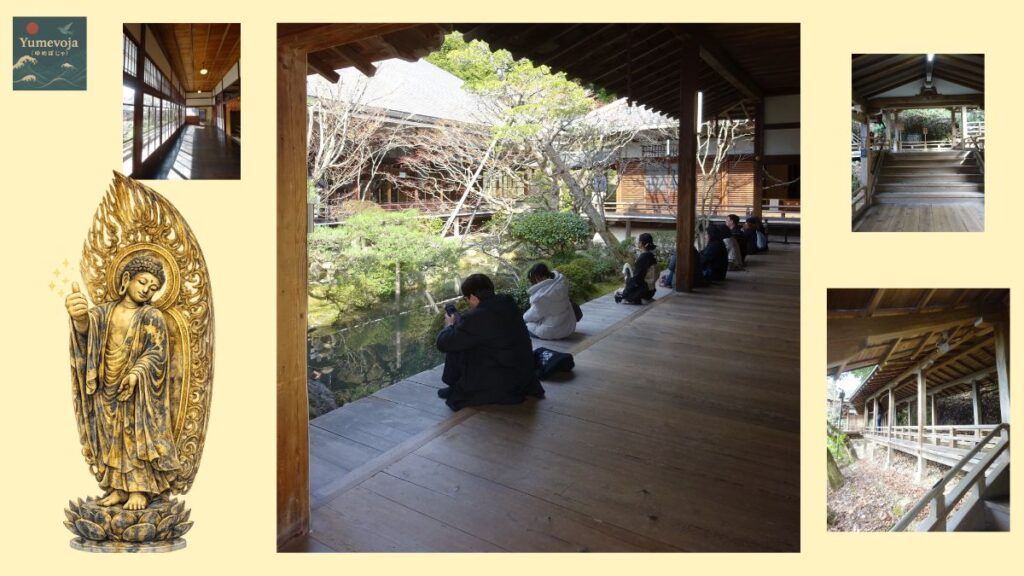
Pausing here feels just right
Toward the Tahoto Pagoda
Putting my shoes back on,
I headed toward the Tahoto Pagoda.
There were fewer people here,
and a sense of quiet returned.
The rooftops of Kyoto spread out below—
mostly gray and brown,
with almost no bright colors.
That, somehow, felt very Kyoto.
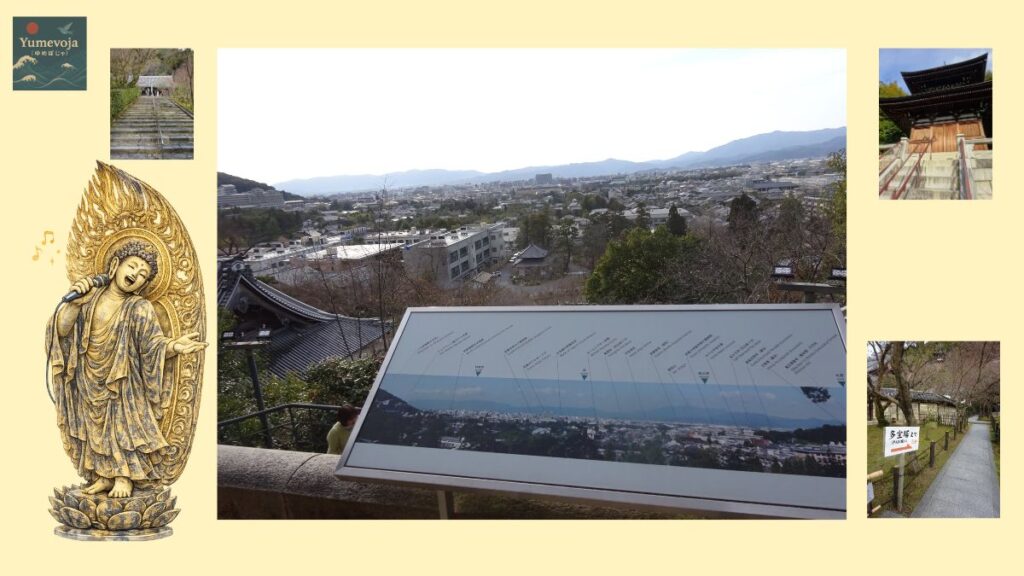
The higher you go, the farther you see
A memory of sound
At 4 o’clock, a bell rang.
It was the same sound I had heard
earlier along the Philosopher’s Path.
Was it from here?
Or from Nanzen-ji?
I walked toward the edge,
but never quite found the answer.
A corner of the grounds
Within the temple grounds,
there is also a kindergarten and a Benzaiten shrine.
When I approached to pray,
there was no offering box—
only coins placed directly on a platform.
The direction of the altar felt slightly unusual.
Something about it seemed different.
The end of the flow
The bell rang twice in quick succession at the end.
As I was leaving,
I made eye contact with the person closing the ticket booth.
We exchanged a small bow.
That simple moment
gently marked the end of the day.
Stepping outside
I stepped out,
walking while searching for my way back.
There were elegant houses,
and also buildings in disrepair.
Beyond the tourist area,
everyday life continues.
🍽 Ending
Still thinking I might grab something light to eat,
I kept walking.
But nothing came easily.
Before I knew it,
I was wandering again.
Eventually,
I found a place near Higashiyama Station and went in.
👉 🍵Dinner near Higashiyama Station: A Casual Meal at Cafe LCM in Kyoto
Choose Kyoto by mood.
👉 View the Kyoto guide

Today’s bonus capsule!
✨ Gateway to the Shōwa Era―Public Bath
The Showa era (1926–1989) was a time when modern technology and ideas began to transform everyday life in Japan.
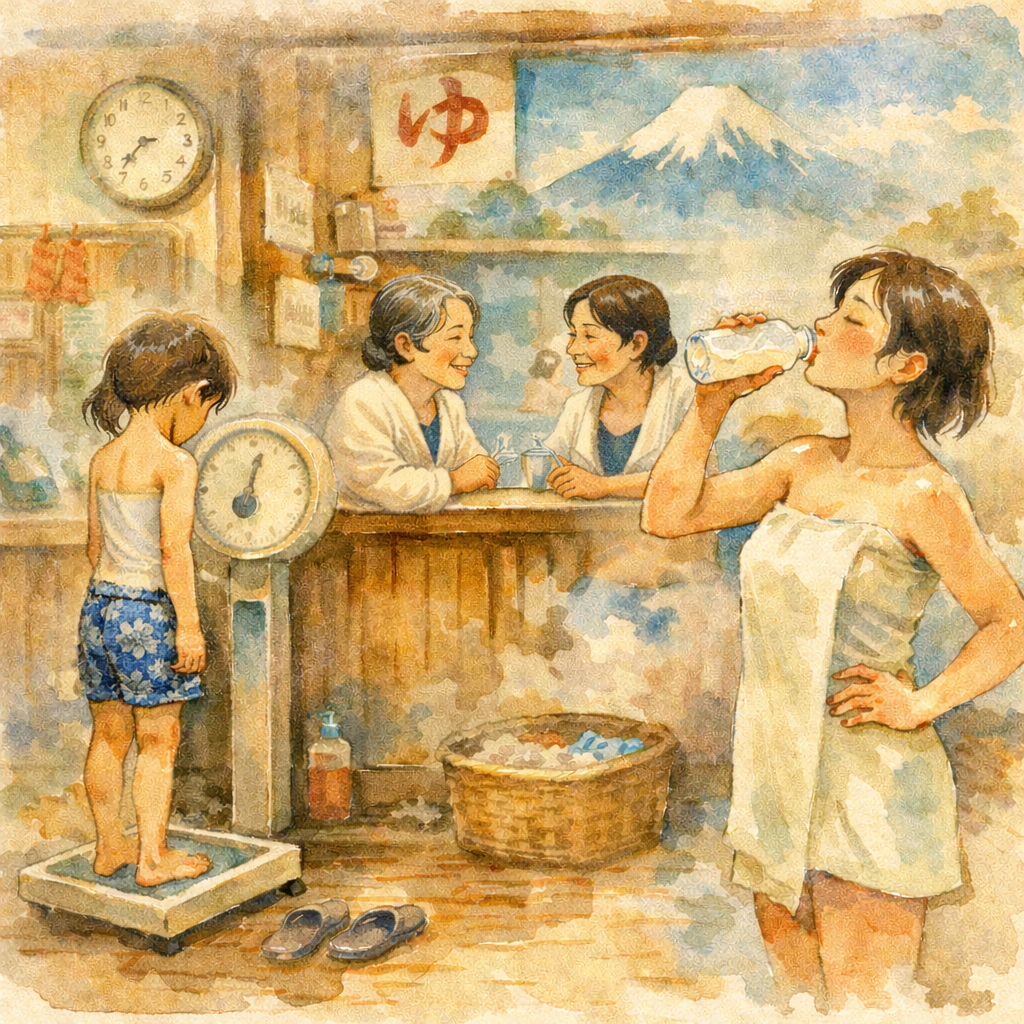
After a bath, stepping onto the scale with wet feet.
A small clank, and you stretch just a little taller.
At the bandai, adults whose names you don’t know laugh as if it’s natural.
“Cold today, isn’t it?”
That alone makes you feel you’re sharing the same moment.
A bottle of milk, hand on your hip.
The cold slips quietly deep into your body.
In that place,
it wasn’t just the water that was warm—
it was people.
Now, it has become a place to quietly reset.
Fewer words, time sinking inward.
The steam is the same.
But what it warms
has changed, just a little.