Date visited: August 5, 2026 (Wednesday)
Weather: Sunny and extremely hot
Steps: 15,574
This was my summer holiday.
Well, technically, I only had this one day off.
I spent the morning working on my blog.
After getting a little writing done, I boarded a train in the early afternoon.
Today’s stop on my Osaka Loop Line journey was Kyobashi Station.
I’m saving Osaka Castle for the next stop, Osakajokoen Station.
So what would I find in Kyobashi?
As usual, I hadn’t done much research beforehand.
For now, I decided to simply get off the train and start walking.
The first surprise came as soon as I stepped off the train.
There were places to eat right on the platform.
It felt completely different from Sakuranomiya Station, my previous stop.
Kyobashi is a major station where JR, Keihan, and the subway all meet.
Even the station restrooms were large and seemed relatively modern.
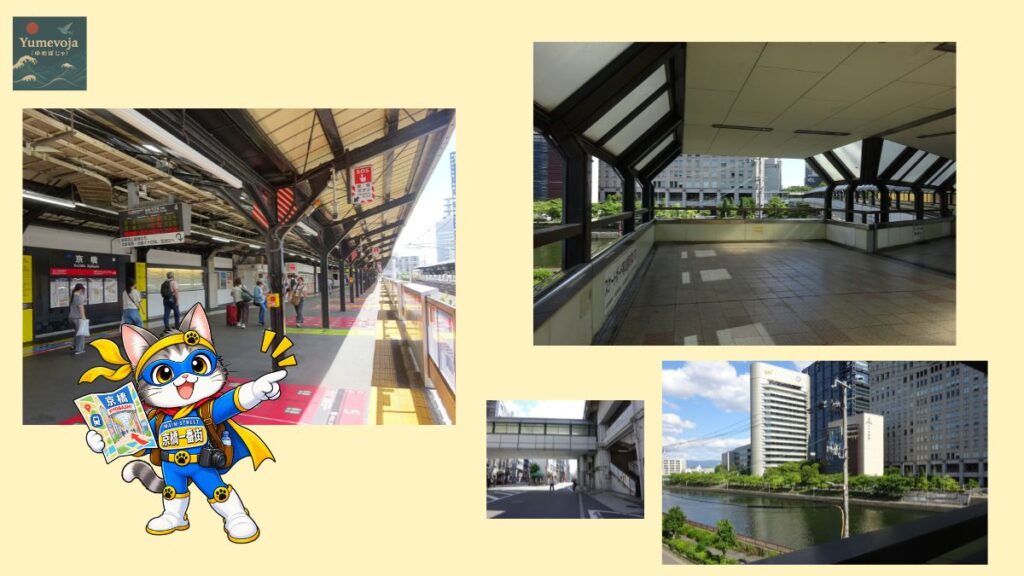
Leaving JR Kyobashi Station and walking toward Osaka Business Park.
Once I moved away from the bustle around the station,
the scenery gradually began to change.
First, lunch.
A short walk from the station, I stepped into an old-fashioned local café.
It was almost 2 p.m., but nearly every seat was occupied.
Rather than being somewhere for tourists, it felt as though I had briefly stepped into the everyday life of the neighborhood.
I had a set meal with a croquette and menchi-katsu, a Japanese-style minced-meat cutlet, and took a short break.
👉 I write more about the café and lunch in my “Beauty & Taste” series.
▶︎ Beauty & Taste | Kissa Megumi in Kyobashi — A Glimpse of Everyday Osaka
After lunch, I walked around Keihan Mall.
The station complex is filled with the kinds of shops you might find all over Japan.
Convenient and clean.
But I still hadn’t found the little thrill of a detour I was looking for today.
At the café tucked away on a side street, I had felt Osaka much more strongly.
So, let’s walk a little farther.
I headed east from the station.
And suddenly, the city changed completely.
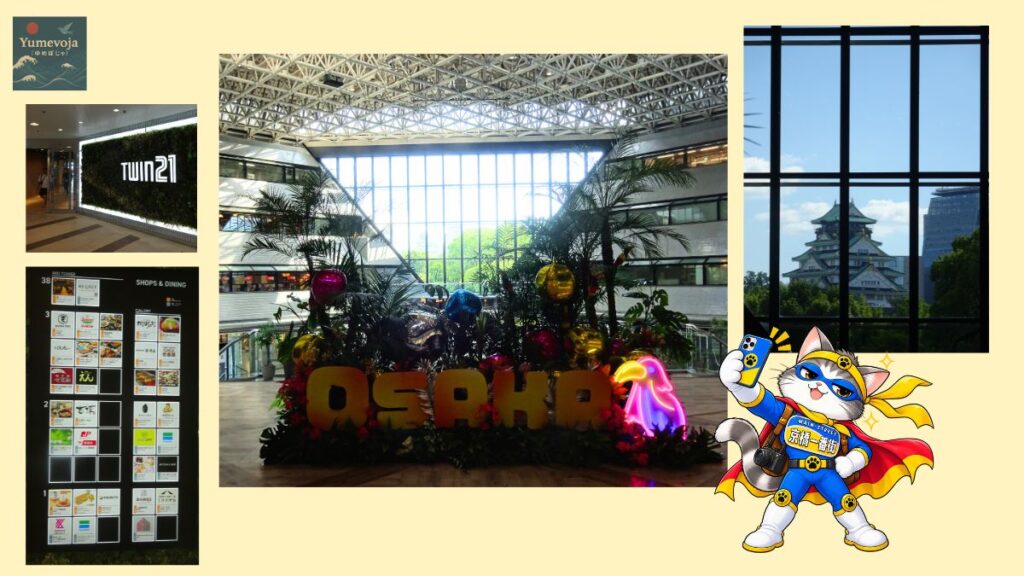
Into TWIN21 at Osaka Business Park.
I walked through its huge atrium,
with Osaka Castle visible beyond the windows.
It was another side of Kyobashi,
completely different from the lively streets around the station.
High-rise buildings.
Wide sidewalks.
A business district.
I had entered an area known as Osaka Business Park, or OBP.
It felt almost as though I had arrived in an entirely different city from the Kyobashi I had just left behind.
I went inside TWIN21.
Through the windows, I could see Osaka Castle.
It was right there.
But not today.
I’m saving it for my next stop, Osakajokoen Station.
It was Wednesday, and I thought I might visit the Sanno Art Museum.
…Closed.
All right, then.
Was there anything else around here?
I kept walking.
Hmm.
There were plenty of restaurants and offices.
There were also stylish-looking places that seemed easy to walk into on your own.
Finding somewhere for dinner certainly wouldn’t be a problem.
But the kind of unexpected detour I was looking for today was proving difficult to find.
It was hot.
I was starting to get tired.
Inside a Panasonic building, I found some chairs in an air-conditioned space.
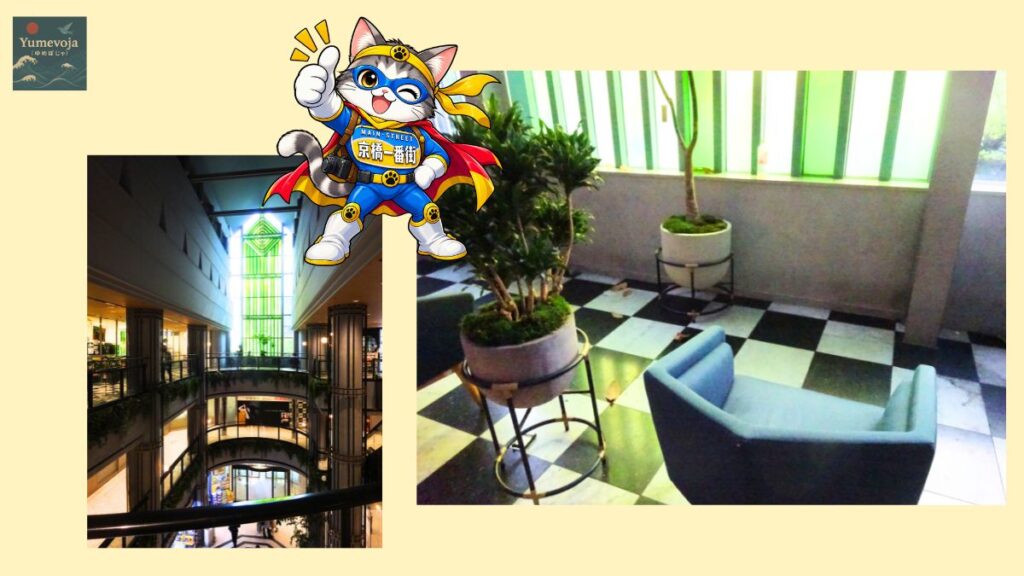
A quiet space I found inside a building while walking.
Outside, Osaka was baking in the summer heat.
Step indoors, though, and it was another world.
This became a small resting point during my Kyobashi walk.
I sat there for a while.
Little by little, my energy returned.
Time to head back toward Kyobashi Station.
I retraced my steps.
A road you have already walked once somehow becomes a “road you know.”
The covered elevated walkway around the third-floor level was especially welcome on such a brutally hot day.
Then I continued to the other side of Kyobashi Station.
That was where I found COMS GARDEN.
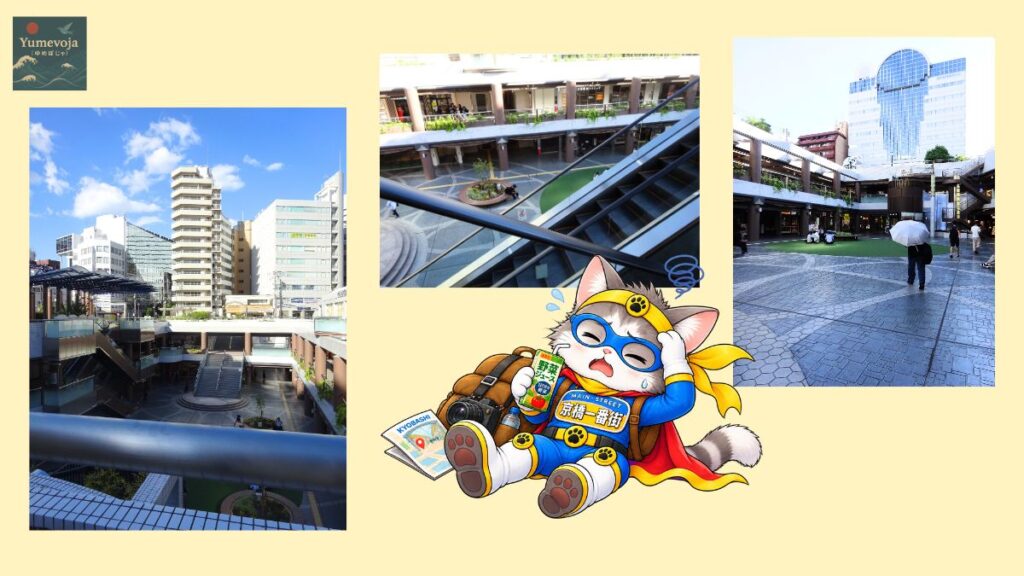
While walking through Kyobashi,
I suddenly came across the huge sunken space of COMS GARDEN.
“A giant hole underground?”
It was one of those unexpected Kyobashi sights that made me stop in my tracks.
At first, I thought it was a park.
But when I got closer, I realized that the ground opened into a huge space below, with shops lining the lower level.
“What on earth is this?”
I drank the second carton of vegetable juice I had brought with me.
After walking through the heat, I needed another break.
Then, once I had finished it, I discovered another small problem.
I couldn’t find anywhere to throw away the empty carton.
Hahaha.
Osaka Metro’s Kyobashi Station was also down there.
I kept walking and eventually emerged back at street level.
And this time, I found myself in a hotel district.
Looking more closely, I realized that several of them were love hotels.
A few minutes earlier, I had been surrounded by high-rise office buildings.
Walk for a few minutes, and once again the city had changed its face.
What kind of place is this?
I continued walking and finally found the shopping arcade.
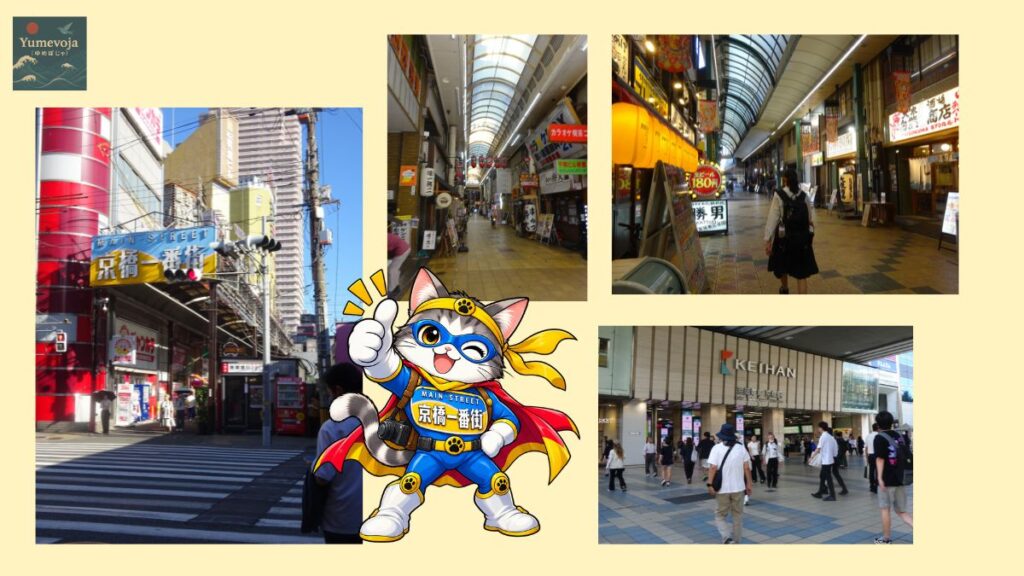
From the business district,
suddenly I was back in a retro shopping arcade.
After walking through the many faces of Kyobashi,
I eventually returned to busy Keihan Kyobashi Station,
where people were constantly coming and going.
Apparently, I had taken quite a detour to get here.
The shopping arcade had a retro feel.
Quite a few shutters were down that day, though.
Perhaps Wednesday was their regular day off. Perhaps they hadn’t opened yet. Or perhaps there was another reason.
I don’t know.
As I walked, I also noticed how many yakiniku restaurants there were.
Then came 5 p.m.
The atmosphere changed.
Restaurants began opening, and more people appeared on the streets.
The closer I got to the station, the livelier the arcade became.
Izakaya lights flickered on, and I could hear staff calling out to passersby.
Even along the same shopping street, the atmosphere near the station was completely different from the quieter stretches farther away.
Apparently, Kyobashi changes not only from place to place, but from hour to hour.
It was probably time for dinner.
I headed back toward Keihan Mall.
Looking at the directory, I found plenty of restaurants.
One caught my attention.
Let’s go.
…And that was when the maze began.
I looked at the map, but I couldn’t figure out where I was.
To make things more confusing, the Keihan Mall directory also listed restaurants in the neighboring building, the “Hotel Building.”
Since they appeared on the restaurant directory, I naturally assumed they were somewhere inside the building I was already in.
But I couldn’t find the restaurant.
“Where is it?”
I looked at the map again.
“Where am I?”
And then:
“How do I even get there?”
Round and round I went.
The Keihan Mall maze had me completely defeated.
At one point, I spotted a group of three men who also seemed to be searching for a restaurant.
Maybe I wasn’t the only one who was lost?
That made me feel slightly better.
Hahaha.
Eventually, I gave up trying to reach it from the confusing upper floors.
I went outside.
Then I approached the hotel building again from the ground floor.
And finally, there it was.
“Found you.”
But as I stood there looking at the menu, something began to feel slightly off.
The food looked good.
But somehow, it didn’t quite match the Kyobashi I had been walking through all day.
I had spent the day wandering through ordinary, everyday Kyobashi.
I wanted to end it somewhere that had genuinely made me curious.
Then I remembered.
There had been a place in TWIN21 that had caught my attention earlier.
A restaurant where miso soup was the star of the meal.
I liked the idea.
“Let’s go back there.”
Back outside again.
I retraced the elevated walkway toward OBP.
By now, people were beginning to leave work for the day.
Streams of office workers were walking toward Kyobashi Station.
I was heading in exactly the opposite direction.
One after another, people who had finished another day’s work disappeared toward the station.
Some of them looked a little tired.
Watching them, a thought suddenly crossed my mind.
Thank you for keeping Japan’s economy running today.
I was off today.
But tomorrow, I would be back at work too.
Walking against the flow of commuters, I returned to TWIN21.
Dinner tonight was at MI SO UP.
The slightly unconventional idea of making miso soup the centerpiece of a meal amused me.
👉 I write more about my dinner at MI SO UP in “Beauty & Taste.”
▶︎ Beauty & Taste| Miso Soup Takes Center Stage at MI SO UP in Kyobashi
Dinner and a draft beer finally brought me back to life.
All right.
Time to go home.
…If the story had ended there, this would have been a peaceful little stop along the way.
But one final challenge was waiting for me.
JR Kyobashi Station.
The toughest opponent of the entire day.
I wanted to get to Osaka Station.
But when I looked at the departure board, I saw all kinds of destinations.
Toward Wakayama.
Toward Universal City.
And several others.
But there was one thing I couldn’t find:
“Osaka.”
Which train was I supposed to take?
Without a good sense of the local rail network, I had no idea.
A train arrived.
I let it go.
Another arrived.
I let that one go too.
“This one feels like it might go to Osaka.”
In the end, I chose one almost entirely on instinct and got aboard.
I made it safely to Osaka Station.
But something still bothered me.
“So…which trains could I actually have taken?”
I spent much of the ride home looking up Kyobashi Station.
Eventually, I began to understand how it worked.
From Platform 3, where I had been waiting, trains heading toward Osaka stop at Osaka Station.
The final destinations displayed may vary, but the trains pass through Osaka Station before continuing in their respective directions.
In other words:
I had watched several perfectly good trains leave without me.
Noooo. 🫨
And Kyobashi has trains leaving from other platforms that head onward without passing through Osaka Station.
Apparently, there are routes designed to bypass crowded Osaka Station altogether.
What kind of station is this?
For a beginner like me, simply memorizing “this direction means this platform” isn’t quite enough.
Kyobashi Station is a formidable opponent.
Train services and platform assignments may change. Please check the latest information from JR West before traveling.
I had expected this to be an easy little stop.
Osaka Castle was at the next station.
This wasn’t supposed to be a day of famous tourist attractions.
And yet, once I started walking, I found:
a business district,
a retro shopping arcade,
an underground commercial area,
a hotel district,
and a city that changed its face again as evening arrived.
Keihan Mall trapped me in its maze.
Miso soup and beer restored my energy.
And just when I thought,
“Time to go home,”
the final boss appeared:
JR Kyobashi Station.
I wouldn’t exactly say I conquered it.
I barely escaped.
Hahaha.
15,574 steps.
Since I only started walking after lunch and also used trains along the way, the number itself wasn’t particularly remarkable.
But it definitely includes all those extra laps around the maze.
Apparently, you don’t need to visit Universal Studios Japan to burn through your energy.
Kyobashi did the job just fine.
Still, I was a little frustrated.
If I got lost here, perhaps someone visiting Kyobashi for the first time might get confused in exactly the same places.
Travel writing doesn’t have to be only about introducing tourist attractions.
Sometimes,
“This part was confusing.”
might be useful to someone too.
So later,
for the people who come after me,
I decided to leave behind a small map.
Precisely because these were the places where I struggled, I wanted to make it as intuitive as possible.
Next time, not as the lost traveler—
but as the mapmaker.
One station at a time around the Osaka Loop Line.
By the time I complete the full circle, will I qualify as an Osaka expert?
Well… maybe not.
There is still so much of Osaka I don’t know.
I’ll take it one step at a time.
Kyobashi Station Quick Guide
| Platform | Line / Main direction | Osaka Station? | Tip for travelers |
|---|---|---|---|
| 1 | JR Tozai Line / Kitashinchi & Amagasaki | ✕ | Does not pass through Osaka Station |
| 2 | Gakkentoshi Line / Shijonawate & Matsuiyamate | ✕ | Opposite direction from Osaka Station |
| 3 | Osaka Loop Line (Inner Loop) / Osaka & Nishikujo | ◎ | The main platform for Osaka Station |
| 3 | Direct to JR Yumesaki Line / Universal City | ◎ | Stops at Osaka Station |
| 3 | Kansai Airport Rapid / Kishuji Rapid | ◎ | Stops at Osaka Station, even though these are rapid services |
| 3 | Services toward Nara, etc. | ◎* | If the train runs via Osaka Station, it stops there |
| 4 | Osaka Loop Line (Outer Loop) / Tsuruhashi & Tennoji | △ | Loop services can eventually reach Osaka, but it is a long way around |
*Destinations and routes vary by train. Check the departure board before boarding.
Trying to get back to Osaka Station?
Platform 3 is the key.
Don’t worry if “Osaka” isn’t shown as the final destination. Some trains continue much farther, but still stop at Osaka Station. Rapid services such as the Kansai Airport Rapid and Kishuji Rapid also stop at Osaka when they run via the station.
For travelers using a JR pass, getting back to Osaka Station can make the next part of the journey easier. From there, you can continue toward Kyoto, or transfer to Shin-Osaka for the Shinkansen.
🗺️ Route I Walked This Time
I’ve marked the route I walked and the places I stopped at on the YUMEVOJA My Map.
👉 Related illustrations here
(Free to use)
▶︎ 🎨View illustration page
👉Choose Osaka by station.
▶︎☆View the Osaka Loop Line Guide
👉How about taking a slow walk through Kyoto today?
▶︎☆View the Kyoto Guide
Today’s bonus capsule!
✨ Gateway to the Shōwa Era
―Use It or Keep It? The Telephone Card
The Showa era (1926–1989) was a time when modern technology and ideas began to transform everyday life in Japan.
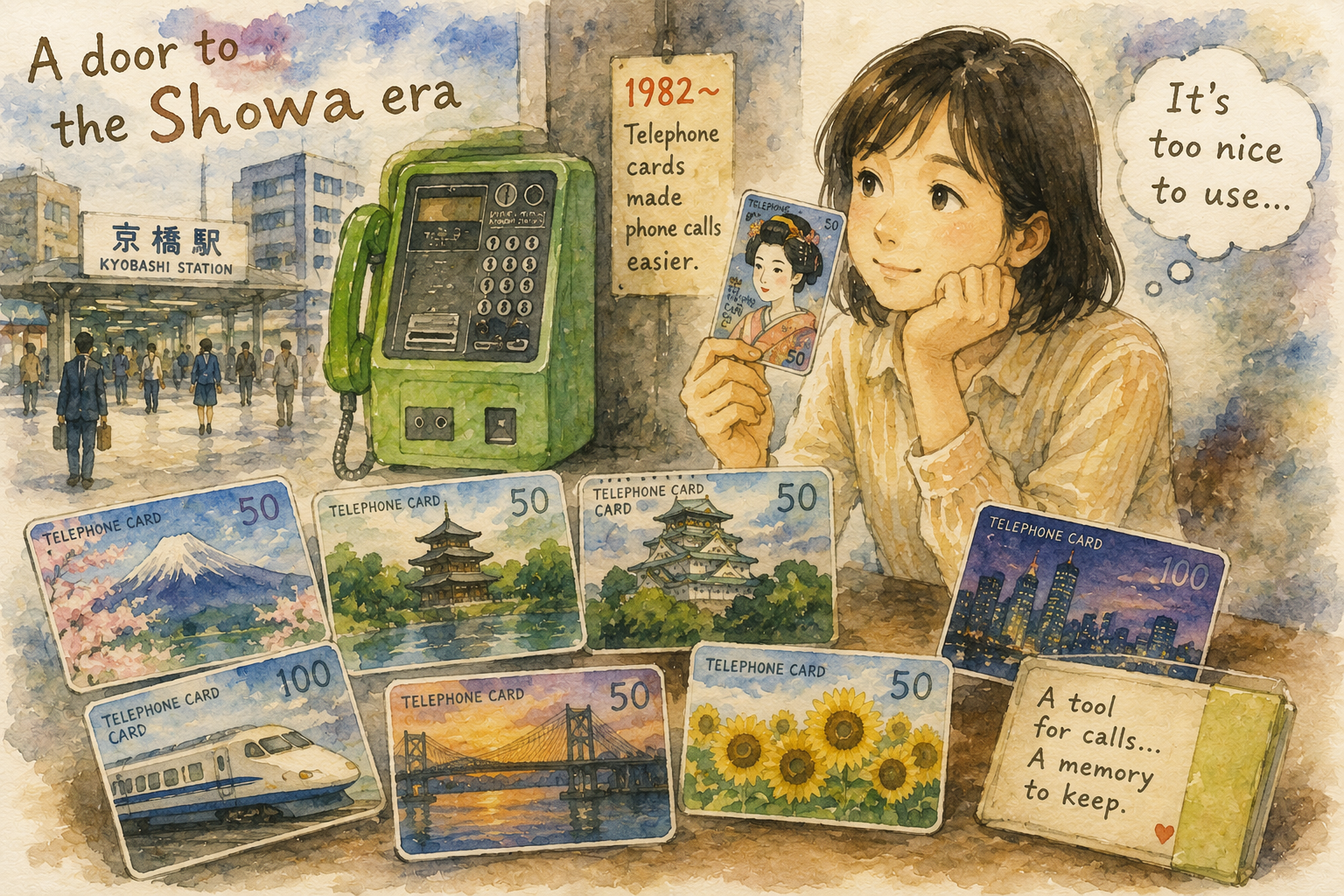
In 1982, telephone cards appeared in Japan along with card-operated public phones.
They were convenient: you could simply insert a card to make a call without carrying coins.
Before long, cards with all kinds of designs appeared.
Some featured scenes from tourist destinations, turning a practical tool for making phone calls into a small souvenir as well.
But then came a dilemma when you found a favorite design.
Every time you used the card, its remaining credit went down.
You bought it to make phone calls, yet found yourself thinking,
“It’s too nice to use.”
Something created as a convenient tool ended up being carefully put away and never used.
Showa-era Japan had little contradictions like that, too.