Stage 4–1 | July 19, 2024
Using My Paid Leave for the Shikoku Pilgrimage
One of the reasons I began the Shikoku Pilgrimage was a change of jobs.
Before starting my new job, I had about fourteen days of paid leave remaining.
I wanted to make good use of this rare stretch of time off.
That was when I thought of the Shikoku Pilgrimage, something I had been interested in for some time.
However, I did not know whether I could suddenly walk for several days in a row.
So, while I was still working at my previous job, I tried completing several short sections of the pilgrimage.
Up to Episode 5, each section was completed during my days off while I was still employed.
After walking several times, I began to think:
“I might be able to do this.”
Then my paid leave began. This time, I decided to stay in Ehime Prefecture for six nights and continue the pilgrimage for seven consecutive days.
I did not use all of my paid leave for the pilgrimage.
I also had some matters to attend to at my next workplace, so these seven days were the only time I actually spent on the pilgrimage.
Postponing Kochi and Heading to Ehime
The 88 temples of the Shikoku Pilgrimage are normally visited in the following order:
Tokushima, Kochi, Ehime and Kagawa prefectures.
Having finished the section in Tokushima, I should have headed to Kochi next.
However, traveling through Kochi on foot and by public transportation is not easy.
The distances between some temples are so long that even after several days of travel, you may still be on the road without reaching the next temple.
I did not want to complete the entire pilgrimage only by car. I wanted to walk as much as possible.
But if I insisted on walking every part of the route, continuing the journey itself would become difficult.
So, as I had done with other challenging sections, I decided to postpone Kochi for the time being.
I did not have to follow the numerical order.
I could begin with the places that were manageable for me now.
And so, I chose Ehime Prefecture as my next destination.
Day 1 | July 19, 2024
For this trip, I stayed at the Toyoko Inn in Matsuyama Ichibancho.
I would spend six nights there while visiting temples throughout Ehime Prefecture.
On the first day, I left home early in the morning and drove to Imabari Station.
Taking into account the travel time to Ehime and the time needed to find parking, I chose a half-day walking route between two railway stations that was featured in my guidebook.
🗺️ Today’s Route
The plan for the day was:
Imabari Station
↓
Take the train to Onishi Station
↓
Temple 54, Enmeiji
↓
Temple 55, Nankobo
↓
Imabari Castle
↓
Imabari Station
Depending on walking speed and the time spent at each temple, walking pilgrims may be able to visit Temples 54 through 59 in a single day.
However, the guidebook I was using was designed for a more leisurely journey.
It divided this section into two days. The plan for the first day was to visit Temples 54 and 55, then go sightseeing at Imabari Castle.
I also had to travel all the way to Ehime that day.
Rather than trying to do too much, I decided to follow the guidebook’s plan.
The Journey Begins with a Search for Parking
I had originally planned to leave my car at Imabari Station East Parking Lot No. 1.
The fee was ¥500 per day.
However, when I arrived, the parking lot was full.
There is no way to know whether a space will be available until you get there.
When completing the pilgrimage in separate stages using a combination of public transportation and walking, finding somewhere to leave the car is always a challenge.
Once again, my journey began with a search for parking.
Parking at a Hot Spring Facility
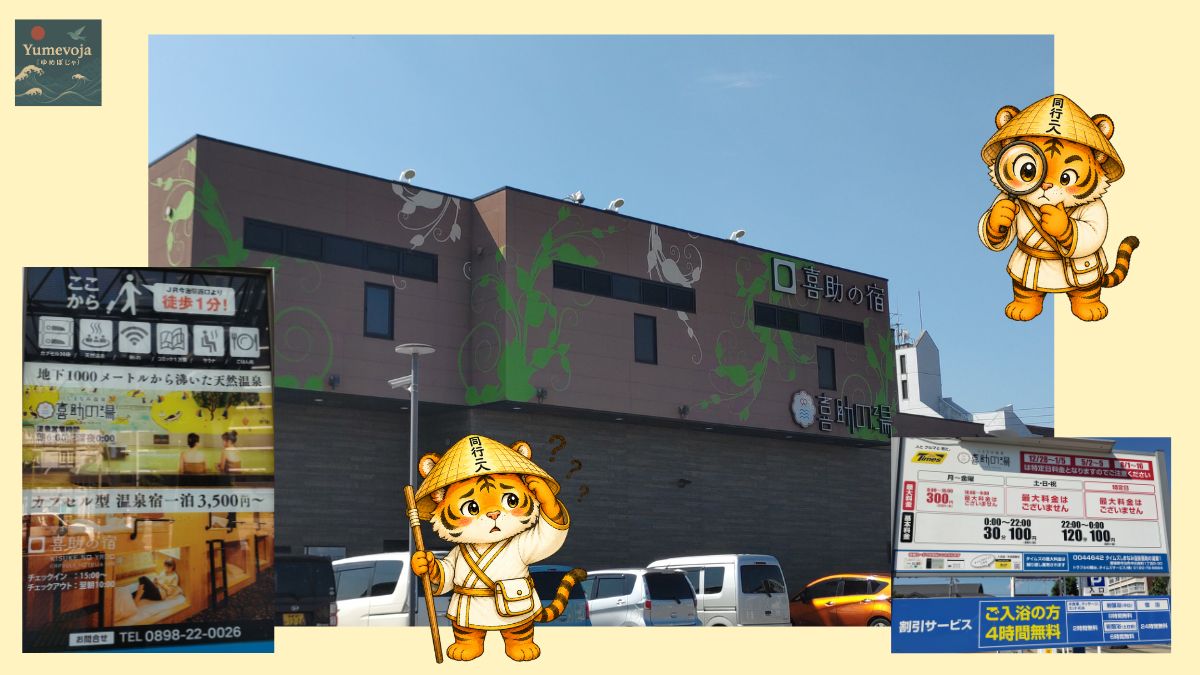
The parking lot near Imabari Station was full,
so I left my car beside Shimanami Onsen Kisuke no Yu.
The weekday rate was ¥300 per day,
while weekends and public holidays followed a time-based rate.
I searched nearby and found the parking lot at Kisuke no Yu.
👉🌐Official website — Kisuke no Yu
The parking fee was ¥300 per day on weekdays.
At other times, it cost ¥100 for every 30 minutes.
The parking information also stated that overnight accommodation was available at the facility and that parking was free for guests.
I should have stayed here for several nights.
I had assumed that a business hotel was the only option for my accommodation.
If I had researched more carefully, I would have discovered another possibility.
At last, I secured a place for my car. I then boarded a train at Imabari Station and traveled to Onishi Station.
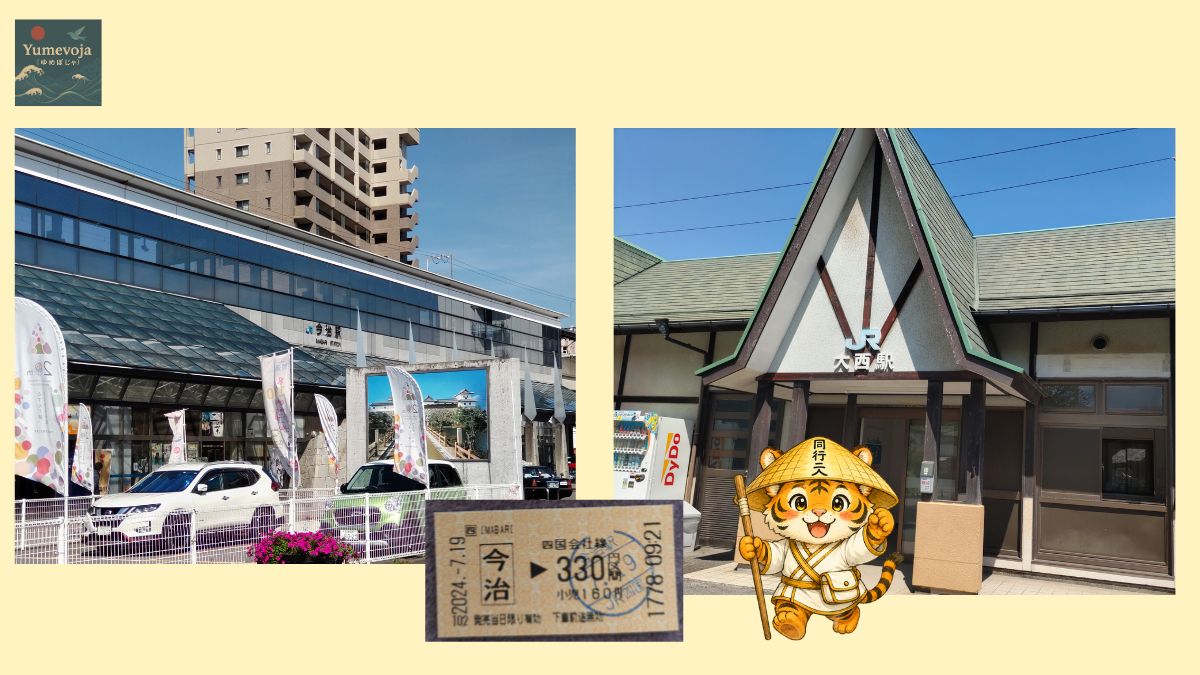
I bought a ¥330 ticket at Imabari Station
and took the JR Yosan Line to Onishi Station.
Unable to continue visiting the temples in numerical order,
I made a major change of route from Tokushima to Ehime
and headed for Temple 54, Enmeiji.
The Dodecamin That Was Supposed to Give Me Energy
It was a hot day.
Hoping for an energy boost, I bought a bottle of Dodecamin Strong. Instead of drinking it immediately, I put it in my backpack and continued walking.
When I opened it a little later, the drink burst out of the bottle.
My trousers were soaked.
It was supposed to give me energy, but instead, the first day of my journey had already turned into a rather undignified mess.
A Call from Work During My Paid Leave
Even though I was on the pilgrimage, I had not yet completely left my previous workplace behind.
I received a call from work during my paid leave.
I hurried to take off my jacket, but the fabric was stuck to my sweaty arms and would not slide off easily.
In my haste, I tore one of the sleeves.
First my trousers were soaked with Dodecamin, and now my jacket sleeve was torn.
My seven-day pilgrimage was off to a very hectic start.
From Temple 54, Enmeiji, to Temple 55, Nankobo
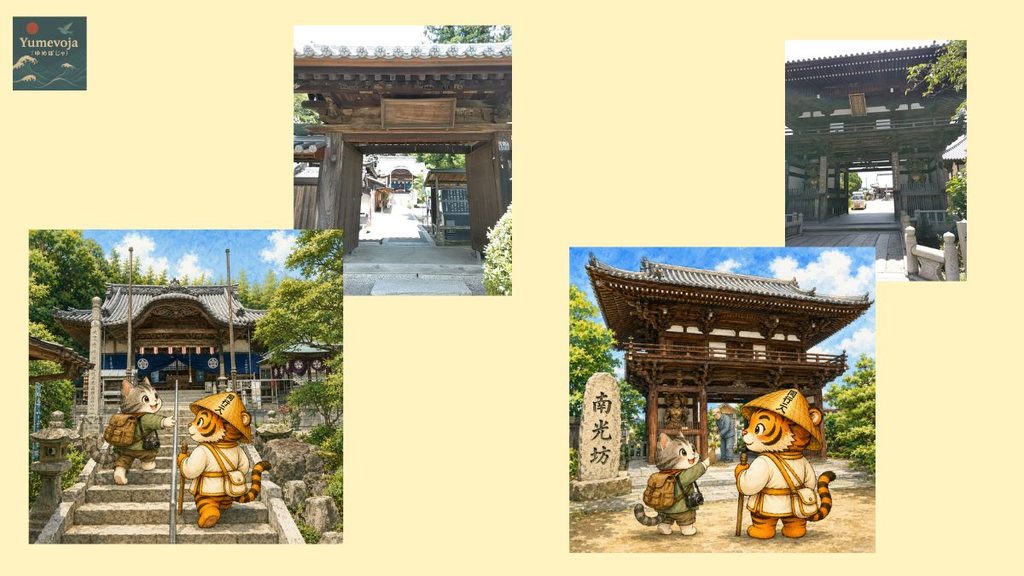
From Onishi Station, I walked to Temple 54, Enmeiji,
and then continued to Temple 55, Nankobo, in central Imabari.
These were the first two temples of this stage of my pilgrimage through Ehime.
From Onishi Station, I walked toward Temple 54, Enmeiji.
(🌐Official website — Temple 54, Enmeiji)
At the time, I did not take as many photographs as I do now.
Only one photograph of Enmeiji remains.
After praying and receiving the temple stamp, I headed for Temple 55, Nankobo.
(🌐Official website — Temple 55, Nankobo)
Only one photograph of Nankobo remains as well.
However, I gradually began to remember events that were never captured in those photographs.
“Please Make Sure You Drink Enough”
While I was resting on a bench at Nankobo, an elderly man who had been sweeping the grounds spoke to me.
“Please make sure you drink enough so that you don’t suffer from heatstroke.”
He said that his regular doctor had repeatedly told him to drink plenty of water and tea.
Perhaps I was being overly concerned, but I said:
“It might also be a good idea to get some salt.”
He replied:
“My doctor didn’t say anything about that.”
His doctor had repeatedly mentioned only water and tea. Perhaps he had a medical reason for limiting his salt intake.
That thought crossed my mind, but I did not know his actual circumstances.
I said nothing more and gratefully accepted his warning about heatstroke.
Wait—Why Can’t I Hear Anything?
It was time to leave.
As I picked up my pilgrim staff and began to walk, something felt strange.
Wait.
There was no sound.
The bell attached to my pilgrim staff was gone.
I was sure it had been there when I set out.
I had been walking so desperately in the heat that I had not noticed when the sound of the bell disappeared.
Where had I dropped it?
The bell on my pilgrim staff was more than a simple decoration to me.
In addition to its Buddhist meaning, its sound with every step gave me the feeling that I was walking the pilgrimage and created a rhythm for my footsteps.
I had once heard that pilgrims should be considerate about the sound of their bells near homes and inside temples.
No one had ever warned me about it.
Even so, I felt that consideration was necessary near places where people lived and prayed, so I would hold the bell still while walking through such areas.
It walked with me where it was free to ring, and I held it quiet where silence was needed.
That was how the bell had traveled with me.
Now that it was gone, I felt far lonelier than I had expected.
If I found a blessed bell at one of the temples, I would buy another one.
With that thought, I took up my now-silent pilgrim staff and began walking again.
After Praying and Receiving My Stamps, I Visit Imabari Castle for the First Time
At Nankobo, I finished visiting the temples and receiving the stamps planned for that day.
All that remained was to follow the guidebook’s route, visit Imabari Castle and return to Imabari Station.
Perhaps I relaxed a little after safely completing the day’s temple visits.
Only one photograph remains from each of the two temples, Enmeiji and Nankobo, but I took several photographs at Imabari Castle.
It was my first visit to the castle.
I took my time exploring this unusual castle, whose moat is filled with seawater.
It was a different kind of time from the hours spent walking toward the temples.
Judging from the number of photographs, I think I was enjoying sightseeing at Imabari Castle with a sense of relief after completing my temple visits.
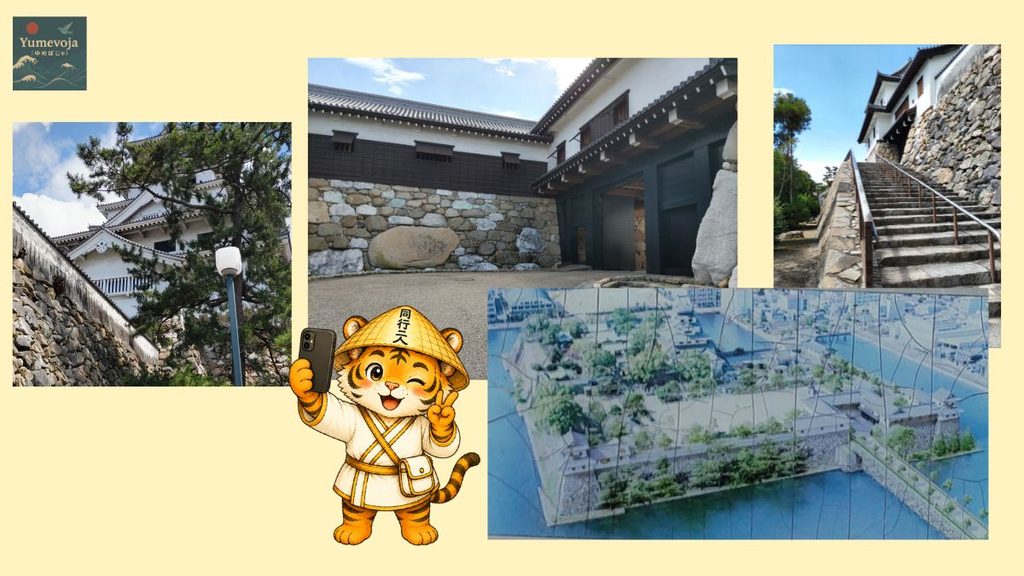
After visiting the two temples and receiving their pilgrimage stamps,
I made a detour to Imabari Castle.
I explored its stone walls, gates and steps,
then viewed the castle and its seawater moat from the keep.
👉🌐Official website — Imabari Castle
Even After Sightseeing, I Couldn’t Simply Return to the Station
After leaving Imabari Castle, all I had to do was return to Imabari Station.
However, even on a half-day route, there is no guarantee that I will reach the station as planned.
Getting lost is nothing unusual for me.
This time, too, I wandered around while trying to find the station.
When I lost my way, I asked an elderly man for directions.
An Osettai Gift After Getting Lost
The man not only showed me the way. When he realized that I was a pilgrim, he handed me an envelope.
The word “Gassho”—a gesture of prayer and respect—was handwritten on it.
Inside were fifty one-yen coins.
It was an osettai, a gift offered to a pilgrim.
It takes time to collect fifty one-yen coins.
Perhaps he had patiently collected them for osettai and carried them with him so that he would be ready whenever he met a pilgrim.
That was what I imagined.
I do not know the truth.
But if I had not lost my way, I would never have spoken to him.
It was a chance connection born from getting lost.
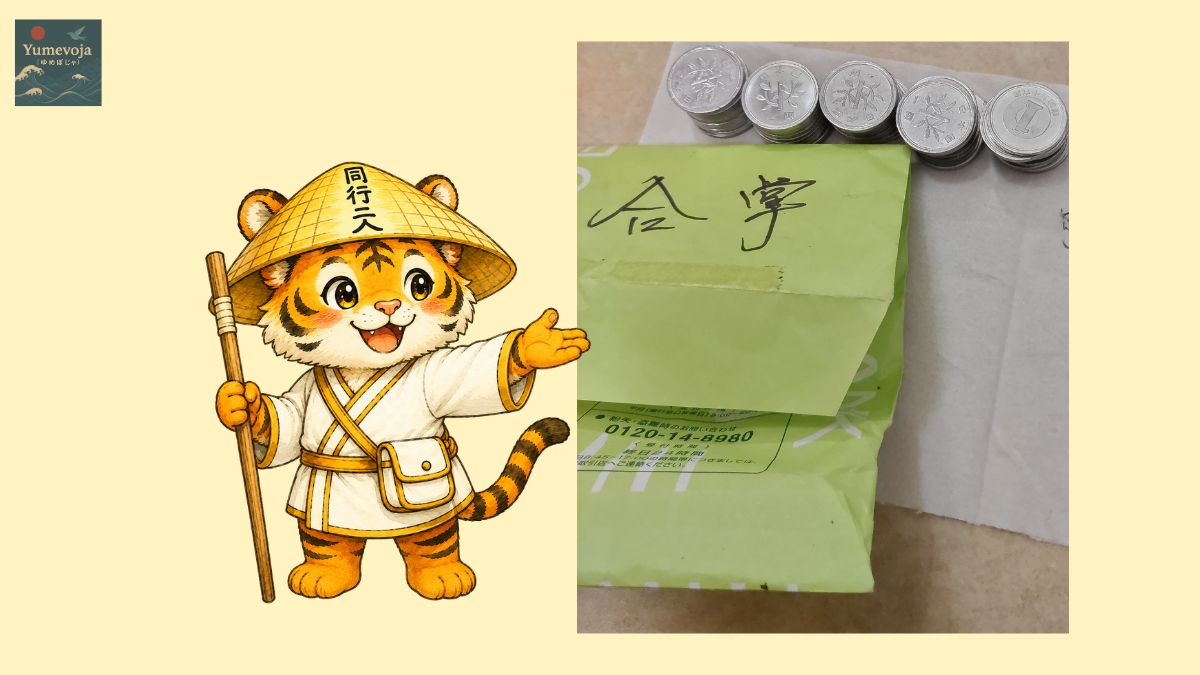
On my way back from Imabari Castle,
I received an osettai gift in an envelope marked “Gassho,” a gesture of prayer and respect. Inside were about fifty one-yen coins,
thoughtfully prepared for a walking pilgrim to use as temple offerings.
A First Day When Nothing Went as Planned
The full parking lot near the station.
The bottle of Dodecamin that burst open.
The torn jacket.
The bell that disappeared from my pilgrim staff.
The first day of my pilgrimage through Ehime brought one unexpected problem after another.
Still, someone stopped to express concern about heatstroke.
When I asked for directions, I received an envelope marked “Gassho” containing fifty one-yen coins.
At the end of the day, what stayed with me was not what had gone wrong, but the warmth I had received from others.
I returned to Imabari Station and drove to Matsuyama.
After checking in at the Toyoko Inn in Matsuyama Ichibancho, the first day of my seven-day, six-night pilgrimage came to an end.
👉 Related illustrations here
(Free to use)
▶︎ 🎨View illustration page
👉 Follow my solo Shikoku pilgrimage, course by course.
▶︎ View the Shikoku pilgrimage overview

Today’s bonus capsule!
✨ Gateway to the Shōwa Era
―The 1-Yen Coin I No Longer Use
The Showa era (1926–1989) was a time when modern technology and ideas began to transform everyday life in Japan.
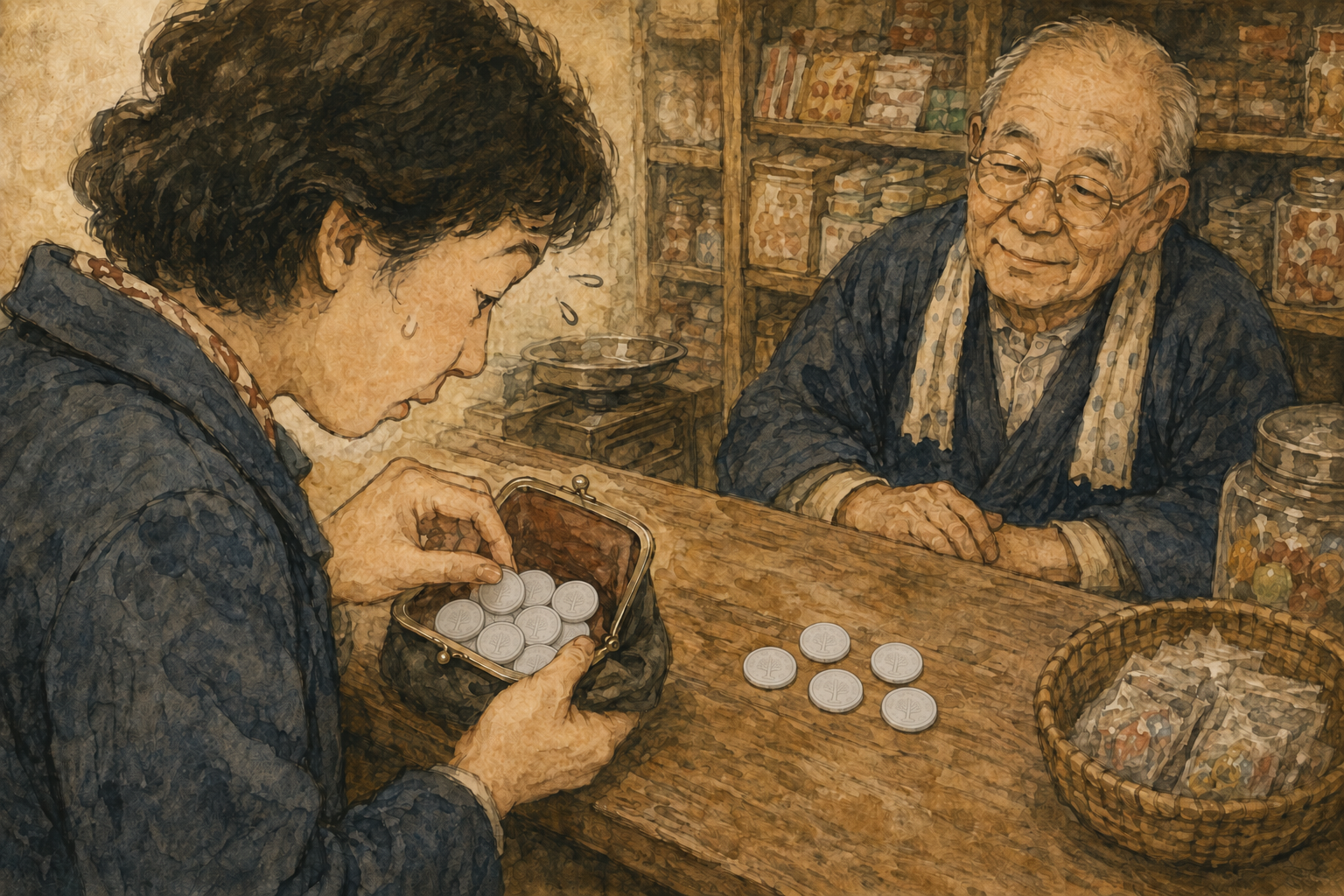
In the Showa era, Japanese wallets were often filled with one-yen coins. We searched for one more yen at the checkout and regularly received them as change. Today, with the spread of cashless payments, I hardly ever use them.
Japan’s current aluminum one-yen coin was introduced in 1955. It weighs exactly one gram and bears the image of a young tree, symbolizing the country’s growth.
One day in Imabari, a man gave me fifty of these coins as osettai, a traditional gift offered to pilgrims. Together they weighed fifty grams—but in my hands, they felt much heavier.