Stage 3-2 | July 15, 2024
Third Pilgrimage Journey – Day Two
The previous day, I visited Temple No. 22, Byōdōji and Temple No. 23, Yakuōji.
On the second day, I would head from Tokushima Station to Temple No. 18, Onzanji and Temple No. 19, Tatsueji.
Looking only at the temple numbers, the order may seem a little unusual.
Temple No. 20, Kakurinji, and Temple No. 21, Tairyūji, are both mountain temples.
Because I walk at a slower pace, someone once told me that a walking pilgrimage might be too difficult for me.
So this time, I decided not to push myself.
I planned to take on Temples No. 20 and 21 only after becoming more accustomed to walking the pilgrimage by completing one full circuit.
On my one-night, two-day pilgrimages, I always plan the second day so that I can return home before the day ends.
I leave my car at the hotel, walk from Tokushima Station to Temples No. 18 and 19, then take the train back from Tatsue Station to Tokushima Station before driving home.
I don’t become too attached to walking every step or following the temple numbers in order.
Instead, I continue my pilgrimage in the way that suits me best.
🗺️ Route of This Journey
Main Stops
- JR Tokushima Station
- Bentenyama
- Katsuura Shrine
- Kōbō Daishi’s Walking Staff Spring
- Temple No. 18 – Onzanji
- Temple No. 19 – Tatsueji
- JR Tatsue Station
- JR Tokushima Station
Leaving Tokushima Station
I set out from Tokushima Station early in the morning.
According to my guidebook, this was considered an intermediate-level route.
I believed that by starting early, I would have enough time to walk all the way to Tatsue Station, as the elevation changes were relatively gentle.
Bentenyama – Japan’s Lowest Natural Mountain
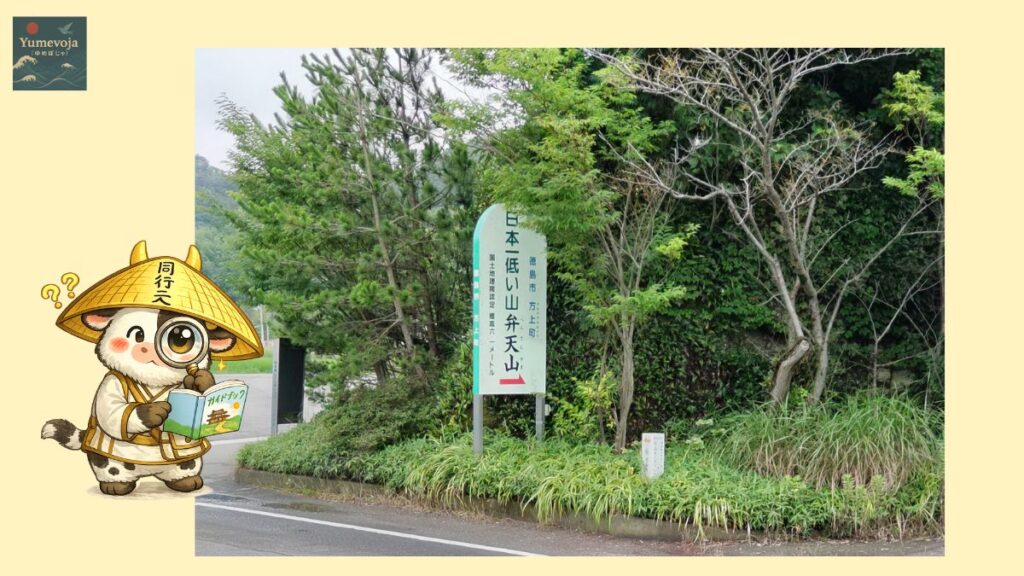
The day’s pilgrimage begins at Bentenyama,
Japan’s lowest natural mountain.
About eighty minutes after setting out, I reached my first stop, Bentenyama.
Its elevation is only about six metres.
“What? This is a mountain?”
I couldn’t help looking around in surprise.
Unable to find the entrance, I walked around to the back, where I found a small torii gate.
Beyond it, Benzaiten was quietly enshrined.
After offering my prayers, I resumed my walk.
Katsura Shrine
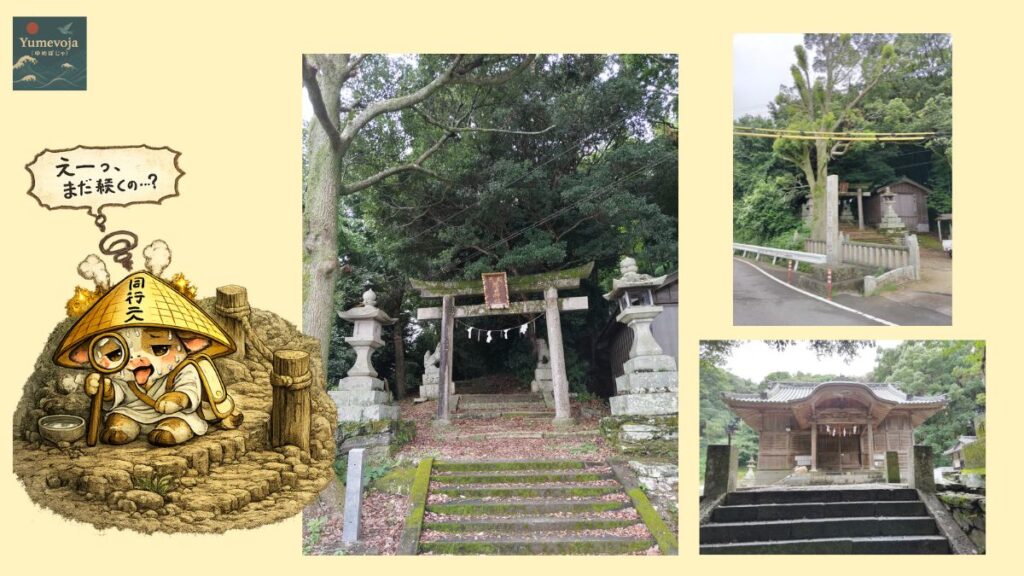
I stopped by Katsura Shrine and enjoyed a peaceful moment.
About fifteen minutes later, I came across a sign pointing toward Katsura Shrine.
The shrine has no direct connection to the Shikoku Pilgrimage.
Even so, when I learned that Minamoto no Yoshitsune is said to have prayed here on his way to Yashima, I decided to make a detour.
Bentenyama is Japan’s lowest natural mountain.
So I assumed the surrounding hills wouldn’t be very high either.
With that thought in mind, I stepped onto the shrine approach.
However, the path was shaded by dense trees, making it dark, and I couldn’t see what lay ahead.
“It should only be a short climb.”
That was what I thought as I began walking.
But what awaited me was a steep uphill trail.
The narrow mountain path wound through one switchback after another.
“Surely I’m almost there.”
Yet every time I thought so, another steep slope appeared.
I couldn’t see the end.
Little by little, my strength began to fade.
More than once, I thought about turning back.
I knew that if I used too much time and energy here, it would affect the rest of my pilgrimage.
Looking at it calmly, turning back would have been a reasonable choice.
Even so, I didn’t want to give up.
I might never come here again.
And I wanted to see, with my own eyes, the scenery that Yoshitsune himself may once have seen.
At last, I reached the shrine grounds.
There was no one there.
Only a quiet stillness filled the air.
The man I had seen earlier wearing work clothes eventually came up to the shrine.
Perhaps he had been carrying out maintenance work.
Seeing someone continue working in such intense heat filled me with respect.
I was glad that I hadn’t given up and had been able to offer my prayers.
At the same time, however, the schedule that had once seemed comfortable had completely fallen apart.
Feeling a little regret, I picked up my pace, battling the summer heat as I headed toward my next destination.
Kōbō Daishi’s Walking Staff Spring
I also stopped at Kōbō Daishi’s Walking Staff Spring that day.
It was a quiet place where I could pause for a moment and catch my breath during the journey.
Temple No. 18 – Onzanji
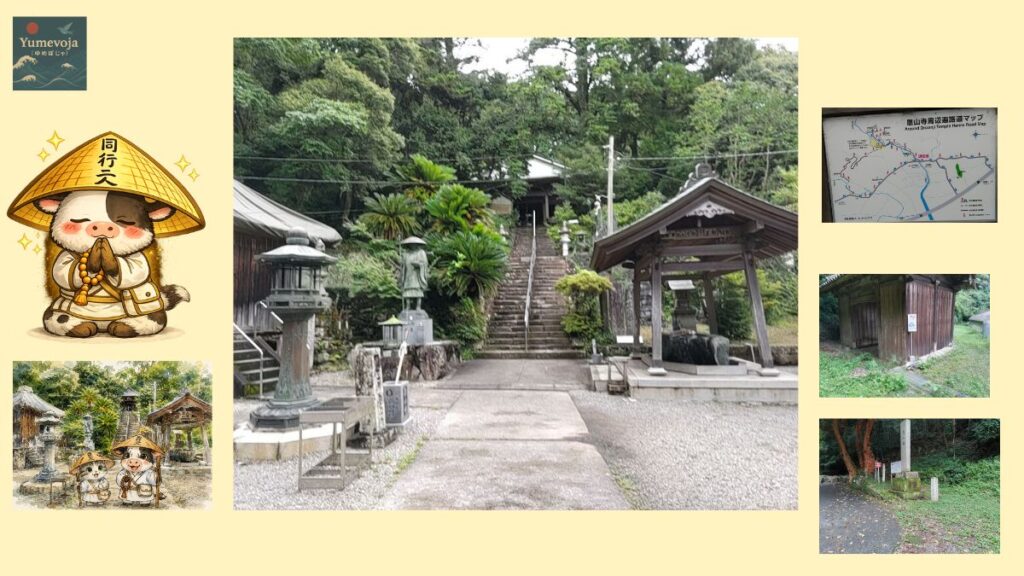
Offering my prayers at Temple No. 18, Onzanji.
For detailed information about the temple’s history and visiting guidance, please visit the official Onzanji website.
From Onzanji to Tatsueji
The route from Onzanji to Tatsueji passes through privately owned land.
Near one of the livestock barns, there was a sign that read:
“Please do not approach the livestock barn.”
I could also hear cows lowing nearby.
In some places, it even felt as though I was walking through the gardens of private homes.
The walking pilgrimage continues only because local residents generously allow pilgrims to pass through their community.
As I walked, I felt deeply grateful for their kindness.
The reason I chose a cow as the illustration for this article is because the sound of those cows along this road left such a lasting impression on me.
Temple No. 19 – Tatsueji
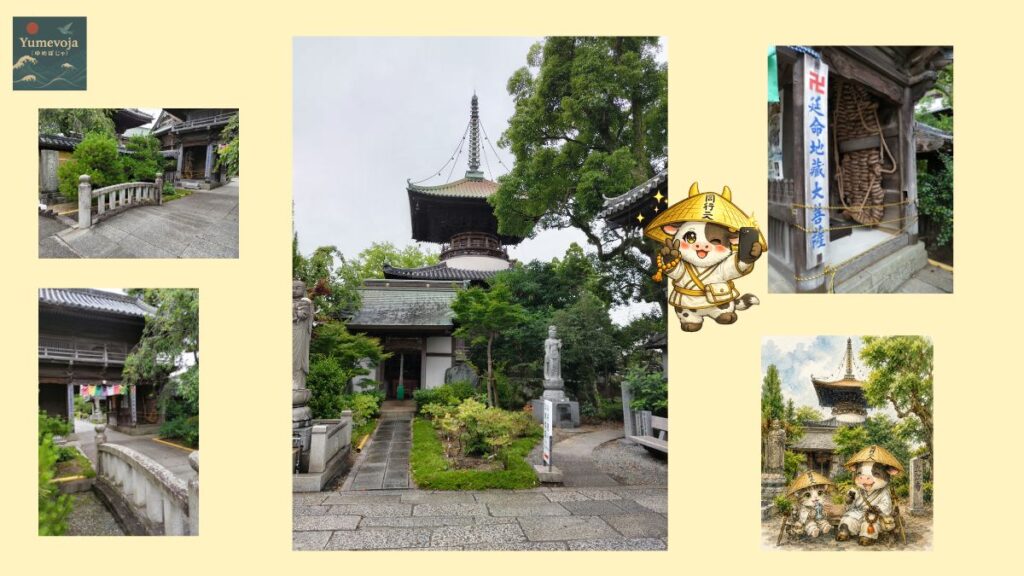
Taking a short break at Temple No. 19, Tatsueji.
For detailed information about the temple’s history and visiting guidance, please visit the official Tatsueji website.
To Tatsue Station
I arrived safely at Tatsue Station.
From there, I took the train back to Tokushima Station, returned to the hotel where I had left my car, and began the drive home.
I don’t insist on walking every single step.
Instead, I connect the distance that I am able to walk, one step at a time.
That is my way of making the Shikoku Pilgrimage.
👉 Related illustrations here
(Free to use)
▶︎ 🎨View illustration page

Today’s bonus capsule!
✨ Gateway to the Shōwa Era―The Ice Man
The Showa era (1926–1989) was a time when modern technology and ideas began to transform everyday life in Japan.
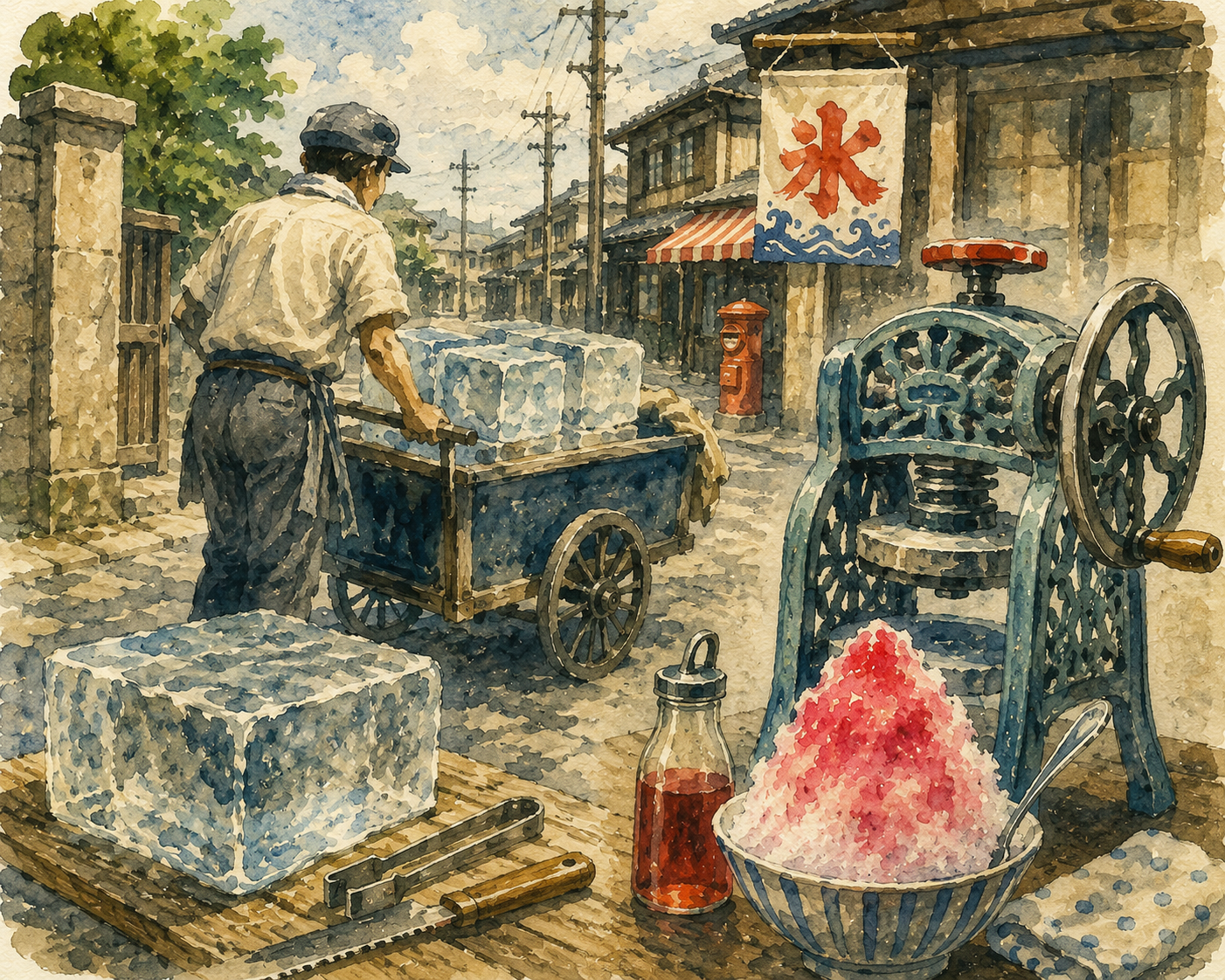
In Showa-era Japan, before refrigerators became common in every home, blocks of ice were delivered by local ice dealers.
The ice was used to keep food cold, chill drinks, and make refreshing shaved ice. It was an essential part of everyday summer life.
Today, home deliveries of ice have almost disappeared.
However, the tradition lives on in a different form.
Some long-established kakigōri (Japanese shaved ice) shops still use blocks of ice made by professional ice makers. Frozen slowly over time, this clear, dense ice contains fewer air bubbles, making it easier to create the light, fluffy texture that Japanese shaved ice is known for.
The ice man may have disappeared from everyday life, but the craftsmanship behind that ice still lives on in every bowl of kakigōri.