
Visited: March 1, 2026 (Sun)
Leaving Ginkaku-ji,
you step slightly out of the flow.
You are still walking,
yet the atmosphere changes.
From here,
it becomes a path for thinking.
■ Philosopher’s Path & Otoyo Shrine (Kyoto Walking Guide)
The Philosopher’s Path is one of Kyoto’s most representative walking routes, stretching from Ginkaku-ji toward Nanzen-ji.
It is about 2 km long, taking roughly 30–45 minutes at a relaxed pace.
Cherry trees line the canal, offering a quiet moment in any season.
Along the way, small shops and cafés appear here and there,
revealing a different side of Kyoto from the usual tourist spots.
If you step slightly off the path, you will find Otoyo Shrine—
a peaceful shrine known for its animal messengers such as mice and foxes.
It is a route well suited for those who prefer to walk away from the crowds.
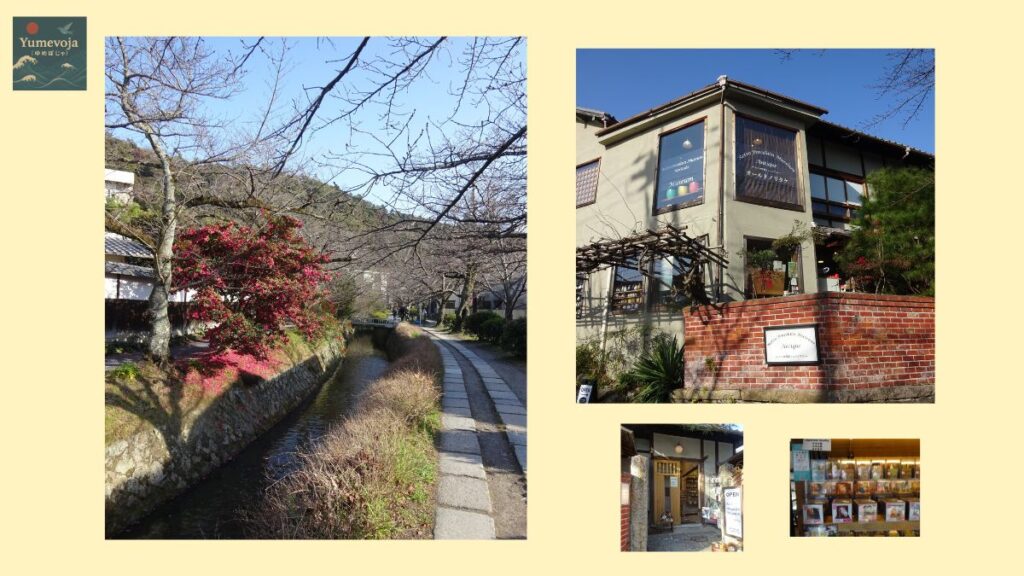
Philosopher’s Path.
Walking along the flow, a sense of space gradually returns.
This walking route is arranged as one continuous flow.
From Ginkaku-ji,
to the Philosopher’s Path,
and then to Otoyo Shrine.
From the station, to walking, to dining—
the movement of an entire day is included as it is.
By stepping slightly off the main path,
what you see begins to change.
📍Route here
👉 Read the Ginkaku-ji article here
🚉 Ginkakuji Temple Kyoto: Highlights, Best Time & Tips
The exact order
does not need to be fixed.
You don’t have to decide
where to stop.
This map does not show a “correct order,”
but rather, one possible flow.
Not following the flow,
but stepping out of it.
This route fits that kind of walk.
■ Philosopher’s Path
There are people here.
But
they are not flowing.
At Ginkaku-ji,
you had no choice but to follow the flow.
Here,
you can choose your own pace.
After walking a little,
someone stood in front of a shop.
Hesitating—
whether to go in or not.
After a moment of thought,
they stepped inside.
Curious,
I followed.
It was a small shop,
slightly unique, selling accessories.
I picked up a pochette.
I hesitated.
But this time,
I decided not to buy it.
The color was a bit too vivid.
On a journey,
choosing not to buy something
can also remain in your memory.
■ Otoyo Shrine
I visited in the evening.
A shrine with no one around.
The only sound
was birds.
Mice, foxes, snakes, monkeys, kites—
they appeared one by one.
A little mysterious,
yet somehow natural.
Among them,
I found my zodiac animal.
A small sense of familiarity
emerged.
I paused.
My favorite flower.
Winter Jasmine.
If I had been rushing,
I might not have noticed it.
A little space
changes the scenery.
After watching for a while,
more people began to arrive.
Before I knew it,
the quiet
had turned into liveliness.
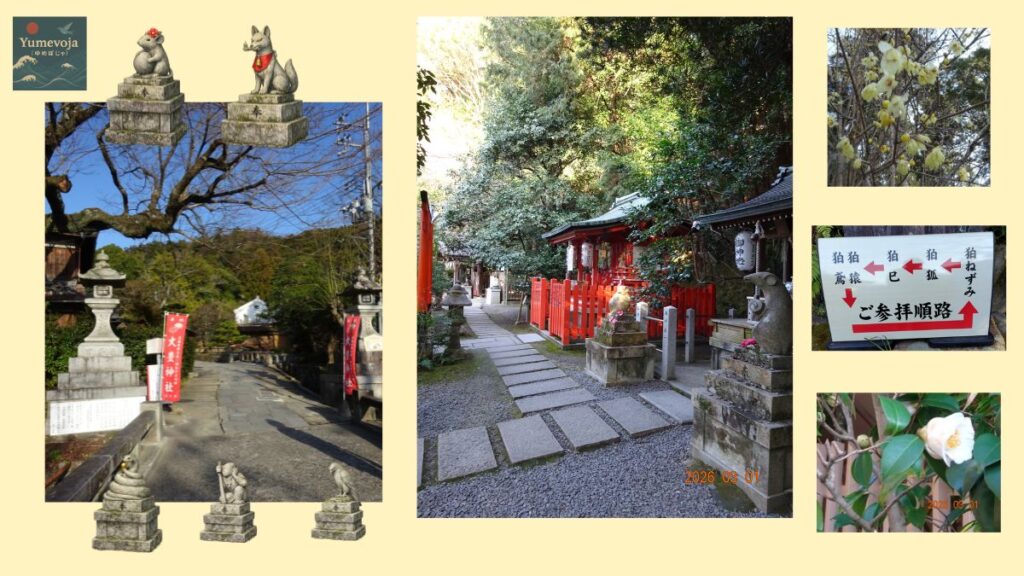
Otoyo Shrine.
Walking through the quiet grounds, as if guided by animals.
Along the Philosopher’s Path,
two foreign men
were photographing early-blooming cherry blossoms.
I wondered—
perhaps Kyoto feels a little boring
for younger people.
But the way they pressed the shutter
looked full of joy.
Perhaps the way we experience travel
is not determined by age.
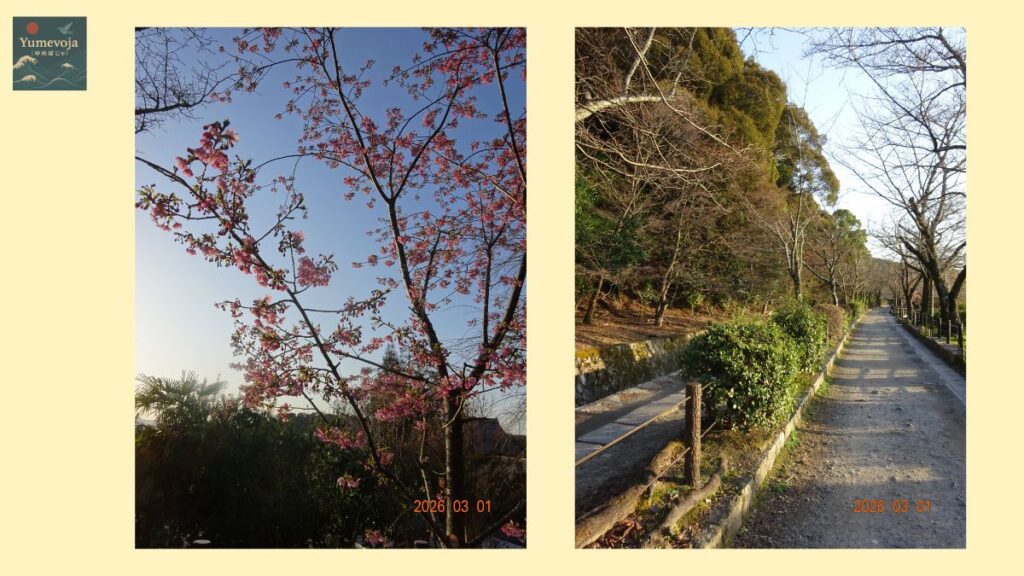
Philosopher’s Path.
Early cherry blossoms and light moving toward evening.
■ Next
If you keep walking,
you will reach the Okazaki area.
Just as you begin to feel a little tired,
there is a place that fits perfectly.
👉 🍵 Okazaki Saryo Kyoto | A Calm Dinner After the Philosopher’s Path
■ Summary
At Ginkaku-ji,
you were within the flow.
On the Philosopher’s Path,
you stepped out of it.
And then,
you return to yourself.
Choose Kyoto by mood.
👉 View the Kyoto guide

Today’s bonus capsule!
✨ Gateway to the Shōwa Era
―Dagashi Shop
The Showa era (1926–1989) was a time when modern technology and ideas began to transform everyday life in Japan.
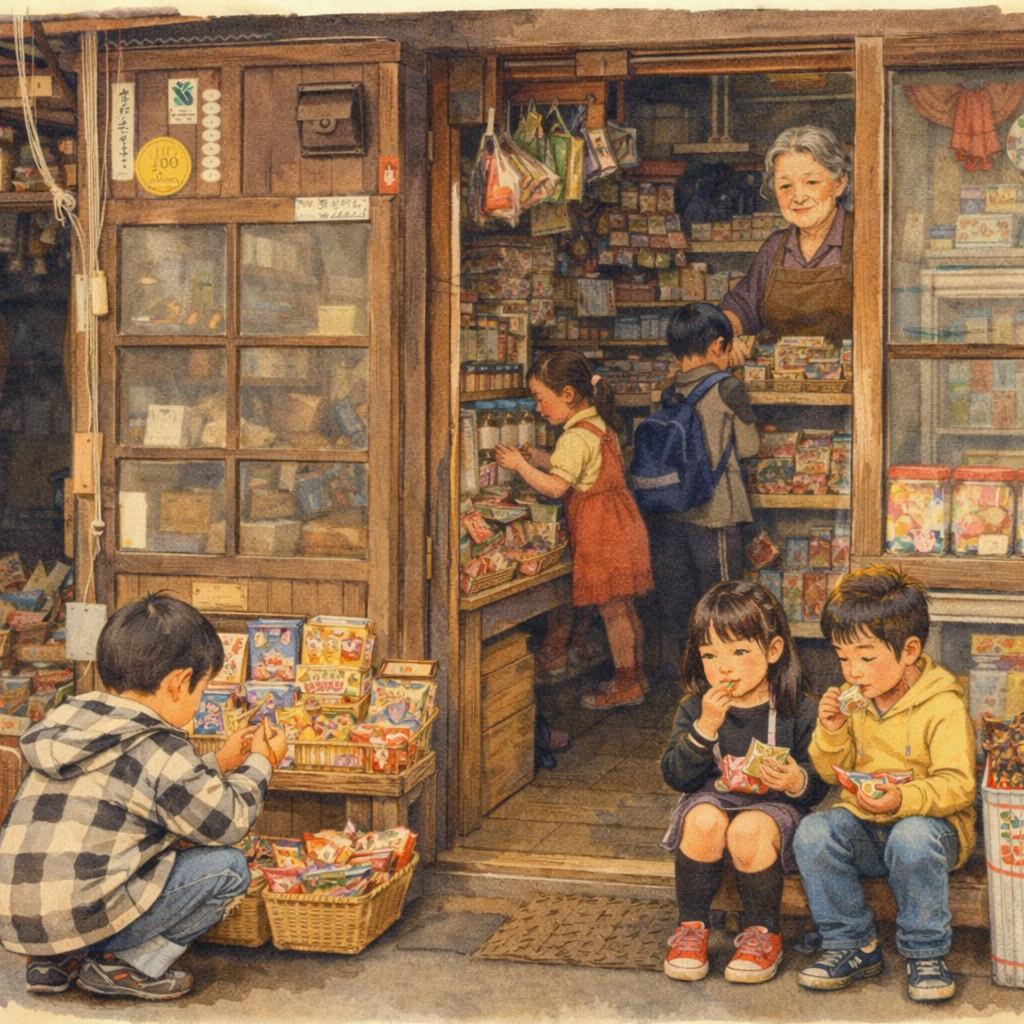
Dagashi shops were once
a joyful gathering place for children.
But they were more than just a place to gather.
They were small worlds,
gently held together by a kind grandmother
who loved children.
The thrill of pulling a string,
not knowing what you might get.
The quiet hope
that an ice candy stick might win you another one.
It wasn’t just about the low prices.
It was a place filled with small moments of joy.
Today,
you can still find dagashi in a corner of supermarkets.
It looks similar,
but somehow feels different.
Because
the grandmother is no longer there.
A small,
quiet sadness remains.