Date of Visit: Wednesday, April 15, 2026 – Rainy
I have visited Kyoto many times.
I have crossed Togetsukyo Bridge and wandered through the famous bamboo grove.
This time, however, I wanted to discover a different side of Arashiyama.
With that thought in mind, I boarded the Hankyu train.
Originally, I had planned to spend a rainy day visiting museums.
But both the Fukuda Art Museum and the Saga Arashiyama Museum of Arts & Culture were closed.
My plans changed before the day had even begun.
“This might turn into a rather challenging trip.”
That was the feeling I had as my journey started.
As usual, I loaded my ICOCA card with a ¥10,000 bill.
Large bills are not always convenient while traveling, so charging the card is also an easy way to break one.
The women-only car was filled with students.
Watching one of them memorize English vocabulary made me smile.
“I really should get back to my own studies,” I thought.
Whenever I find an empty seat on the train, I often sit down.
But if an elderly passenger is nearby, I wait for just three seconds.
Some people appreciate the offer of a seat, while others prefer not to be treated differently.
It is my own quiet travel habit.
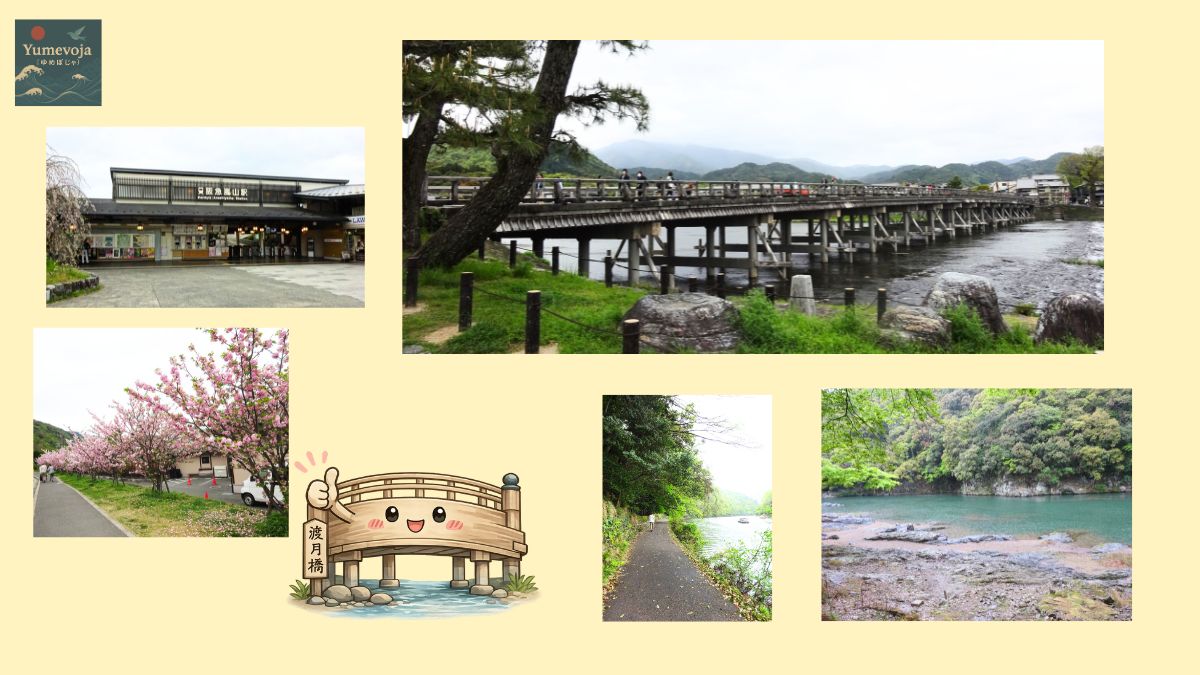
A rainy morning in Arashiyama.
Leaving Hankyu Arashiyama Station, I walked beneath the late cherry blossoms and followed the riverside path at an unhurried pace.
Ahead of me waited Senkoji Temple—and beyond that, Togetsukyo Bridge.
Arriving at Hankyu Arashiyama Station, I was glad I had chosen the comfortable walking shoes I bought earlier this year.
Even after twenty thousand steps, they rarely leave my feet tired, and they are reassuring on rainy days.
The station’s restrooms were newly renovated and equipped with several accessible facilities.
Little conveniences like these make traveling much more comfortable.
Stepping outside, I heard cheerful music from an ice cream shop mixed with birdsong.
A few cherry blossoms still remained on the trees, and visitors happily posed for photographs.
Then the rain began.
As I put on my raincoat, a woman walking behind me opened her umbrella and reached for her jacket.
“It’s cold today, isn’t it?” she said.
It was only a brief exchange, but somehow it felt like a true travel moment.
Togetsukyo Bridge looked as beautiful as ever.
Many visitors headed straight toward the bamboo grove.
Today, however, I decided to walk in the opposite direction.
Stepping Away from the Classic Route
A soba restaurant scheduled to open at 11:00 caught my attention, so I wandered around the neighborhood while waiting.
When it opened, I ordered the Nishin Set Meal, choosing udon instead of soba.
There was nothing flashy about it.
Yet the dashi broth was rich and comforting, and the udon had just the right amount of firmness.
It was a quiet lunch that perfectly matched the rainy day.
For more about this meal, please see Beauty & Taste | Nishin Set Meal.
Many visitors continue toward the Monkey Park.
Very few walk beyond it.
I followed the riverside path for about twenty minutes.
The sound of raindrops touching the river.
The gentle rhythm of rain hitting my umbrella.
Birdsong echoing through the trees.
The silence was so complete that it almost felt unsettling.
Stone steps eventually led me to Senkoji Temple.
At the entrance stood several bamboo walking sticks.
“Is it really that steep?” I wondered.
Visitors are free to ring the temple bell.
Its deep sound echoed through the rainy mountain air, creating a peaceful atmosphere.
Climbing higher, I found a small hall.
The original main building had been destroyed by a typhoon, and the Thousand-Armed Kannon was now enshrined in a temporary structure.
One of the temple caretakers began talking to me.
“Many people ring the bell and leave without going any farther.”
Admission costs only 400 yen.
It is not a grand or luxurious temple.
Instead, it quietly continues to protect its Buddhist traditions in the mountains.
He also told me that Nison-in Temple preserves the grave of a wealthy merchant closely connected with its history.
Visitors often spend thousands of yen on lunch or cafés in famous tourist areas.
Compared with that, supporting this peaceful place with a 400-yen admission fee suddenly felt very meaningful.
If you ever visit Senkoji, I hope you will walk beyond the bell and meet the Thousand-Armed Kannon waiting farther up the path.
By chance, I met a couple from Canada.
With simple English and plenty of gestures, I managed to say,
“The autumn colors are even more beautiful.”
Then I added,
“The gentleman talks for quite a long time, doesn’t he?”
They laughed.
Perhaps that little conversation became the best memory of my day.
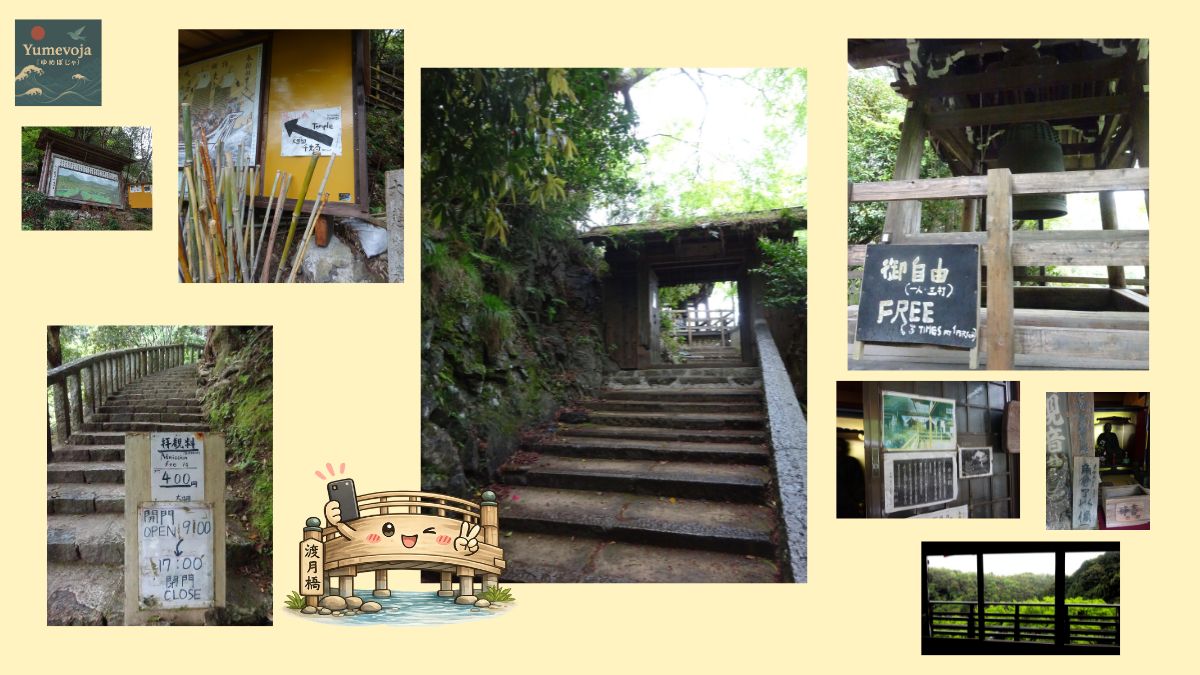
After climbing the rain-soaked stone steps, I was welcomed by the quiet grounds of Senkoji Temple and the fresh green maple leaves.
A Quiet Side of Kyoto
I crossed Togetsukyo Bridge.
By noon, the atmosphere had completely changed.
Tour buses arrived one after another.
School excursions filled the streets.
The rain continued to fall.
In what felt like only a few moments, the peaceful Arashiyama I had been enjoying returned to the busy tourist destination everyone knows.
So I walked a little farther toward Rakushisha Cottage.
Many visitors stop to look from outside, but only a few step inside.
An old well.
A traditional kitchen stove.
A thatched roof.
It is a small place, yet it quietly preserves the feeling of everyday life from centuries ago.
On a rainy day, perhaps it is better to sit for a while than to rush from one attraction to another.
I wondered if the poets who once lived here also listened to the sound of rain while composing their haiku.
Leaving the bamboo grove behind, I crossed the railway tracks.
The crowds slowly disappeared.
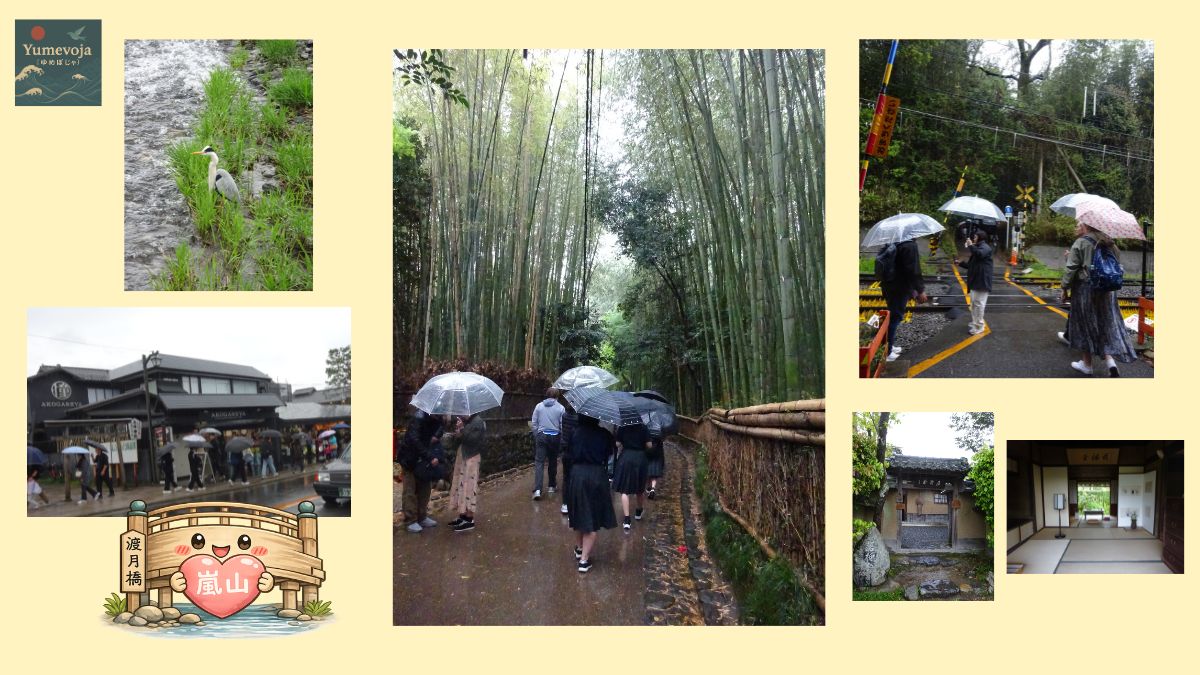
Wrapped in the sound of rain, the bamboo grove and the peaceful Rakushisha Cottage reveal a different side of Arashiyama.
Sometimes, taking a small detour leads to an entirely new journey.
Instead, I found several small cafés hidden along the quiet streets.
One of them looked more like an antique shop than a café.
I ordered the tiramisu.
At first glance, it looked rather ordinary.
But the first bite was surprisingly rich and creamy.
Because I had expected so little, it became one of the most memorable flavors of the day.
For more details, please see Beauty & Taste | Tiramisu.
Listening to the Rain at Nison-in Temple
I entered Nison-in Temple.
At the entrance, one of the temple staff smiled and said,
“There aren’t many visitors today.”
At first, I had always thought,
“All temples look more or less the same.”
So I kept walking.
Fresh green maple leaves stretched across the path, almost as if they were gently stopping me.
If every temple seems similar, perhaps there is no need to visit dozens of them.
Maybe it is enough to stay in one place and simply wait until the temple begins to speak to you.
The sound of rain.
Drops falling from the roof of the main hall onto small stones.
The gentle rhythm of the shishi-odoshi bamboo fountain.
Even its timing changed slightly as the rain became stronger or weaker.
These were sounds that could only be heard on a rainy day.
Soon the rain turned into a steady downpour.
“Well… I don’t remember requesting this!”
I laughed quietly to myself.
Leaving the main hall, I decided to walk a little farther.
The site associated with Fujiwara no Teika, famous for the One Hundred Poets, One Poem Each, was just ahead.
But a large puddle blocked the path.
Signs warned of bears, bees, snakes, and landslides.
Curiosity won for a moment, and I continued a little farther.
Then I looked at the time.
It was already 4:30 in the afternoon.
I decided to turn back.
Perhaps it was the right choice.
Later, I asked one of the temple staff about the viewpoint.
He smiled and said,
“It’s just a nice view.”
Some places remain unforgettable precisely because we never reach them.
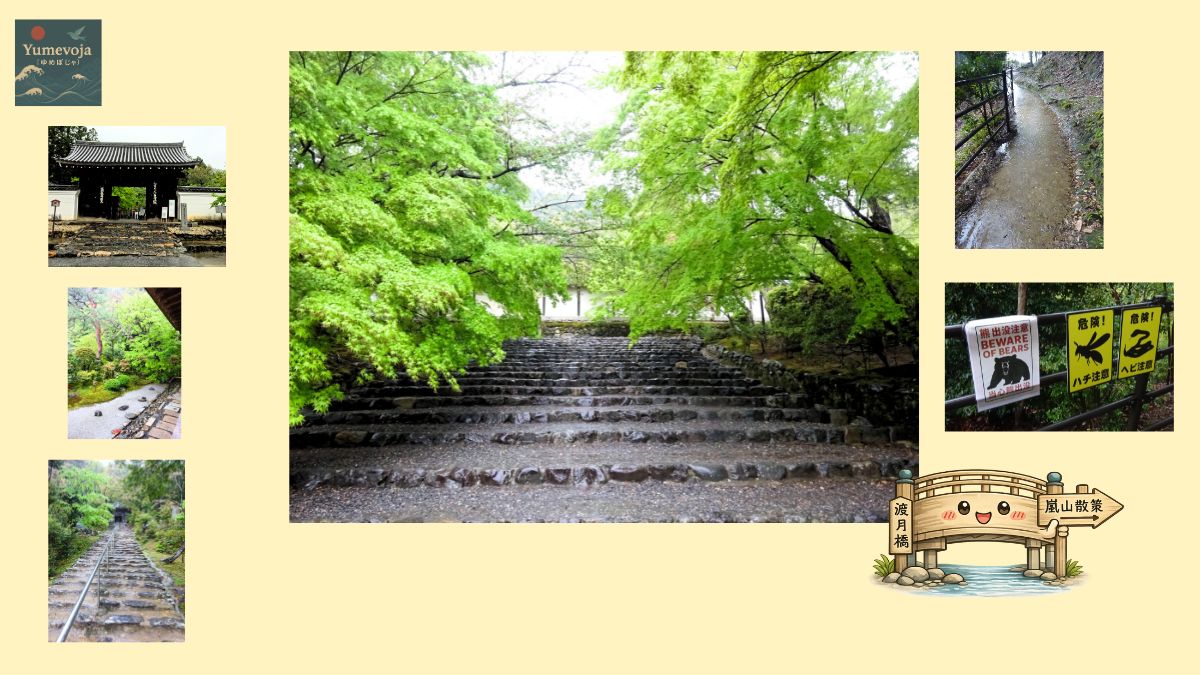
Rain-washed stone steps and fresh green maple leaves welcomed visitors to Nison-in Temple.
It was the kind of place that made me want to slow down and simply keep walking.
Returning to Reality
I continued walking toward Saga-Arashiyama Station.
There were hardly any restaurants.
Even after returning toward Togetsukyo Bridge, most places had already closed.
I had unexpectedly become a dinner refugee.
Perhaps little mishaps like this are part of traveling.
So I walked all the way back to Hankyu Arashiyama Station.
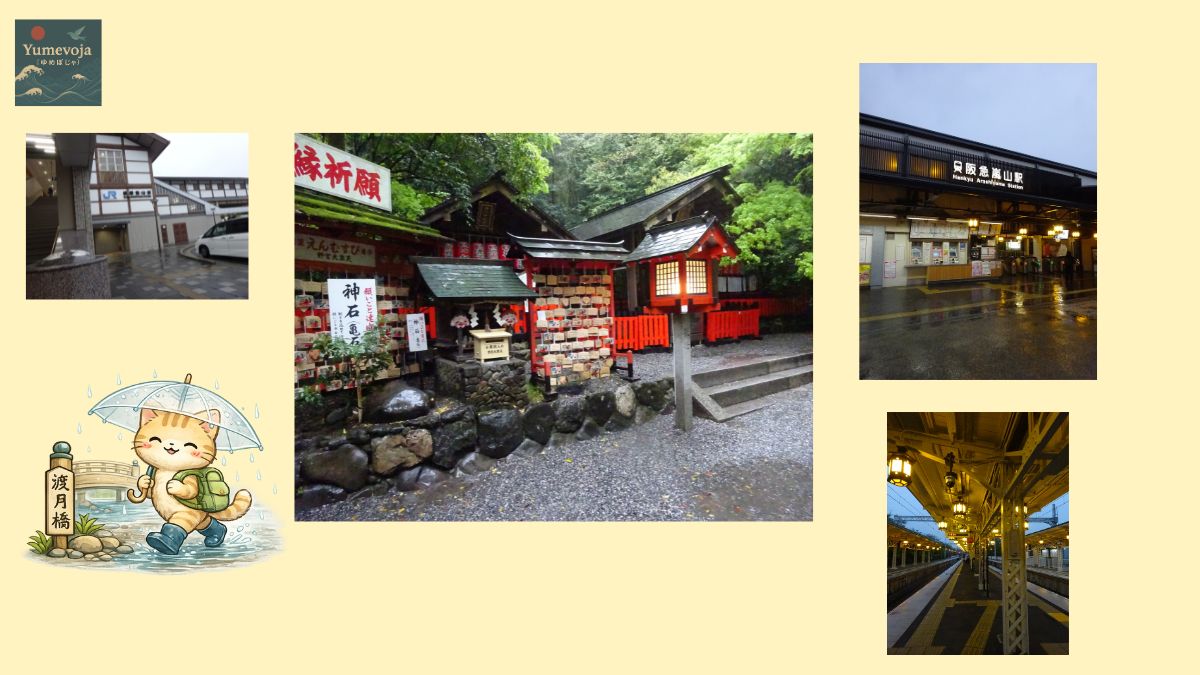
As the rainy day came to an end, the lights of Nonomiya Shrine and Hankyu Arashiyama Station quietly illuminated the evening.
A peaceful ending to a slow journey.
Perhaps not many people stay in Arashiyama for dinner.
Instead of heading toward downtown Shijo-Kawaramachi, I decided to make another stop and got off at Katsura Station.
Looking back, it turned out to be the perfect choice.
Hot sake.
Gyoza.
Chicken sukiyaki.
An ordinary neighborhood izakaya filled with local people.
There was nothing fashionable or luxurious about it.
And that was exactly what made it comfortable.
Sometimes the most ordinary places become the most memorable.
For more details, please see Beauty & Taste | Gyoza & Hot Sake.
On the Hankyu train home, I found myself wondering,
“Did I take the wrong train again?”
I had boarded a Semi-Express.
According to the electronic display, it seemed like the fastest option.
But apparently, the Limited Semi-Express behind us would arrive first.
Limited Express.
Limited Semi-Express.
Commuter Limited Express.
Express.
Rapid.
The Hankyu Railway system can be surprisingly confusing.
Well, at least I had a seat.
That was good enough.
I changed trains at Nagaoka-Tenjin Station and reached my destination without any problems.
In the end, everything worked out.
One of the greatest pleasures of solo travel is the freedom to change plans.
That day, I walked 26,567 steps.
I walked a lot.
I ate well.
And I got lost more than once.
Nothing went according to schedule.
Yet what stayed with me were different memories:
the quiet sound of a temple bell,
fresh green maple leaves,
the gentle rhythm of the bamboo fountain,
the smiles of a Canadian couple,
and a cup of hot sake shared with the ordinary evening atmosphere of Katsura.
There was a side of Kyoto that only a rainy day could reveal.
Kyoto is more than its famous landmarks.
Step just a little away from the classic route, and a quieter world begins to appear.
That was the kind of stopover journey this became.
🗺️ YUMEVOJA My Map
This My Map follows the walking route of this rainy-day journey through Arashiyama.
Just a short distance beyond Togetsukyo Bridge, I discovered a quieter Kyoto filled with the sound of rain and temple bells.
🍜 Related Articles | Beauty & Taste
👉 Nishin Set Meal
Simple but comforting, with a rich dashi broth that was perfect for a rainy day in Arashiyama.
👉 Tiramisu (Coming Soon)
An unexpected café stop that became one of the sweetest memories of the journey.
👉 Gyoza & Hot Sake (Coming Soon)
An evening in Katsura that proved getting lost can sometimes lead to the best meal of the day.
👉 Related illustrations here
(Free to use)
▶︎ 🎨View illustration page
👉Choose Kyoto by mood.
▶︎☆View the Kyoto guide

Today’s bonus capsule!
✨ Gateway to the Shōwa Era
―Sharing an Umbrella
The Showa era (1926–1989) was a time when modern technology and ideas began to transform everyday life in Japan.
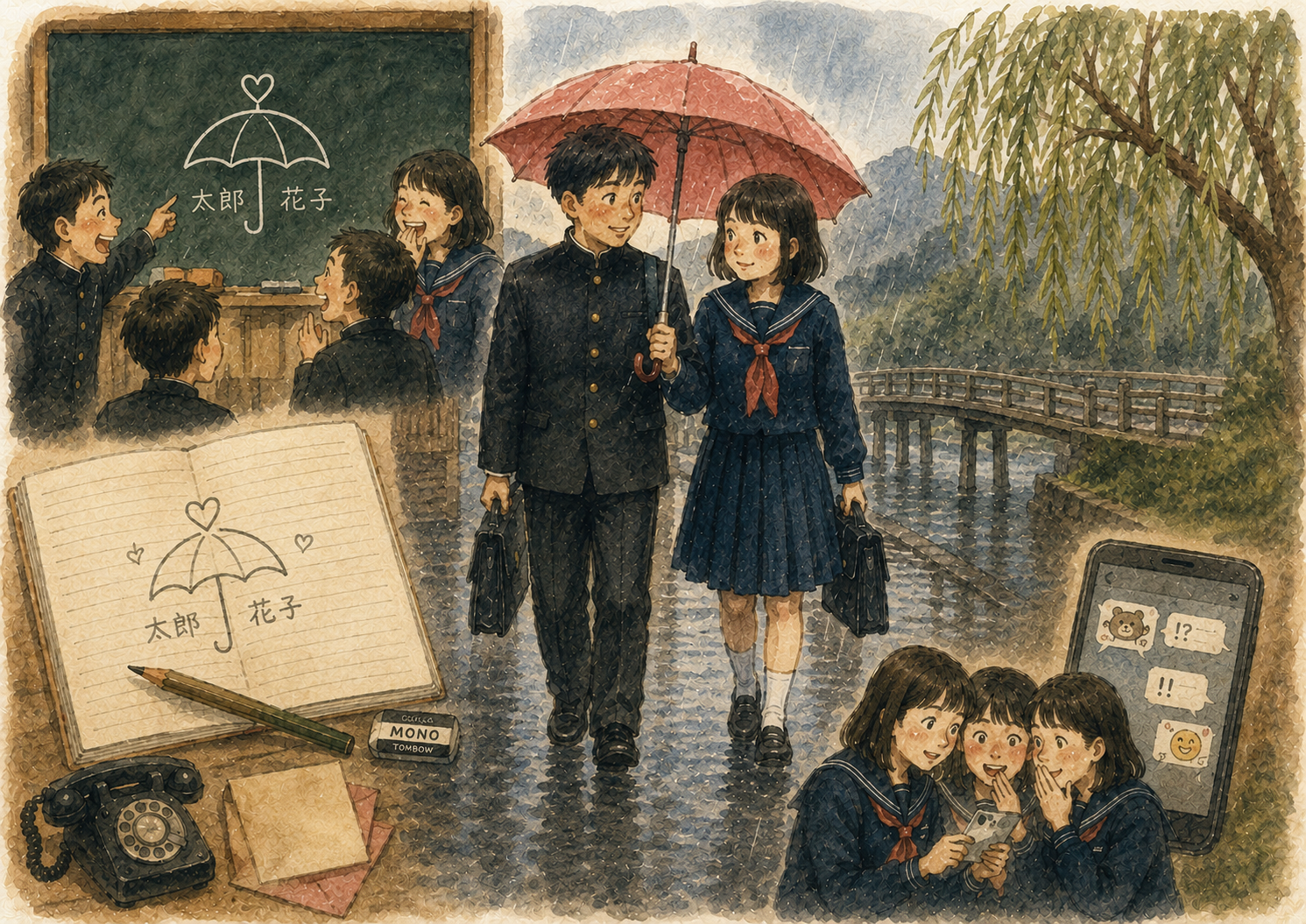
In Japanese schools during the Showa era (1926–1989), when two students were rumored to like each other, their names might be written on a blackboard or notebook with a small umbrella drawn above them.
This was called “Aiai-gasa” (sharing an umbrella).
Today, similar rumors might spread through group chats or social media.
Back then, however, there were no smartphones. Most communication happened through home telephones or handwritten letters.
Because of that, walking home under the same umbrella could feel a little special.
As you stroll across Togetsukyo Bridge on a rainy day in Arashiyama, you might imagine the simple and innocent romances of the Showa era.
☂ In old Japan, an umbrella could sometimes become a symbol of young love.