Visited: March 1, 2026 (Sun)
Ginkaku-ji is a place where it is difficult to stop.
Before you realize it, you keep walking.
It should be quiet,
yet there is no space to think.
Still, something remains.
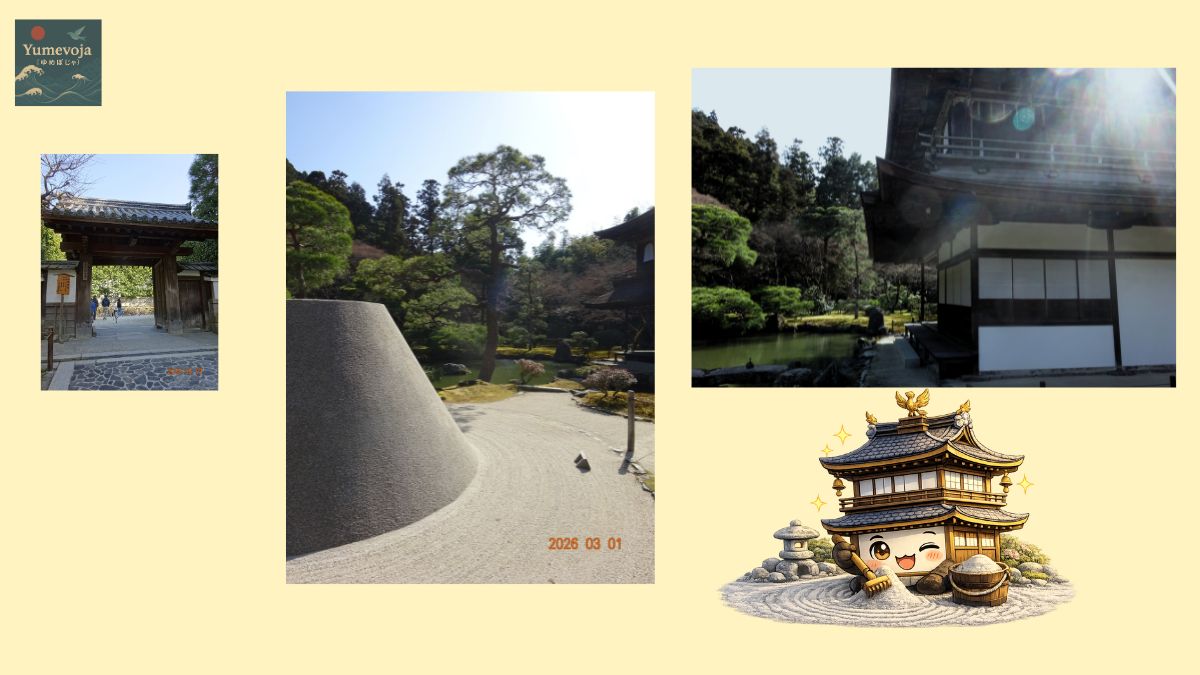
Through the gate, into a quiet garden.
Walking, something slowly settles.
I will leave today’s route here, just for a moment.
It looks simple on a map,
but feels different when you walk it.
👉 🚶♀️ Read the Philosopher’s Path & Otoyo Shrine article here
A walk that gently steps away from the flow.
🚉Philosopher’s Path & Otoyo Shrine | Stepping Out of the Flow in Kyoto
Before heading to Ginkaku-ji, I stopped by a small vintage kimono shop in Higashiyama.
Hearing that pure silk dislikes rain, I realized that in Kyoto, even the weather feels like part of kimono culture.
👉 👘Between Kimono and People ②|An Obiage, Kyoto Rain, and Everyday Culture
Ginkaku-ji (officially Jishō-ji) originated as a mountain villa built by Ashikaga Yoshimasa during the Muromachi period.
It is part of the UNESCO World Heritage site “Historic Monuments of Ancient Kyoto,”
and is known as a symbol of Higashiyama culture.
■Highlights
・Kannon Hall (Silver Pavilion)
A quiet presence. Architecture of shadow rather than light.
・Sand Garden (Ginshadan / Kogetsudai)
The white sand feels less like decoration, and more like something guiding the gaze.
・Moss Garden
A space filled with humidity. Time seems to sink quietly.
■Time & Route
・Time required: about 40–60 minutes
・One-way strolling garden
・Difficult to turn back once you enter
Rather than stopping, you are guided to keep moving.
■Crowds & Timing
・Morning: crowded with school groups
・Around 2 PM: relatively calm
・After 3 PM: crowds return
I entered around 2 PM.
There was some space at first, but groups began arriving after 3 PM.
■With Children
To be honest, strollers are difficult here.
・Stone steps
・Gravel paths
・Slopes
・A route where stopping is difficult
A baby carrier is more practical.
■Access (Yamashina Route)
This time, I started from Yamashina Station (a stop for Special Rapid trains).
On the way in, you can avoid Kyoto Station.
On the way back toward Osaka,
you have a good chance of getting a seat on the Special Rapid.
To reach Higashiyama, transfer to the Tozai Subway Line.
This section is not JR,
so the JR Pass cannot be used.
It takes a little more effort,
but if you want to avoid crowds,
this is a good option.
Just stepping slightly off the main route,
the flow begins to change.
■Before entering Ginkaku-ji
Before entering Ginkaku-ji,
I had lunch at a small restaurant in Higashiyama.
The entrance was hard to notice,
and I hesitated, wondering if it was open.
But once inside, it felt local.
The hexagonal bento was not extraordinary.
But,
it felt like I had returned to Kyoto.
From there, I headed toward Ginkaku-ji.
👉 🍵 Suginoko | A Quiet Kyoto Return in Higashiyama, Gentle Bento
■Walking through
People approach from behind.
There are people ahead.
There is no reason to stop.
It should be quiet,
but before you feel the silence,
you move on.
Before thinking, you are already walking.
■Stepping off the path
There is a narrow path to the side.
A small Benzaiten shrine.
Away from the main route.
No one is there.
You hesitate.
You are not sure if you should enter.
Curious, you step in.
Then,
you begin to sense people behind you.
One by one,
they leave the main path and follow.
The narrow path becomes difficult to pass.
A place that was quiet moments ago
suddenly turns into a flow.
You feel slightly sorry.
As if you had led them astray.
Whether you found it,
or revealed it, you cannot tell.
■Invisible paths
In the distance, a gardener is moving.
No one is watching.
All eyes are on the garden.
On the arranged scenery.
But somehow, that movement draws attention.
Looking closely,
there is a small stone staircase.
You had not noticed it before.
The gardener climbs up.
Only then do you realize there was a path.
It is not for visitors.
It is for work.
A path that exists so as not to be seen.
For a moment,
you feel like you discovered something.
Perhaps it is not only the garden that is being arranged.
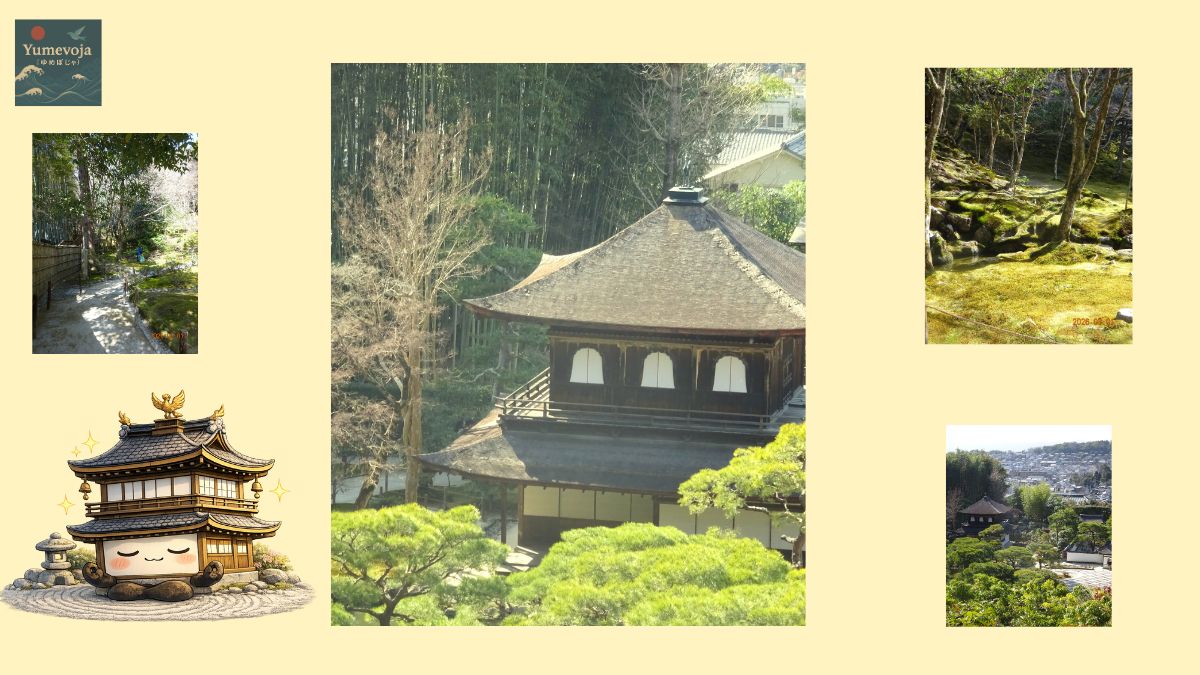
From above, the flow becomes visible.
You begin to understand why you keep moving.
■Approach
Once outside, something loosens.
The flow of people begins to unravel.
You eat something sweet.
Only then can you finally stop.
A short walk along the approach,
there is a place where you can pause.
Fumiya Onigiri Shop
A rice ball shop.
You can take out,
or eat inside.
They also serve sweets,
perfect for a short break.
Ginkaku-mochi comes in two kinds.
Green (matcha white miso bean paste)
and brown (sweet miso).
Both are popular,
but I was told the brown one is recommended.
You pay at the front.
Credit cards were accepted.
Normally, you are called when it’s ready,
but this time, it was brought to my seat.
Perhaps because it was not crowded.
Tea is served together.
Refills are self-service, freely available.
The interior is clean,
with both table and counter seating.
About 30 seats in total.
Many people take out,
so seating was relatively available.
You sit.
You drink tea.
Just that,
and time gently returns.
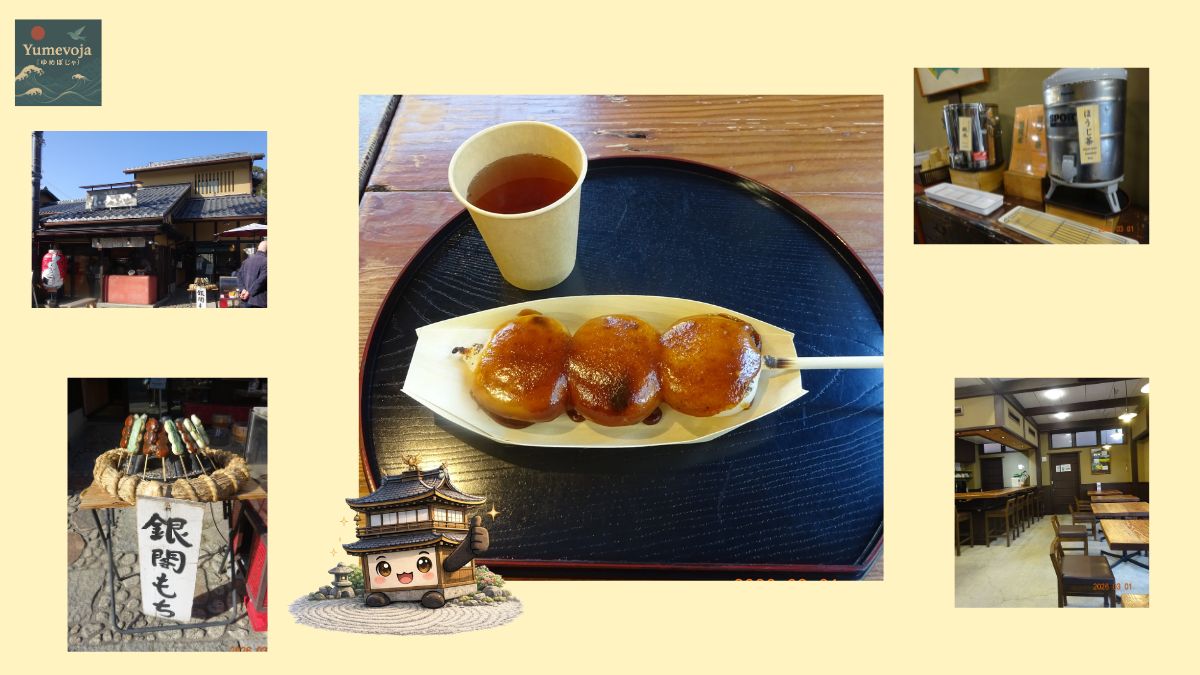
After walking, you finally pause.
With something sweet and tea, time returns.
■Toward the Philosopher’s Path
A sense of unfinished walking remains.
So I continue on,
toward the Philosopher’s Path.
Only then does breathing return.
■Summary
Ginkaku-ji is not a place to stay,
but perhaps a place to pass through.
The quietness does not stay there,
it comes afterward.
👉Choose Kyoto by mood.
▶︎☆View the Kyoto Guide
👉Next time, why not explore Osaka one station at a time?
▶︎☆View the Osaka Loop Line Guide

Today’s bonus capsule!
✨ Gateway to the Shōwa Era―Onbuhimo
The Showa era (1926–1989) was a time when modern technology and ideas began to transform everyday life in Japan.
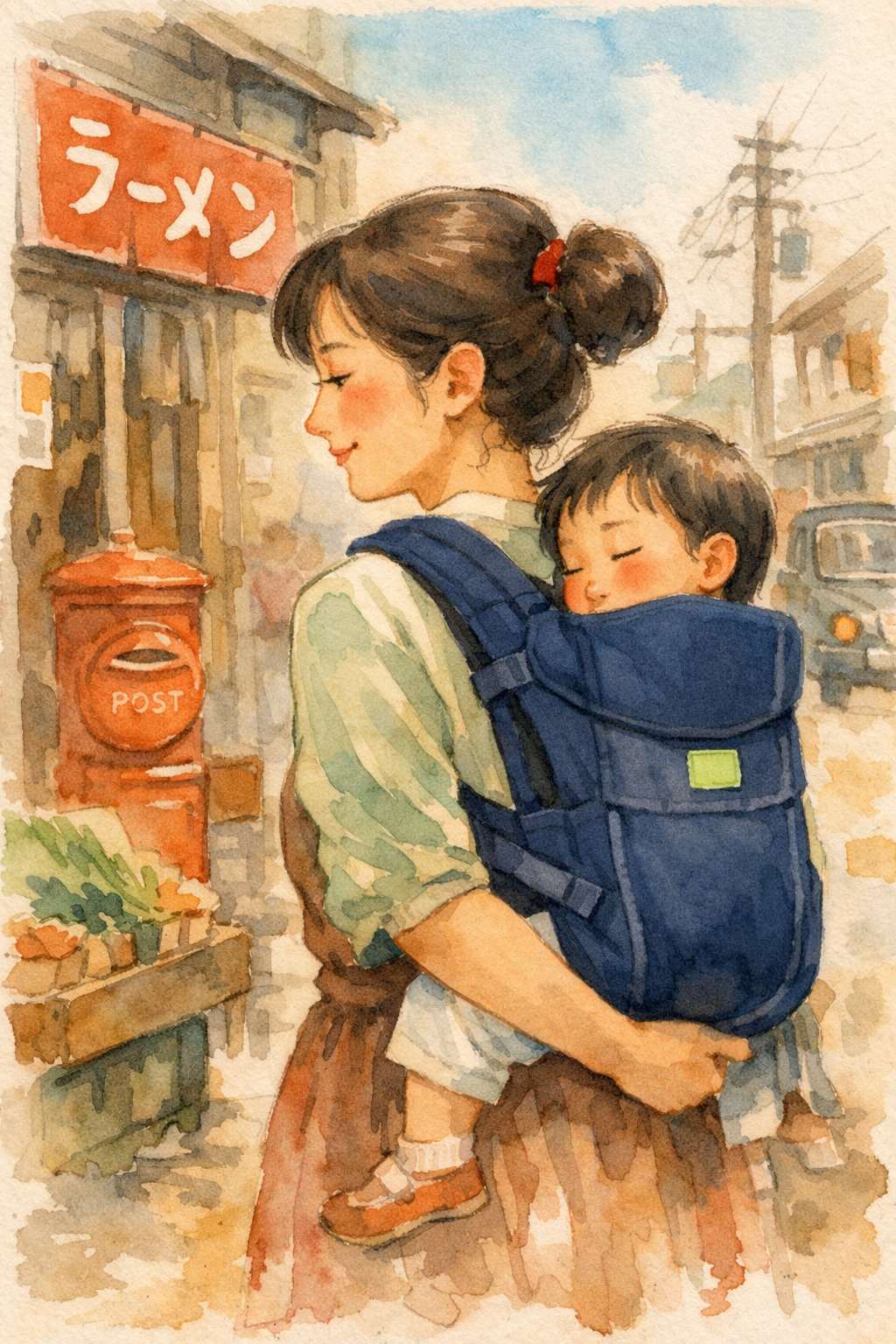
I grew up on my mother’s back, tied with a traditional baby carrier.
Mothers in the Showa era were always busy,
managing the household and raising children at the same time.
Today, with more machines,
life may have become a little easier.
But there is always more to do.
I raised my own children the same way—
with a baby on my back.
The good thing about carrying a baby on your back
is that your arms remain free.
When an older child becomes fussy,
you can focus on them.
Holding hands with two children,
while the youngest stayed on my back.
That was how I raised my children.