Visited: February 22, 2026 (Sun)
I summarized the route of this day in Kyoto on a My Map.
It shows the journey including Kinkaku-ji, Ryōan-ji, and the places where I stopped to eat.
It was a day of walking and good food.
You can follow the path of the day on the map.
▶ Read the Ryōan-ji article
🚉Ryoanji Rock Garden — A Garden Where Sound Disappears
The moment I stepped off the packed Kyoto city bus, the journey had already begun.
It was the first day of a long holiday weekend in Kyoto.
After passing Saiin, more and more people boarded, and it became difficult to move inside the bus.
And yet, strangely, there were no angry voices.
People made space for one another, exchanging small smiles.
Even on the way to a place of brilliant light, it already felt like Kyoto.
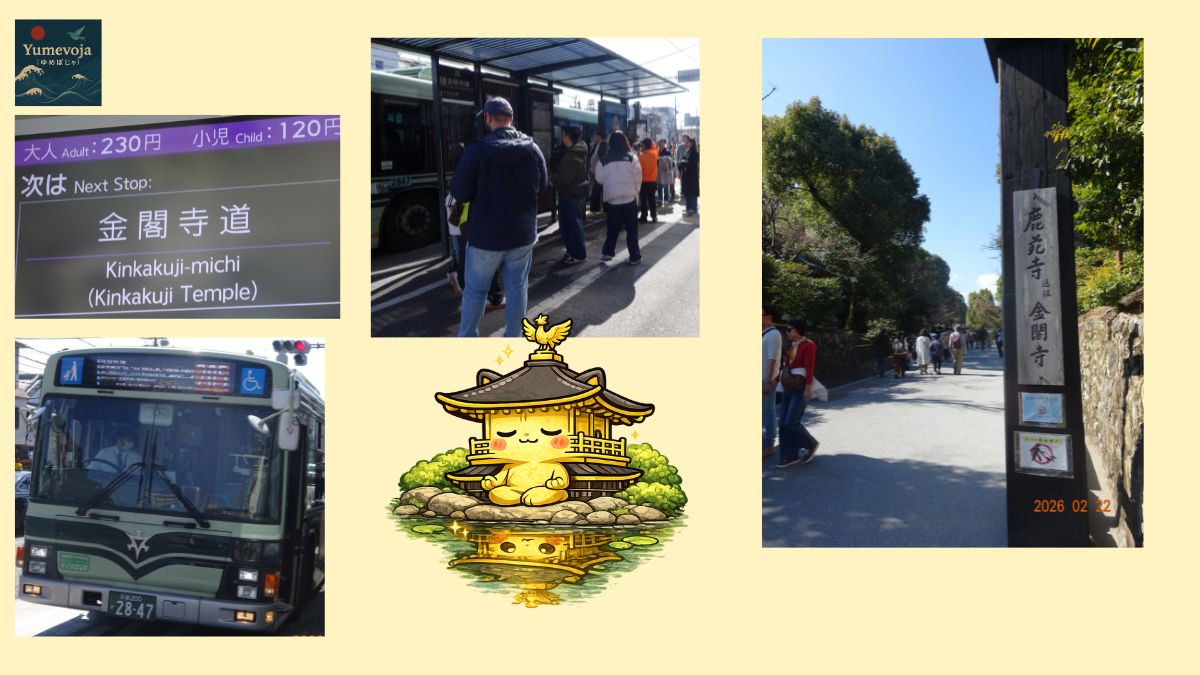
Access to Kinkaku-ji and the crowd heading toward the temple
from the Kinkakuji-michi bus stop.
What is Kinkaku-ji?
Kinkaku-ji (officially Rokuon-ji) is a temple built during the Muromachi period and is famous for its golden pavilion reflected in Kyoko-chi Pond.
It is one of Kyoto’s most iconic landmarks and is registered as a UNESCO World Heritage site, attracting visitors from all over the world.
That is the usual explanation.
But when you actually stand there, the first thing you notice is not the gold.
It is the flow of people.
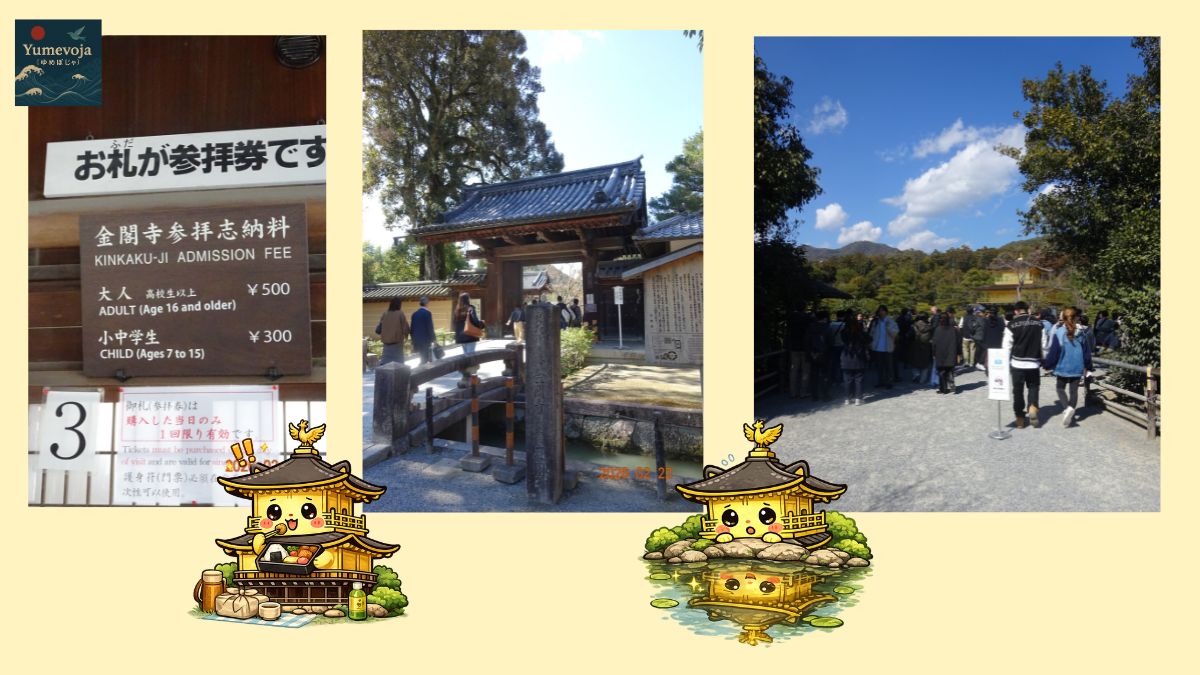
The entrance and main gate area of Kinkaku-ji.
Even in the morning, the stream of visitors never stops.
Highlights of Kinkaku-ji
The Golden Pavilion (Shariden)
Seen across the pond, the golden building has an overwhelming presence.
The moment a tour group arrives, the atmosphere shifts.
The light is intense.
Everyone faces the same direction, taking photos from the same angle.
There is a beauty that feels perfectly completed as a tourist destination.
A Corner of Moss
Then I looked in the opposite direction.
A moss-covered corner where no one stopped.
No one was taking photos.
If the gold is the light, the moss is the shadow.
It felt as if the quiet accumulation of time rested here instead.
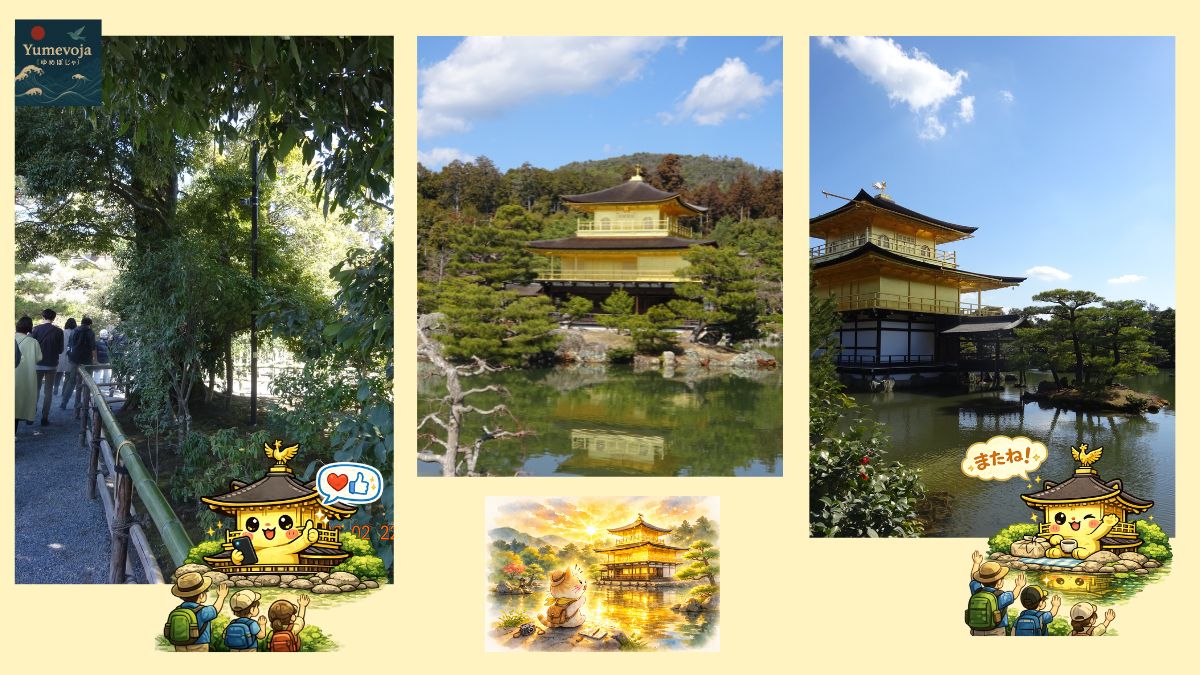
The Golden Pavilion reflected in Kyoko-chi Pond,
surrounded by pine trees and blue sky — the classic view of Kinkaku-ji.
Crowds at Kinkaku-ji (Holiday Experience)
People are constantly moving within the temple grounds.
There are many tour groups, and people gather at the main photo spots.
The city buses from Kyoto Station seemed especially crowded.
At the bus stop for the return trip, a long line had already formed.
It was crowded.
Yet strangely, it didn’t feel chaotic.
There was order.
There was a flow.
Getting to Kinkaku-ji and Choosing the Way Back
The most common way to reach Kinkaku-ji is by city bus, but during tourist seasons it can become very crowded.
On the way back, I decided to avoid the bus and take the Randen tram instead.
Sometimes changing just one small choice changes the entire atmosphere.
A journey is not made only of destinations.
Souvenirs around Kinkaku-ji
Right in front of the bus stop, there are rows of typical souvenir shops.
There I noticed a bag featuring Hokusai’s Great Wave and Godzilla together.
I almost bought it.
But the sightseeing had only just begun.
It would become extra baggage.
I decided to come back later.
In the end, because I switched to the Randen line, I never returned to that shop.
I had come to see a golden temple.
But the thing that caught my attention was Godzilla.
What I Felt While Walking There
As the bus rocked along, I remembered coming here long ago with my children.
Back then, the heat and the crowds left little room to notice anything else.
At that time, I saw only the gold.
Today, I see the shadows.
There is a reason why people gather at famous places.
But the reason is not the gold alone.
The quiet moss,
and the atmosphere of people making space for one another.
Those were the things I carried home.
👉 Related article:
🍵Kyoto Lunch Near Kinkaku-ji|Seasonal Bento on the Way to Ryoan-ji

Today’s bonus capsule!
✨ Gateway to the Shōwa Era―Film Cameras
The Showa era (1926–1989) was a time when modern technology and ideas began to transform everyday life in Japan.
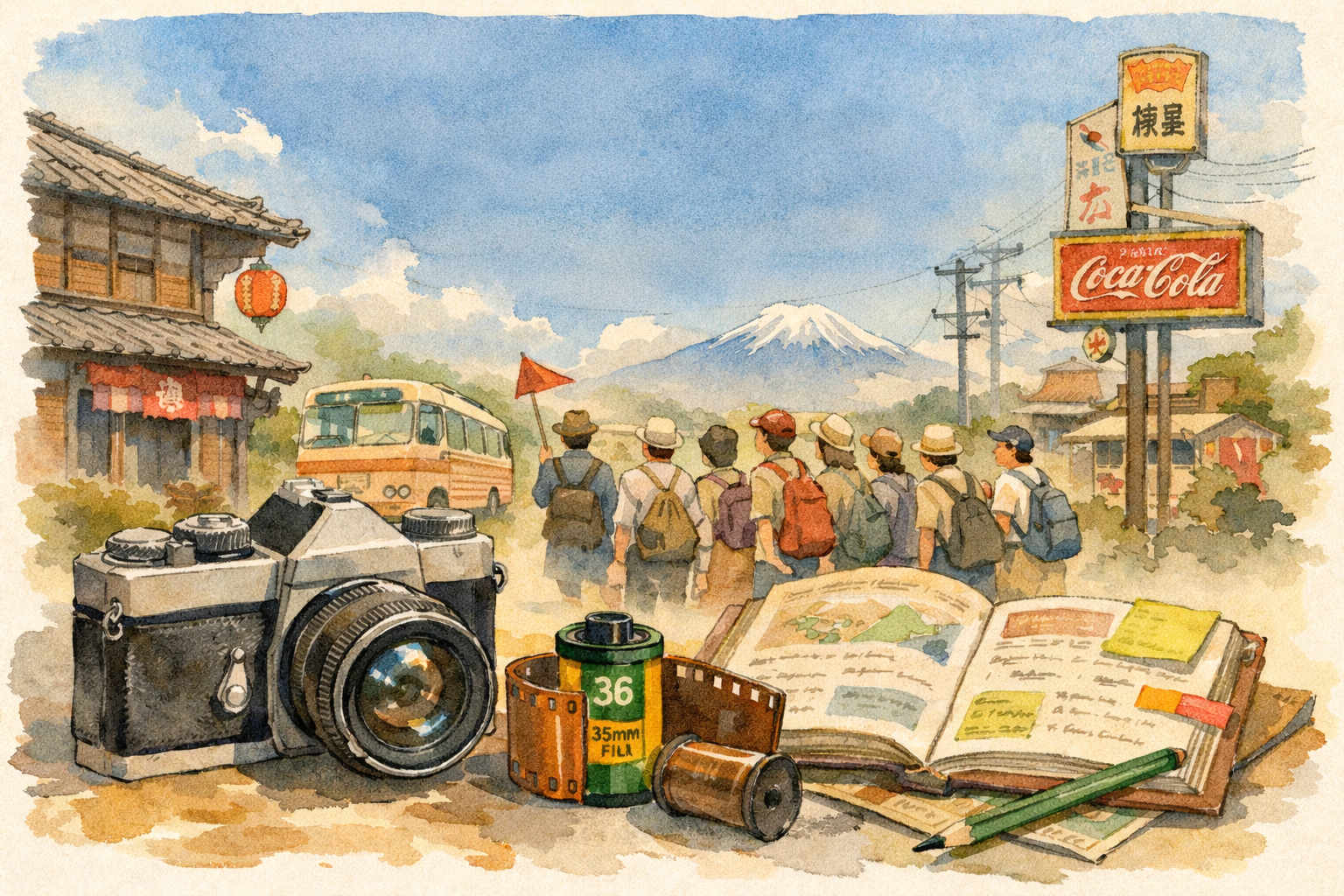
When people think of tourist destinations in the Showa era, they often picture film cameras and large group tours.
Visitors would walk neatly behind a guide holding a small flag.
Today, smartphones have taken center stage.
Yet the moment a tour group arrives, the atmosphere subtly shifts. Somehow, it still feels a little like those Showa-era trips.
Back then, travel relied on guidebooks.
Thick books filled with sticky notes and highlighted passages.
The corners of the pages were folded, and fingers traced the maps again and again.
The journey had already begun before leaving home.
During a university seminar trip, we even made our own small guidebook.
We copied maps, wrote short explanations, and stapled together a simple booklet.
With that booklet in hand, we walked across the Tottori Sand Dunes.
It was forty years ago.
If you descend the steep slope of the dunes, you reach the sea.
But of course, that means climbing the same slope on the way back.
Perhaps because of that, no one else tried to go down.
Only three curious students decided to try.
Naturally, I was one of them.
We struggled through the soft sand to reach the shore,
and later climbed back up the dune, stopping to catch our breath.
Today someone would probably check a phone and say,
“Maybe we shouldn’t.”
But back then,
only the people who decided to go found the next view waiting for them.