Visit: May 11, 2025
The Kyoto National Museum was as crowded as ever.
Still, entry was smoother than I expected.
Once inside, the flow of visitors was constant, and a strategy I had learned before—
start by looking where it’s less crowded—proved useful again this time.
The special exhibition “Japan: A Tapestry of Beauty” traces how Japanese art developed through encounters with other cultures.
From the Yayoi and Kofun periods to the Meiji era, paintings and crafts quietly convey the accumulation of time.
What left a strong impression on me was maki-e lacquerware.
Lacquer itself was introduced from abroad, but maki-e evolved as a uniquely Japanese technique.
Rather than using what was received as it was, it was refined to an extraordinary degree.
I felt that this attitude is what has given Japanese beauty its depth.
Another piece that captured my attention was a restored tea caddy.
Shattered fragments, once burned and broken, had been reassembled with lacquer, restoring its outward appearance completely.
X-ray images, however, revealed countless joints inside.
It was clear that skill and persistence reside precisely where they cannot be seen.
In restoration, there is a method called kintsugi, where cracks are joined with gold and the damage is intentionally revealed.
On the other hand, there are restorations like this tea caddy, where even the breakage itself is made invisible.
Both reflect a distinctly Japanese sense of aesthetic commitment.
Beauty that takes pride in being broken,
and beauty that erases the fact of being broken.
Japanese aesthetics, I felt, have continually asked not only how to create,
but also how to see.

Opened in 1897 as the Imperial Kyoto Museum.
A Western-style building designed to harmonize with Kyoto’s temple and shrine landscape.
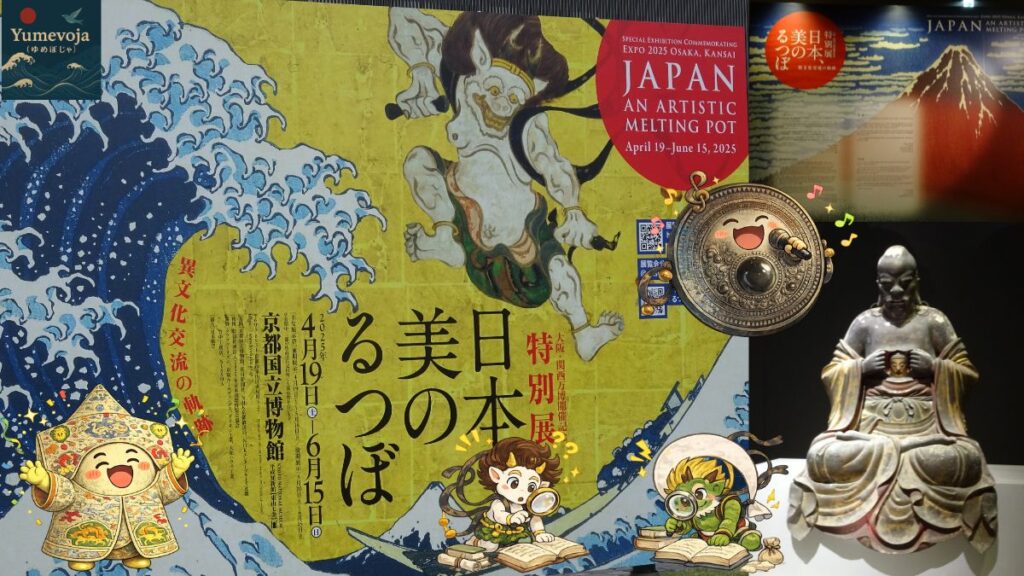
I like the Wind and Thunder Gods so much that I bought a tote bag.
Yellow background—and a friend said it looks like it might boost my luck with money.
👉 Related article:
🍵 Beauty & Taste (The Crucible of Beauty) ① / ②Tsukigase

Today’s bonus capsule!
✨ Gateway to the Showa Era―Basket
The Showa era (1926–1989) was a time when modern technology and ideas began to transform everyday life in Japan.
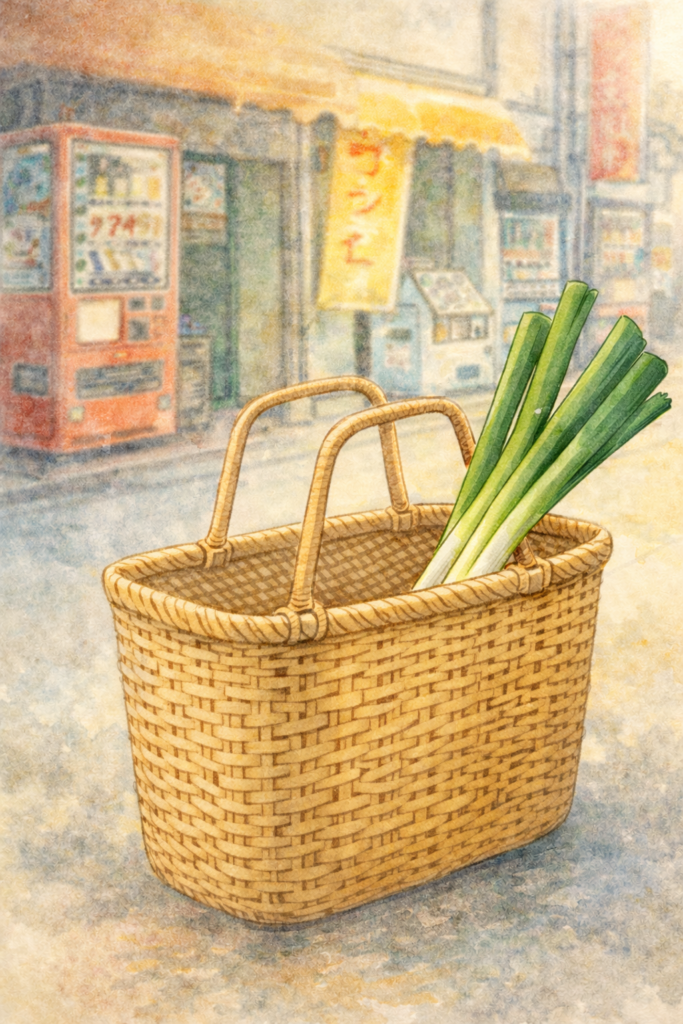
When I was a child,
we went to the shopping street
carrying a basket from home.
Vegetables were wrapped in newspaper.
Leeks sticking out of the basket
were a perfectly ordinary sight.
Today,
vegetables come in plastic bags,
and we pack them into our own tote bags
at the supermarket.
Shopping is quick
and quietly finished.
But in the past,
buying things was not the only purpose.
We were taught how to cook them well,
how to store them so they would last longer.
There was
natural conversation there.
Even now,
some small local shops remain.
But continuing them is not easy.
Behind convenience,
human interaction has gradually faded.
I think the Shōwa era
was a time when shopping came with conversation.