The Famous Stage and Temple Structure in Kyoto
Visited: February 23, 2026 (Mon)
A national holiday in Japan — the Emperor’s Birthday.
I mapped out the route of this day.
Starting from Kiyomizu-dera, I walked through Higashiyama toward Kodai-ji and Entoku-in.
👉In the second half of the day, I visited Kodai-ji and Entoku-in.
The quiet atmosphere and reflections are shared in the next article.
👉🚉Kodai-ji Temple and Entoku-in in Kyoto|A Quiet Walk and Reflection
There are so many people heading to Kiyomizu-dera,
so I thought I could simply follow the flow
and decided not to check Google Maps.
Walking freely while looking at the streets of Kyoto
is part of the enjoyment.
After a while,
I noticed the crowd moving in one direction.
“This must be the way,” I thought,
and followed along.
People kept entering a temple gate one after another.
…But it wasn’t Kiyomizu-dera.
There are simply too many temples in Kyoto.
Watching people walk into a different temple,
I couldn’t help but smile,
thinking, “This is such a Kyoto thing.”
In the end, I checked the map
and headed again toward Kiyomizu-dera.
In Kyoto,
following the crowd doesn’t always lead you to the right place.
Still, getting a little lost along the way
is part of the joy of exploring Kyoto.
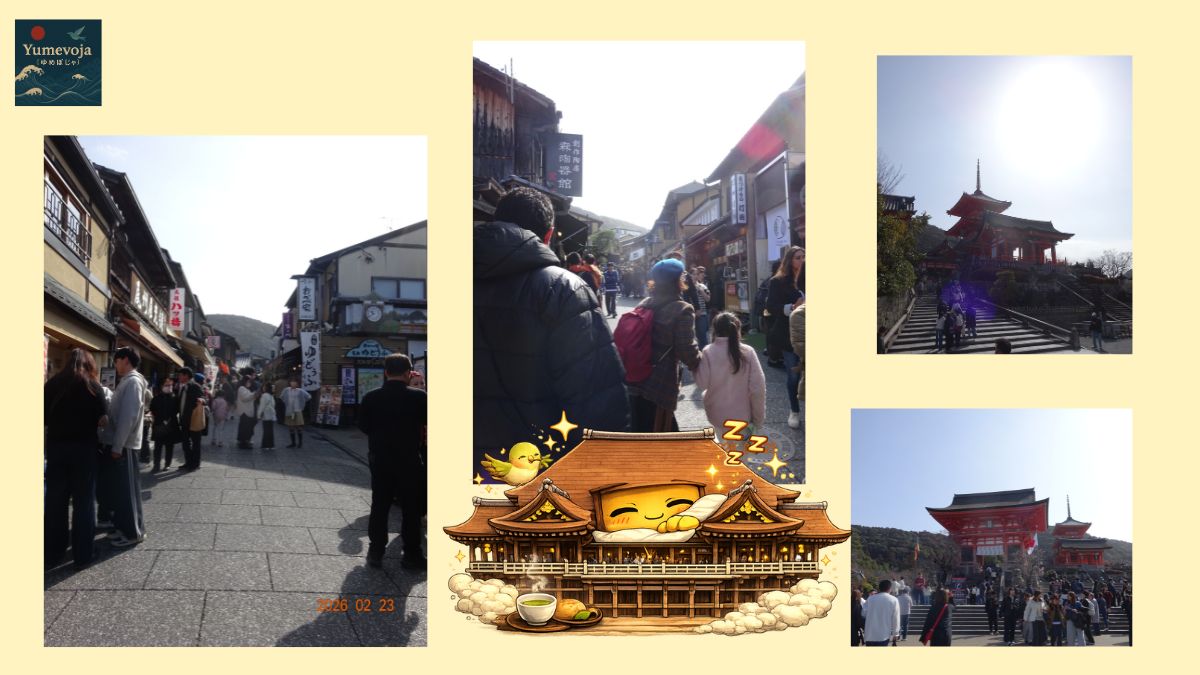
Following the flow of people,
I slowly made my way to Kiyomizu-dera.
Once inside Kiyomizu-dera,
most people headed toward the stage.
As expected, it was popular,
and many people were enjoying the view.
The stage has a slight slope,
and standing there gives you
a small sense of unease.
But because of that,
the view of Kyoto opens up beautifully.
You hear many languages—
people taking photos, laughing, praying.
People from all over the world gather here.
Watching this scene,
I found myself thinking,
“If the world could always be like this, it would be peaceful.”
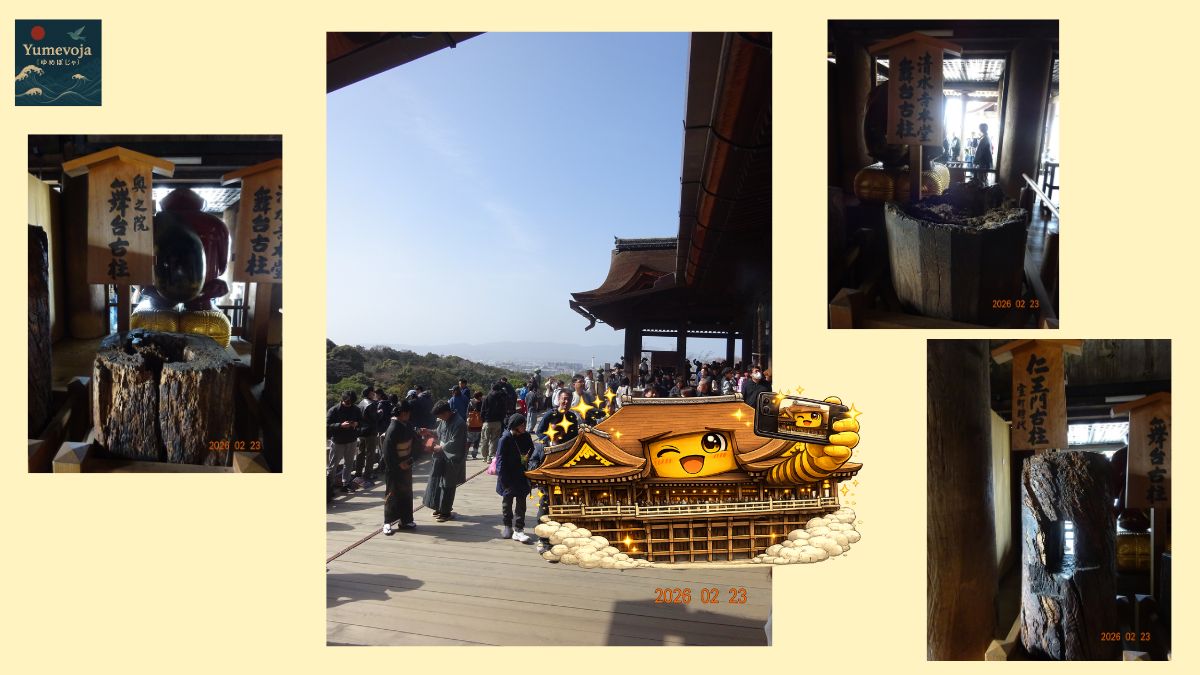
At the back of the stage, inside the main hall,
there was a space displaying pillars from different eras.
These were actual pillars once used,
lined up from periods such as the Nara era.
Yet almost no one stopped to look at them.
Most people
take photos on the stage,
and offer a prayer in the main hall.
Beyond that,
they don’t seem very interested.
I became curious
and took a closer look at the pillars.
The old pillars
had turned completely black.
They almost looked like ink,
but that wasn’t the case.
Over a long period of time,
the wood itself seemed to have changed color.
*In the photos, perhaps due to the light,
they may not appear quite this dark.
In the dim main hall, they seemed even darker.*
That blackness
felt more than just “old,”
it carried something hard to define.
There was even
a slightly unsettling feeling.
A child nearby said,
“It’s kind of scary,”
and I could understand why.
It’s easy to summarize it as “history,”
but standing in front of the actual wood,
you can feel the weight of time.
Even with so many people,
somehow a quietness remains.
I also walked beneath the stage.
There,
massive pillars stand in rows.
This area leads toward the exit,
so many people pass through.
But very few stop.
Most people simply glance up at the pillars
while walking,
and continue on.
It seemed that seeing the view from above
was enough for them.
But when you look up from below,
you begin to understand
the structure of Kiyomizu-dera.
Huge pillars support the stage,
and wood is joined with wood.
And there are no nails.
A wooden structure built hundreds of years ago
still continues to support the stage today.
On the underside of the platform,
there were places where writing remained.
It wasn’t clearly readable from a distance,
but perhaps it was a record left by someone.
While people passed by,
I paused for a moment
and looked up at the pillars.
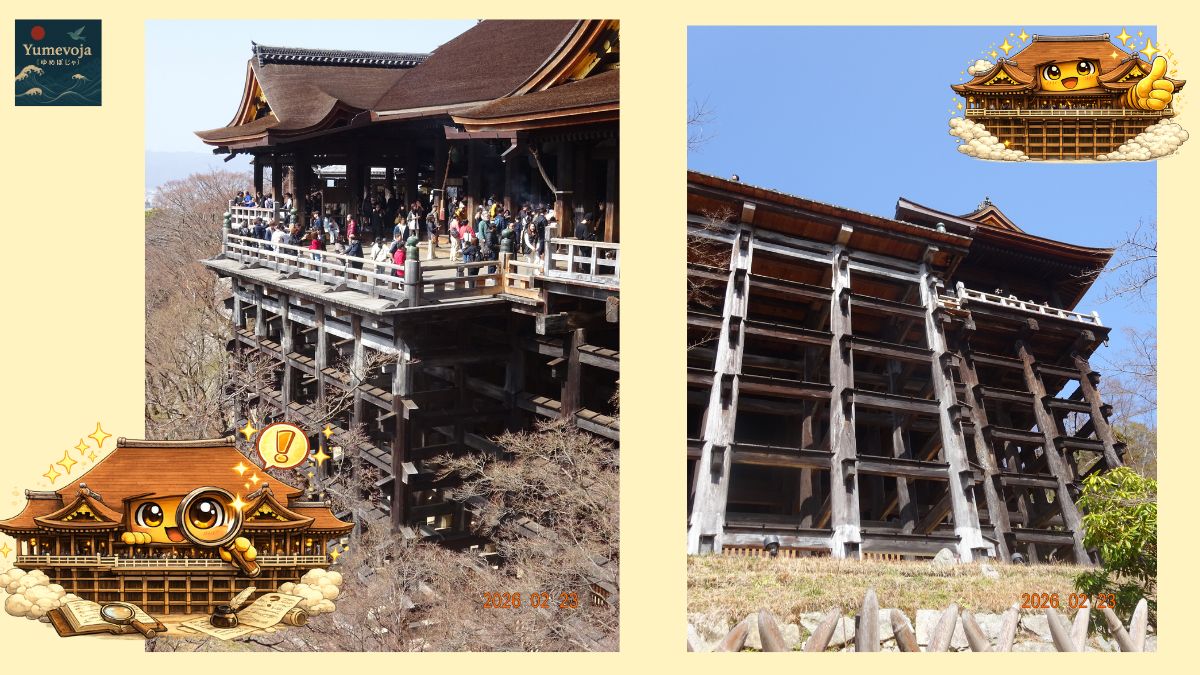
Supported—
yet it looks as if it is floating.
Kiyomizu-dera has burned down many times,
and each time, it has been rebuilt.
Still, it stands again,
and people return.
A structure built on shifting ground,
designed with movement in mind.
Looking at it,
these words came to me.
It’s okay to sway. As long as you don’t break.
Perhaps Kyoto
is a place that,
even after being broken again and again,
continues to return.
The atmosphere I felt here today
will likely continue to flow in the same way.
Thinking this,
I left Kiyomizu-dera behind.
After this, I headed to lunch.
Even that quiet moment after walking
is part of the journey.
👉 Read the article here
🍵Beauty & Taste | Trying Matcha and Pickles Pizza near Kiyomizu-dera
Choose Kyoto by mood.
👉 View the Kyoto guide

Today’s bonus capsule!
✨ Gateway to the Shōwa Era
―School Trips in Kyoto
The Showa era (1926–1989) was a time when modern technology and ideas began to transform everyday life in Japan.
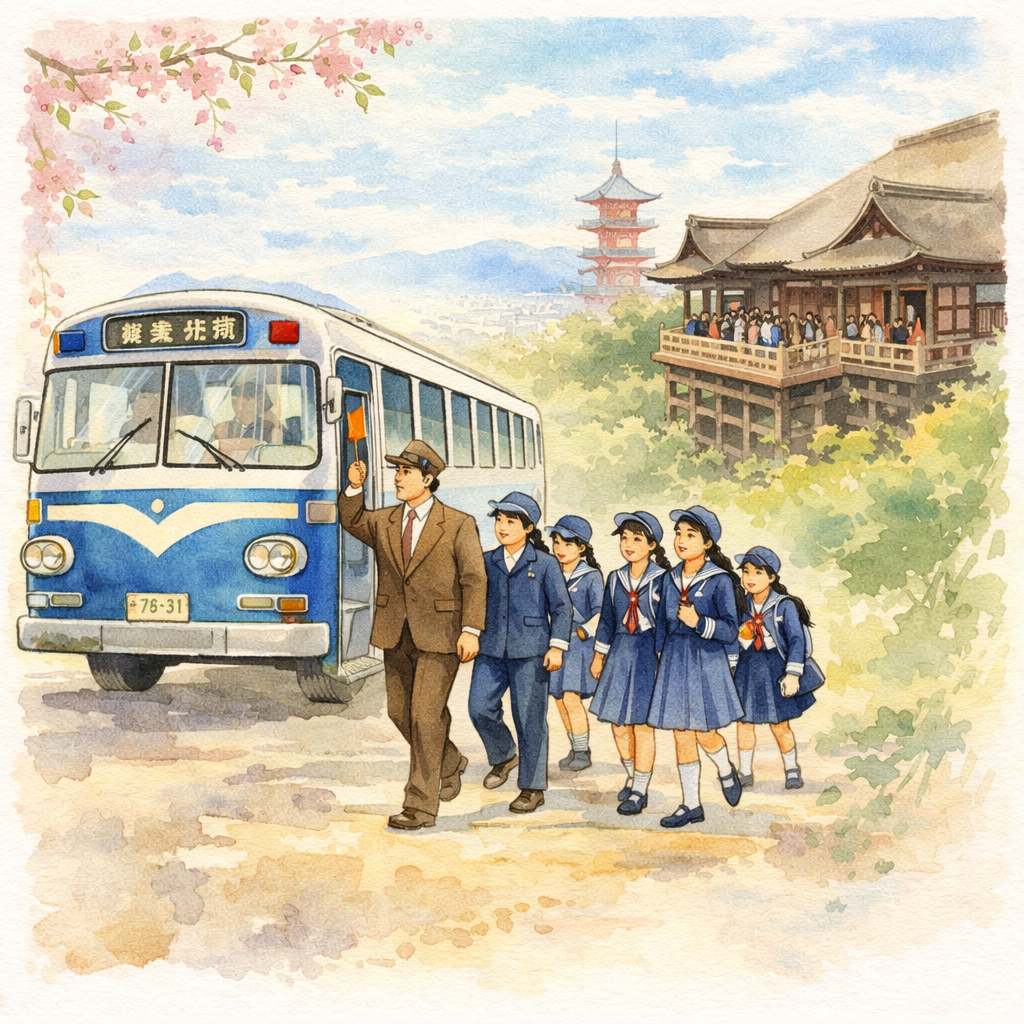
In the Showa era,
Kyoto was a classic destination for school trips.
Back then, students traveled by bus
and visited places together as a group.
Within a fixed schedule,
they followed the same route.
That was the standard way.
Today,
you sometimes see a different scene.
Small groups take taxis,
visiting places they have chosen themselves.
The driver also acts as a guide,
and each group moves at its own pace.
Personal, safe, and full of learning—
perhaps this is a reflection of our time.
And yet,
in any era,
the view seen in that place
becomes a memory that stays with each person.