Visit: May 6, 2025
■ A Holiday Morning Spent in the Quiet of Art
The destination was the Kobayashi Art Museum,
where the spring special exhibition “Ridiculously Fascinating! Edo Paintings”
was nearing its final days.
(※ This is a reflection from six months ago, so the exhibition has already ended.)
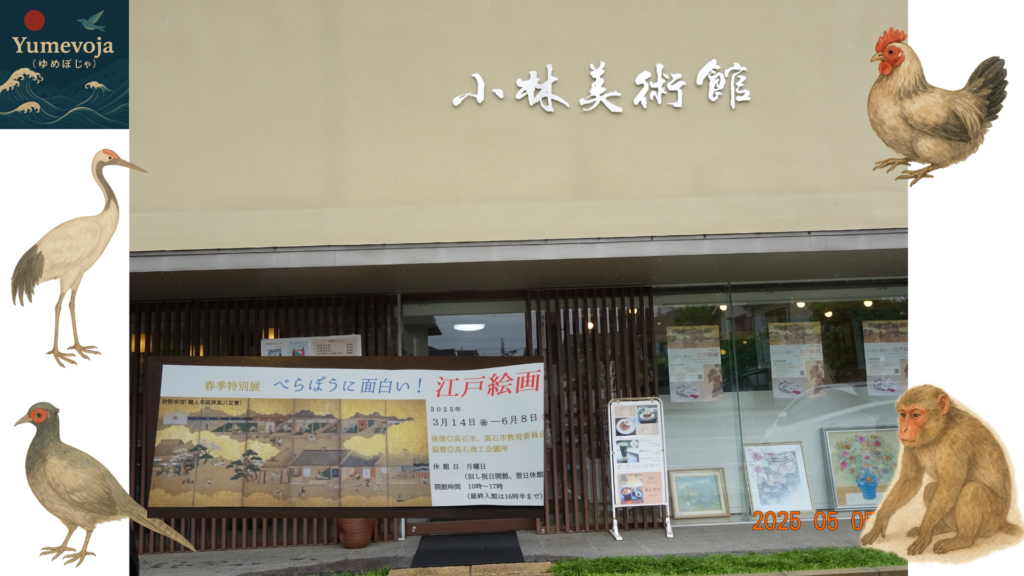
The Edo period — one of the eras in which Japanese culture reached its most refined and vibrant form.
During more than 260 years of peace, the country’s isolation policy limited foreign influence, allowing uniquely Japanese aesthetics to flourish in remarkable ways.
Inside the museum, a world unfolded —one where the vibrant spirit of Edo could almost be felt on the skin.
Maruyama Ōkyo, the Kano school, and other remarkable talents — works that are witty, full of humor, and overflowing with an extraordinary sense of life.
“It felt as if I were touching the very air captured inside the paintings —
a sensation of stepping beyond time.”
If I had to describe this special exhibition in one phrase, that would be it.

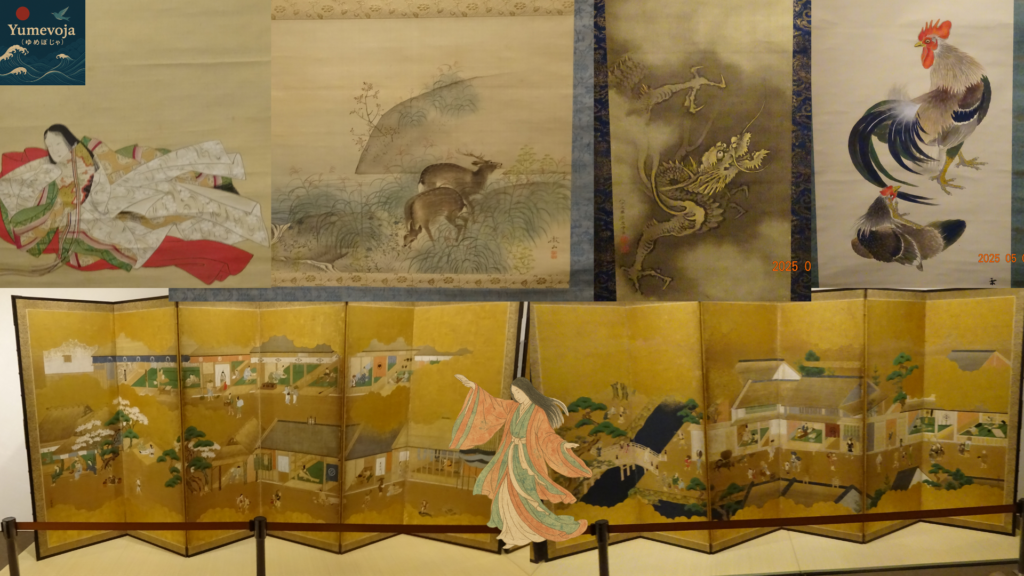
“Berabōni Omoshiroi! Edo Paintings” — Photography permitted.
■ Smiling at the gentle humor of Edo-period paintings
The galleries were filled with works depicting everyday life —
scenes of ordinary people, playful caricatures that draw a spontaneous smile,
paintings where the breath of Edo still lingers as if unchanged.
It wasn’t the famous masterpieces,
but an anonymous painter’s single, unassuming work that captured my heart.
Moments like this reminded me of what makes museums so special.
■ Pausing Before the World of Sōsuke Yamada
— “The Vanishing Thatched House” & “Village in Late Autumn”
Although I had come to see the special exhibition “Exceptionally Entertaining! Edo Paintings,”
the works that truly captured my heart were those of Sōsuke Yamada, whom I encountered entirely by chance.
With a background in creating illustrated signboards for films,
Yamada brings to his landscapes a unique worldview—one that seems to seal time itself within the scene.
The large oil paintings displayed at the time—
“The Vanishing Thatched House” and “Village in Late Autumn”—
each depicted a single elderly figure within a vast landscape,
imbued with a quiet warmth and a faint, lingering loneliness.
There was a cinematic immediacy reminiscent of his signboard work,
a realism that made you feel the wind passing through the scene.
Standing before the paintings, I felt my gaze drawn deeper and deeper into their world.
Especially before “The Vanishing Thatched House,”
the moment I sat down on the bench placed in front of it,
the entire world of the painting sank deeply into my chest—
and I found myself unable to stand up for quite some time.
“I came for the special exhibition, yet it was another artist’s work that seized my heart.”
It was the kind of quiet, luxurious coincidence that only a museum can offer.
I may never have the chance to see those works again.
Perhaps that is why the air and the stillness of that day now shine
with a special kind of brilliance in my memories of the journey.
■ A Gentle Japanese Pause in the Museum Café
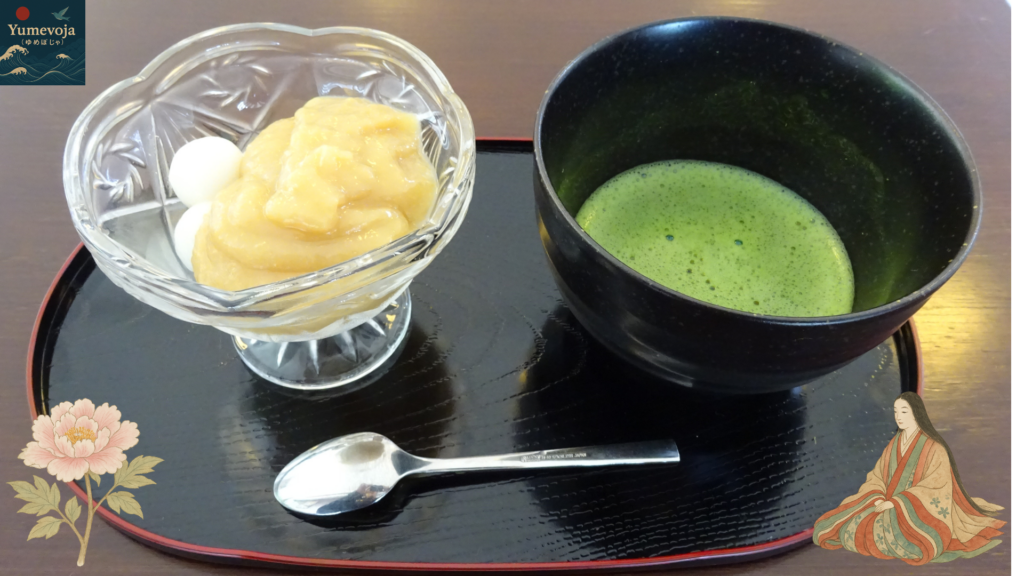
Kurumi mochi & Tsuboichi Matcha Set
After finishing my viewing, I headed to the adjoining café.
What arrived at the table was a plate of gently sweet mochi,
paired with the deep, refined aroma of Tsuboichi matcha from the old tea house in Sakai.
The way the sweetness and bitterness leaned into each other
felt like a quiet companion to the stillness that follows time spent with art.
Sitting there, sipping tea in silence,
I realized that this too is an essential pause within any journey.
📎 Further Reading
For a detailed tasting note on the Walnut Mochi & Tsuboichi Matcha Set,
👉🍵 Beauty & Taste (Osaka – Art Museum Days) ①/③Kurumi mochi & Tsuboichi Matcha — A Quiet Moment at the Museum Café
■ To Be Continued
After filling my heart with the quiet beauty of the Kobayashi Museum,
I headed to Hagoromo Terrace in search of their 20-servings-a-day Japanese lunch box.
In the next article,
I’ll share a “travel-flavored lunch” discovered inside a station building,
followed by a small wander through Shinsekai.

Today’s bonus capsule!
✨ Gateway to the Showa Era―Best Hit USA
The Showa era (1926–1989) was a time when modern technology and ideas began to transform everyday life in Japan.

■ Best Hit USA and the Concert Ticket My Father Found for Me
① When English Felt Far Away
In the Showa era, English existed only in textbooks and memorization drills.
It was a distant language, with hardly any chances to hear it in daily life.
② Best Hit USA — My First Window to the World
Every week, Best Hit USA brought “living English” into my home.
Foreign artists, lyrics, and voices filled the screen,
and it felt as if the world suddenly became a little wider
each time I sat in front of that small TV.
③ The Ticket My Father Obtained for Me
I still remember the day I went to Rick Springfield’s concert.
Tickets were not easy to find back then,
and my father managed to get one through a friend.
The excitement I felt holding that ticket,
the noise of the venue, the music echoing in my chest—
it remains one of my most precious memories.
④ A Door That Quietly Opened
Translating lyrics with friends, looking up every word in a dictionary,
and my father’s quiet support—
all of it connected in ways I didn’t understand at the time.
Looking back,
Best Hit USA and that single concert ticket quietly opened my door to English.
The excitement I felt in those Showa moments
is still part of who I am today,
as I now speak, learn, and share with the wider world.