Visited on: May 3, 2025 (Constitution Memorial Day)
🛫 After Plane Spotting, I Set Out in Search of Dinner
At Itami’s famous plane-spotting area—where powerful landings unfold right before your eyes—
I had been completely absorbed in photographing the aircraft until dusk.
Before I knew it, there was still a little time left before the runway lights would come on.
“Maybe I should grab dinner while I can…”
But the area around me was filled with small factories,
and there were no restaurants in sight.
“Do people around here not eat out?”
I wondered as I kept walking, until finally I spotted a sign for Yakitori Yamadori.
I hesitated because it wasn’t quite opening time yet,
but the owner, a friendly woman, called out:
“Please come in and wait inside.”
Her kindness warmed me before the meal even began.
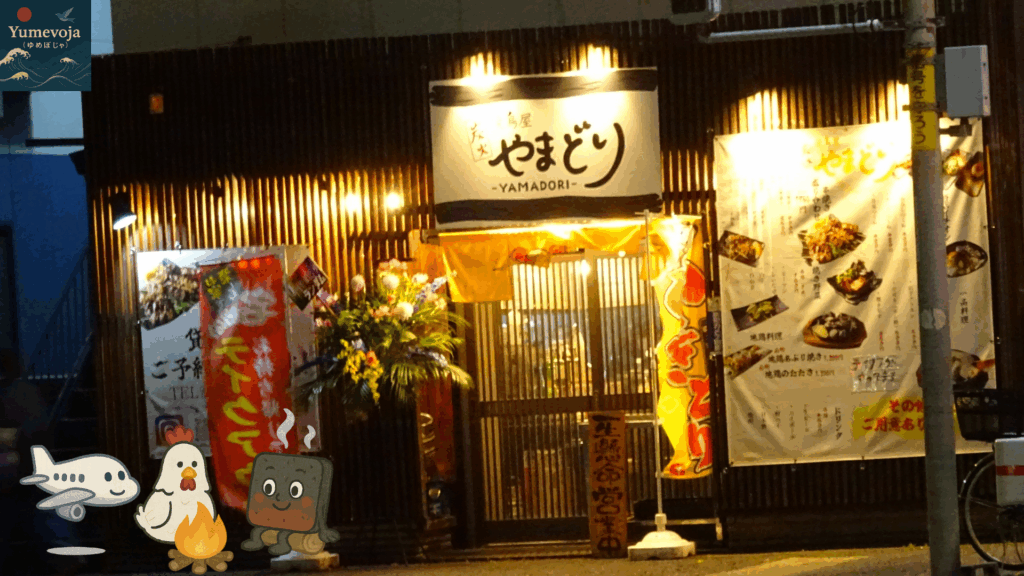
After I had taken a seat and settled in,
a regular customer walked in and began chatting with the owner about their one-year anniversary.
At that moment, I remembered the large flower arrangement displayed at the entrance
and realized I had wandered into a small neighborhood celebration entirely by chance.
🍺 A Night That Begins with Grilled Local Chicken and a Cold Draft Beer
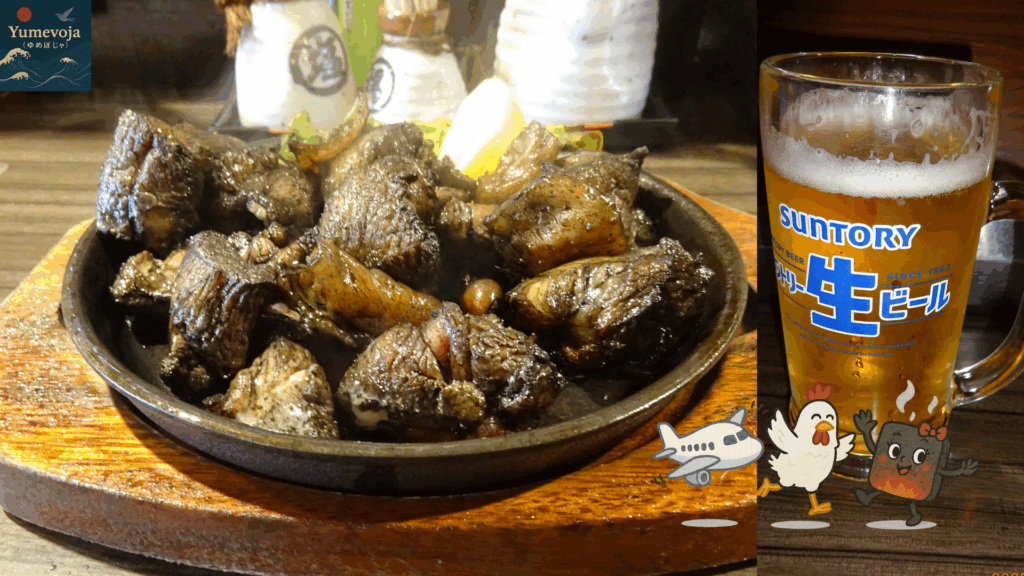
The first thing I ordered was the restaurant’s signature dish —
charcoal-grilled local chicken — along with a cold draft beer.
When it arrived, I was struck by its rugged, almost pitch-black appearance.
But the moment I took a bite, the aroma of charcoal and the concentrated savoriness
made themselves known.
The more I chewed, the deeper the flavor became —
a dish I won’t soon forget.
“Wild on the outside, delicate at the core.”
Drawn in by that charm, I found myself ordering the next dish.
🐔 You Can Tell the Skill from the Skin and Liver
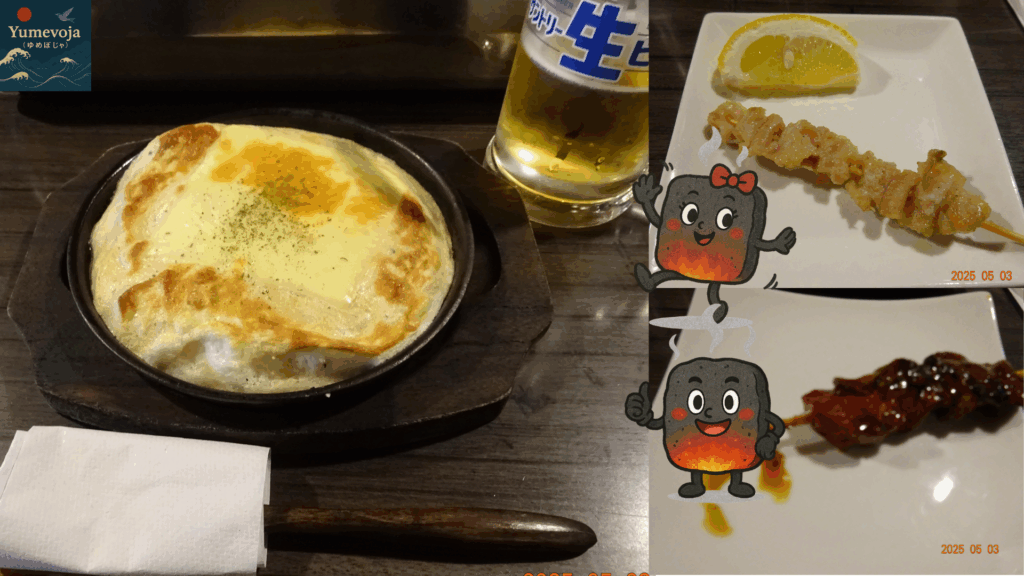
Next, I ordered the chicken skin and the liver.
The skin was crisp and fragrant, with the excess fat perfectly rendered out.
The liver had no bitterness or odor at all—tender, yet cooked through with remarkable precision.
People often say you can judge a yakitori restaurant by its liver,
and with just this one skewer, I knew:
this was a place I could trust.
🧀 The Mystery of the Yam Gratin — Solved by That Mixer Sound
Curious, I ordered the yam gratin.
A few moments later, I heard the sound of a mixer coming from the back of the restaurant.
I wondered, “Are they prepping something?”
It turned out that the very thing being mixed was my gratin —
light and airy when it arrived at the table.
When my spoon sank into it, the fluffy, aerated layer collapsed gently,
and the soft, mellow flavor of yam spread across my tongue.
It was a dish that showed a kind of careful craftsmanship
different from the charcoal grilling.
At a charcoal-grill restaurant, it’s the sound of a mixer that stayed with me.
That unexpected contrast made it a memorable experience.
⏰ Too Absorbed to Make It Back in Time for the Light-Up
With the light-up time on my mind,
I kept telling myself, “Just one more… just a little longer,”
yet I still couldn’t put my chopsticks down.
I hurried through the bill and ran back,
reaching the viewing spot just two minutes before 7:00 p.m.—
the exact time the lights had come on during my previous visit.
But the runway lights were already on.
Perhaps the timing had changed with the sunset.
I didn’t make it in time —
but if the reason was simply that the food was delicious,
then it was the best kind of lateness a journey can offer.
💬 A Note to Myself
Perhaps the truly memorable places on a journey aren’t the ones we search for,
but the ones we stumble upon after losing our way.
Click here for more articles from the Itami series 👇
🚉 Stopover Journey (Hyogo) – Itami ① /② A Journey into Art and Japanese Sake Culture
🍵Beauty & Taste (Hyogo)–Itami ① /② Shirayuki Brewery – A Cozy Avocado Bowl Lunch
✈️🚉 Stopover Journey (Hyogo) ② Itami — Aircraft Thrill & A Warm Yakitori Night

Today’s bonus capsule!
✨ Gateway to the Showa Era―Clacker Balls
The Showa era (1926–1989) was a time when modern technology and ideas began to transform everyday life in Japan.
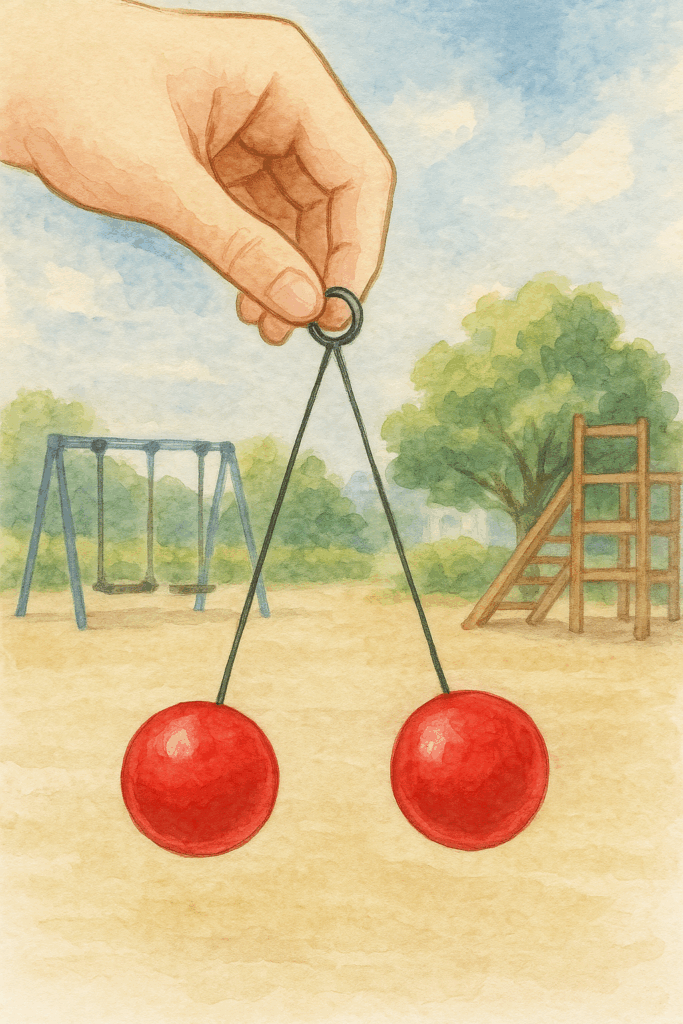
① The “Clack-Clack” Sound of Showa Childhood
One toy that children in Showa-era Japan couldn’t resist was
the clacker ball — two hard balls that strike against each other.
In parks, in front of candy shops, everywhere you went,
the sound “clack, clack, clack!” echoed through the evening,
becoming part of the soundtrack of after-school life in Japan.
② Born in America, Echoing Around the Globe
Surprisingly, this small toy didn’t originate in Japan.
It began in the United States in the late 1960s, where it was known as “Clackers.”
Its popularity soon crossed oceans, and by the 1970s
children in Japan, France, and beyond were swinging the same toy,
creating the same rhythm in their streets and playgrounds.
③ A Little Dangerous… and Impossible to Forget
Swing too hard and—whack!—the balls would smack your hand.
Some overseas models even cracked and broke, causing accidents.
But that tiny bit of danger, that thrill, was exactly what made it unforgettable.
Even today, just seeing a pair of clacker balls is enough
to bring back that reckless excitement of childhood.
④ A Small Toy That Connected Kids Across the World
There were no smartphones, no video games—just the joy of making sounds.
Looking back, that simple obsession feels luxurious.
And the most fascinating part?
The rhythm Japanese kids made in their neighborhoods
was the same rhythm echoing in the hands of children in America and France—
linked through time, without ever meeting.
Clacker balls were just a toy…
but they were also a Showa rhythm that quietly traveled the world.